Five financial institutions merge to become commercial bank
ArthaExpress, 29-Apr-08
Five financial institutions — Mahalaxmi Finance Ltd, Birgunj Finance Ltd, Siddhartha Finance Ltd, Butawal Finance Ltd and Himchuli Development Bank — have signed an accord yesterday to merge and upgrade to ‘A’ level commercial bank.
“All the financial institutions are planning to increase their paid up capital to Rs 400 million each to make Rs 2 billion in total required for the upgradation for the commercial banks,” said Ramesh Kumar Bhattarai, coordinator of the Merger committee.
The proposed ‘United Bank of Nepal’ after the merger, will have head office in Kathmandu, according to the Memorandum of Understanding (MoU).
However, the companies that have currently Rs 50 million to 100 million paid up capital have to increase to Rs 400 million each to make a total of Rs 2 billion required for a commercial bank. “We will hold special AGM and propose 1:4 rights shares,” informed Bhatta-rai, without clarifying what will happen if they cannot raise paid up capital to almost four to eight times.
Mahalaxmi Finance, National Finance and Narayani Finance have earlier declared a merger for upgradation to a Development bank. However, the plan didnot work.
Wednesday, April 30, 2008

Tuesday, April 29, 2008
NEA reduces load shedding hours by more than half
NEA reduces load shedding hours by more than half
Nepalnews, 28-Apr-08
People tired of daily power cuts will get some respite with Nepal Electricity Authority (NEA) slashing the load-shedding hours by more than half from Tuesday onwards.
Sher Singh Bhatt, chief of NEA's Load Dispatching Center, said that NEA would from now on impose only 21 hours of power cuts four days a week.
Bhatt said that the load shedding hours were reduced as the water level in reservoirs increased owing to melting of snow with the advent of the summer season. He said this has led to increased production of electricity in the power plants.
Earlier, consumers were forced to bear more than 46 hours of load shedding every week, adversely affecting their daily lives.
According to the new load shedding schedule, NEA would impose two and half hours of load shedding three days a week and then eight and six hours of load shedding one day each in separate time schedules for different parts of Kathmandu. Similarly, consumers would not have to face any power outages two days a week as against the current one.
Nepalnews, 28-Apr-08
People tired of daily power cuts will get some respite with Nepal Electricity Authority (NEA) slashing the load-shedding hours by more than half from Tuesday onwards.
Sher Singh Bhatt, chief of NEA's Load Dispatching Center, said that NEA would from now on impose only 21 hours of power cuts four days a week.
Bhatt said that the load shedding hours were reduced as the water level in reservoirs increased owing to melting of snow with the advent of the summer season. He said this has led to increased production of electricity in the power plants.
Earlier, consumers were forced to bear more than 46 hours of load shedding every week, adversely affecting their daily lives.
According to the new load shedding schedule, NEA would impose two and half hours of load shedding three days a week and then eight and six hours of load shedding one day each in separate time schedules for different parts of Kathmandu. Similarly, consumers would not have to face any power outages two days a week as against the current one.
Ensure workers' right in new constitution: Trade union leaders
Ensure workers' right in new constitution: Trade union leaders
Nepalnews, 29-Apr-08
Nepalnews, 29-Apr-08
Be prepared for higher prices: rice traders
Be prepared for higher prices: rice traders
eKantipur, 28-Apr-08
Nepali consumers staggering under mounting food prices should brace themselves for another rise in the price of rice, said traders.
They said that as Indian security forces had been intensifying border patrols, informal rice imports had slowed to a trickle. Nepali merchants have been bringing in grain through informal channels in the porous border after India stopped its export.
The traders also chided the government for not lobbying the Indian government to resume rice shipments to Nepal. India slapped a ban on rice exports in a bid to arrest rising inflation.
The local price of rice has gone up 25 percent compared to a year earlier, said traders.
Ganesh Lath, president of the Birgunj Chamber of Commerce, predicted that prices would keep shooting up until mid-September.
He said consumers wouldn't have been put in such a difficulty if the government had tried to persuade the Indian government through diplomatic channels to resume rice exports to Nepal.
The Birgunj Office of Nepal Rastra Bank said that prices would stay on an upward trajectory until the embargo was revoked. According to its findings, local rice production fulfills only 65 percent of demand.
An official at Birgunj Customs said no rice has come in from India from last October. Before the ban, 26,448 tons of paddy and 3,276 tons of rice were imported in the first quarter of the current fiscal year.
eKantipur, 28-Apr-08
Nepali consumers staggering under mounting food prices should brace themselves for another rise in the price of rice, said traders.
They said that as Indian security forces had been intensifying border patrols, informal rice imports had slowed to a trickle. Nepali merchants have been bringing in grain through informal channels in the porous border after India stopped its export.
The traders also chided the government for not lobbying the Indian government to resume rice shipments to Nepal. India slapped a ban on rice exports in a bid to arrest rising inflation.
The local price of rice has gone up 25 percent compared to a year earlier, said traders.
Ganesh Lath, president of the Birgunj Chamber of Commerce, predicted that prices would keep shooting up until mid-September.
He said consumers wouldn't have been put in such a difficulty if the government had tried to persuade the Indian government through diplomatic channels to resume rice exports to Nepal.
The Birgunj Office of Nepal Rastra Bank said that prices would stay on an upward trajectory until the embargo was revoked. According to its findings, local rice production fulfills only 65 percent of demand.
An official at Birgunj Customs said no rice has come in from India from last October. Before the ban, 26,448 tons of paddy and 3,276 tons of rice were imported in the first quarter of the current fiscal year.
Nepali workers take great leap outward
Nepali workers take great leap outward
eKantipur, 28-Apr-08
The total number of Nepali workers leaving for overseas jobs rose by 22.65 percent during the first nine months of fiscal year 2007/08 compared to the same period last year.
According to the data compiled by the Department of Labor and Employment Promotion (DoLEP), there were 167,785 departures during the period, up from 136,805 previously.
Qatar was the most popular destination for Nepali fortune seekers with 62,045 of them making their way there. This is a 77 percent rise from the same period last year.
Malaysia, which is number two in the Nepali list of the greatest places to work, witnessed a decline in arrivals of more than one-third during the period under review.
The number of migrant jobseekers departing for the United Arab Emirates (UAE) shot up a whopping 104 percent to reach 32,453 persons during the nine-month period.
Saudi Arabia, the fourth most popular labor destination, took in 27,215 Nepali workers to register a modest rise of 5 percent.
A month-wise breakdown shows that departures decreased during the period mid-March to mid-April to 13,375 individuals from 21,588 during the preceding month.
Officials said the election to the Constituent Assembly was the main reason behind the decline in the number of workers leaving for overseas jobs during the month.
Of the total number of workers going abroad to work, 436 are women. The DoLEP had provided prior approval to 19,181 job aspirants during the month.
Qatar received 5,132 Nepali workers, Malaysia 2,995, the UAE 2,970, Saudi Arabia 886 and Bahrain 489 workers during the month under review.
Afflicted jobseekers registered 47 complaints at the DoLEP against fraudulent individuals and manpower agencies seeking compensation of about Rs 22 million. The agencies paid out Rs 4.8 million in damages at the mediation of the DoLEP.
eKantipur, 28-Apr-08
The total number of Nepali workers leaving for overseas jobs rose by 22.65 percent during the first nine months of fiscal year 2007/08 compared to the same period last year.
According to the data compiled by the Department of Labor and Employment Promotion (DoLEP), there were 167,785 departures during the period, up from 136,805 previously.
Qatar was the most popular destination for Nepali fortune seekers with 62,045 of them making their way there. This is a 77 percent rise from the same period last year.
Malaysia, which is number two in the Nepali list of the greatest places to work, witnessed a decline in arrivals of more than one-third during the period under review.
The number of migrant jobseekers departing for the United Arab Emirates (UAE) shot up a whopping 104 percent to reach 32,453 persons during the nine-month period.
Saudi Arabia, the fourth most popular labor destination, took in 27,215 Nepali workers to register a modest rise of 5 percent.
A month-wise breakdown shows that departures decreased during the period mid-March to mid-April to 13,375 individuals from 21,588 during the preceding month.
Officials said the election to the Constituent Assembly was the main reason behind the decline in the number of workers leaving for overseas jobs during the month.
Of the total number of workers going abroad to work, 436 are women. The DoLEP had provided prior approval to 19,181 job aspirants during the month.
Qatar received 5,132 Nepali workers, Malaysia 2,995, the UAE 2,970, Saudi Arabia 886 and Bahrain 489 workers during the month under review.
Afflicted jobseekers registered 47 complaints at the DoLEP against fraudulent individuals and manpower agencies seeking compensation of about Rs 22 million. The agencies paid out Rs 4.8 million in damages at the mediation of the DoLEP.
Building costs double in 3 yrs
Building costs double in 3 yrs
Construction materials hit ceiling
eKantipur, 28-Apr-08
By Milan Mani Sharma
Prices of construction materials have hit the ceiling. Over a span of two weeks, the prices of cement and steel rods, which together take up 60 percent of building construction budgets, increased by 35 percent and 18 percent respectively.
Price records at the Nepal Construction Materials Dealers Association (NCMDA) show that cement is currently being sold at an average of Rs 750 per 50 kg sack and steel rod at about Rs 95 per kg.
Even bricks, which generally cost less during the production season, have increased to Rs 3,800 per 1,000 pieces, said Roshan Dahal, president of the association.
Cement was priced at Rs 440 per sack, rod at 42 per kg and brick at Rs 3,500 per 1,000 in mid-July 2007. Builders further stated that the cost of building a house in Kathmandu Valley has nearly doubled over the last three years. The price of materials has been on the rise from September 2007, when growing demand for steel and rising coal prices pushed up the international price of iron and billets.
The rise in cement, however, has been dramatic. It was triggered by the Indian government's decision to restrict exports of cement and raw materials two weeks ago.
As Nepal meets some 70 percent of its national cement requirements of 2 million tons a year through the import of cement and raw clinker from India, the restriction has hit consumers hard.
"There is no shortage of the product, but consumers are already panicking. Dealers have taken advantage of the situation and raised prices far in excess of ex-factory prices," said a local producer. He tagged the current prices uncalled for and flayed market inspectors and revenue officials for turning a blind eye to the black market.
India may lift export ban
Commerce Secretary Purushottam Ojha said that India could soon lift the restriction on exports to Nepal of cement and clinker, the main raw material for cement factories.
"India has responded positively to our request to lift the ban on cement and clinker exports," Ojha told the Post. He stated that India was holding inter-ministerial consultations on the issue, and a decision to lift the ban was expected in the next few days.
Pashupati Murarka, member of Nepal Cement Producers Association, said that local producers and importers have enough stocks to meet a month's demand. "If India lifted the ban soon, supply will not be affected and prices will ease as well," he said.
Construction materials hit ceiling
eKantipur, 28-Apr-08
By Milan Mani Sharma
Prices of construction materials have hit the ceiling. Over a span of two weeks, the prices of cement and steel rods, which together take up 60 percent of building construction budgets, increased by 35 percent and 18 percent respectively.
Price records at the Nepal Construction Materials Dealers Association (NCMDA) show that cement is currently being sold at an average of Rs 750 per 50 kg sack and steel rod at about Rs 95 per kg.
Even bricks, which generally cost less during the production season, have increased to Rs 3,800 per 1,000 pieces, said Roshan Dahal, president of the association.
Cement was priced at Rs 440 per sack, rod at 42 per kg and brick at Rs 3,500 per 1,000 in mid-July 2007. Builders further stated that the cost of building a house in Kathmandu Valley has nearly doubled over the last three years. The price of materials has been on the rise from September 2007, when growing demand for steel and rising coal prices pushed up the international price of iron and billets.
The rise in cement, however, has been dramatic. It was triggered by the Indian government's decision to restrict exports of cement and raw materials two weeks ago.
As Nepal meets some 70 percent of its national cement requirements of 2 million tons a year through the import of cement and raw clinker from India, the restriction has hit consumers hard.
"There is no shortage of the product, but consumers are already panicking. Dealers have taken advantage of the situation and raised prices far in excess of ex-factory prices," said a local producer. He tagged the current prices uncalled for and flayed market inspectors and revenue officials for turning a blind eye to the black market.
India may lift export ban
Commerce Secretary Purushottam Ojha said that India could soon lift the restriction on exports to Nepal of cement and clinker, the main raw material for cement factories.
"India has responded positively to our request to lift the ban on cement and clinker exports," Ojha told the Post. He stated that India was holding inter-ministerial consultations on the issue, and a decision to lift the ban was expected in the next few days.
Pashupati Murarka, member of Nepal Cement Producers Association, said that local producers and importers have enough stocks to meet a month's demand. "If India lifted the ban soon, supply will not be affected and prices will ease as well," he said.
Monday, April 28, 2008
Nepal, Bahrain to Ink Labour Pact
Nepal, Bahrain to Ink Labour Pact
ArthaExpress, 28-Apr-08
Nepal and Bahrain are set to ink a bilateral labour pact — that will pave way for secured employment opportunities and provide legal recognition to Nepali migrant workers in this Gulf state — on Tuesday.
Bahrain´s labour minister Dr Majeed Bin Muhsin Al Alawi is arriving Kathmandu tomorrow on a three-day long official visit leading a nine-member delegation.
Dr Al Alawi is scheduled to sign a memorandum of understanding (MoU) with his Nepali counterpart Ramesh Lekhak on Tuesday here in Kathmandu, said Uddav Baskota, spokesperson at the ministry of labour and transport management.
According to him, the accord will not only set a legal framework for hundreds of migrant workers but also clearly spells out requirements needed for the job seekers and recruiting agencies in the source country. The employers in Bahrain will then be bound to comply with domestic labour laws and provide facilities as per the laws.
The accord seeks to protect workers´ rights and prevent improper practices by private labour supply agencies which tend to exploit the workers by demanding exaggerated fees, providing false information about their working conditions in host country as well as misleading the employers in Bahrain regarding the workers´ qualifications, experiences and documents.
More than 10,000 Nepalis are currently working in Bahrain as domestic helps. Most of them are unskilled labourers.
Meanwhile, a high-level Nepali delegation is leaving for Tokyo on May first week to take fresh stock of information on possibility to send Nepali migrant workers to Japan and also discuss with high-level government officials to ink a bilateral labour pact.
Labour secretary Shyam Prasad Mainali is leading the Nepali delegation and is scheduled to meet his Japanese counterpart and senior office bearers of the Japan Industrial and Technical Cooperation Organisation (JITCO) during his stay in Japan.
ArthaExpress, 28-Apr-08
Nepal and Bahrain are set to ink a bilateral labour pact — that will pave way for secured employment opportunities and provide legal recognition to Nepali migrant workers in this Gulf state — on Tuesday.
Bahrain´s labour minister Dr Majeed Bin Muhsin Al Alawi is arriving Kathmandu tomorrow on a three-day long official visit leading a nine-member delegation.
Dr Al Alawi is scheduled to sign a memorandum of understanding (MoU) with his Nepali counterpart Ramesh Lekhak on Tuesday here in Kathmandu, said Uddav Baskota, spokesperson at the ministry of labour and transport management.
According to him, the accord will not only set a legal framework for hundreds of migrant workers but also clearly spells out requirements needed for the job seekers and recruiting agencies in the source country. The employers in Bahrain will then be bound to comply with domestic labour laws and provide facilities as per the laws.
The accord seeks to protect workers´ rights and prevent improper practices by private labour supply agencies which tend to exploit the workers by demanding exaggerated fees, providing false information about their working conditions in host country as well as misleading the employers in Bahrain regarding the workers´ qualifications, experiences and documents.
More than 10,000 Nepalis are currently working in Bahrain as domestic helps. Most of them are unskilled labourers.
Meanwhile, a high-level Nepali delegation is leaving for Tokyo on May first week to take fresh stock of information on possibility to send Nepali migrant workers to Japan and also discuss with high-level government officials to ink a bilateral labour pact.
Labour secretary Shyam Prasad Mainali is leading the Nepali delegation and is scheduled to meet his Japanese counterpart and senior office bearers of the Japan Industrial and Technical Cooperation Organisation (JITCO) during his stay in Japan.
High-speed Internet in offing
High-speed Internet in offing
eKantipur, 27-Apr-08
Nepal Telecom (NT) phone subscribers are going to enjoy ADSL (asymmetric digital subscriber line), a high-speed internet access service, within two weeks.
Nepal Telecom Authority (NTA) on Friday gave the green light to NT to operate the service that allows NT customers to connect to the internet without interrupting their phone connection. For this, the subscribers have to install a device called splinter -- which costs less than US $50 in the international market -- to begin browsing the service. The NT has not fixed the rate for the splitter yet.
Once this service comes into operation, subscribers troubled by low speed of net connectivity can heave a sigh of relief.
The regulatory authority has fixed the charge for unlimited service for dial-up modems rated at 128 kilobites per second (kbps) at Rs 900 per month. And customers won’t have to pay any additional charges.
At a press conference Sunday, Kailash Neupane, spokesperson of NTA said the authority has also asked NT to allow private service internet providers to sell the service.
"Infrastructure is ready to begin the service. All we need to do now is to follow procedural matters, and let customers enjoy cheaper and better internet browsing," Sugat Ratna Kansakar, managing director of NT told the Post. "It will take anywhere between one and two weeks in the Kathmandu Valley. Outside the capital it will take two to four months."
He said NT has the capacity to distribute the new service to over 20,000 customers in the Valley in the first phase.
Tariff rates per month
Service Type Price
128 kbps Rs 900
256 kbps Rs 1,500
512 kbps Rs 2,700
1 mbps Rs 5,000
2 mbps Rs 9,300
eKantipur, 27-Apr-08
Nepal Telecom (NT) phone subscribers are going to enjoy ADSL (asymmetric digital subscriber line), a high-speed internet access service, within two weeks.
Nepal Telecom Authority (NTA) on Friday gave the green light to NT to operate the service that allows NT customers to connect to the internet without interrupting their phone connection. For this, the subscribers have to install a device called splinter -- which costs less than US $50 in the international market -- to begin browsing the service. The NT has not fixed the rate for the splitter yet.
Once this service comes into operation, subscribers troubled by low speed of net connectivity can heave a sigh of relief.
The regulatory authority has fixed the charge for unlimited service for dial-up modems rated at 128 kilobites per second (kbps) at Rs 900 per month. And customers won’t have to pay any additional charges.
At a press conference Sunday, Kailash Neupane, spokesperson of NTA said the authority has also asked NT to allow private service internet providers to sell the service.
"Infrastructure is ready to begin the service. All we need to do now is to follow procedural matters, and let customers enjoy cheaper and better internet browsing," Sugat Ratna Kansakar, managing director of NT told the Post. "It will take anywhere between one and two weeks in the Kathmandu Valley. Outside the capital it will take two to four months."
He said NT has the capacity to distribute the new service to over 20,000 customers in the Valley in the first phase.
Tariff rates per month
Service Type Price
128 kbps Rs 900
256 kbps Rs 1,500
512 kbps Rs 2,700
1 mbps Rs 5,000
2 mbps Rs 9,300
Sunday, April 27, 2008
53RD NRB ANNIVERSARY : Role of central bank increasing
53RD NRB ANNIVERSARY : Role of central bank increasing
ArthaExpress, 26-Apr-08
Nepal Rastra Bank (NRB) today celebrated its 53nd anniversary. On the occasion, employees of the central bank voiced serious concerns over the long-absence of the regulatory authority’s head. “How can the regulatory authority function without its head for so long,” the speakers questioned, adding that the morale of staff is down.
“Financial sector reform programme and action against the bank defaulters have also been hit hard due to the delay in governor’s case,” they opined. They even challenged the government to action against the wilful defaulters.
In the last fiscal year only, three new commercial banks came into operations making it a total of 23 commercial banks. Similarly, 21 new development banks came into existence making it to a total of 58 development banks and nine finance companies came into operations making it to a total of 79 finance companies.
“Now the supervisory and regulatory role of the central bank has increased,” said acting governor Krishna Bahadur Manandhar. “With the increasing financial institutions, NRB’s supervisory capacity also has to be increased.”
The country has entered into a new era and for a strong economic growth, role of the central bank cannot be ruled out. “Economic inclusion is not possible without higher economic growth,” he added.
“However, political stability and lasting peace are prerequisite for higher economic growth,” he said, adding that rising price and plummeting exports are major concerns for the economy at present.
“Ever increasing global fuel price has also hurt our budget,” he said, adding that economic stability has become a strong challenge in such a situation.
Himalaya Shumshere JBR, the founding governor of the central bank, on the occasion, said that Nepalis have done nothing for economic revolution and social transformation in last 50 years.
“After political revolution one chapter of histroy ended and its high time now to work for economic revolution,” he added.
ArthaExpress, 26-Apr-08
Nepal Rastra Bank (NRB) today celebrated its 53nd anniversary. On the occasion, employees of the central bank voiced serious concerns over the long-absence of the regulatory authority’s head. “How can the regulatory authority function without its head for so long,” the speakers questioned, adding that the morale of staff is down.
“Financial sector reform programme and action against the bank defaulters have also been hit hard due to the delay in governor’s case,” they opined. They even challenged the government to action against the wilful defaulters.
In the last fiscal year only, three new commercial banks came into operations making it a total of 23 commercial banks. Similarly, 21 new development banks came into existence making it to a total of 58 development banks and nine finance companies came into operations making it to a total of 79 finance companies.
“Now the supervisory and regulatory role of the central bank has increased,” said acting governor Krishna Bahadur Manandhar. “With the increasing financial institutions, NRB’s supervisory capacity also has to be increased.”
The country has entered into a new era and for a strong economic growth, role of the central bank cannot be ruled out. “Economic inclusion is not possible without higher economic growth,” he added.
“However, political stability and lasting peace are prerequisite for higher economic growth,” he said, adding that rising price and plummeting exports are major concerns for the economy at present.
“Ever increasing global fuel price has also hurt our budget,” he said, adding that economic stability has become a strong challenge in such a situation.
Himalaya Shumshere JBR, the founding governor of the central bank, on the occasion, said that Nepalis have done nothing for economic revolution and social transformation in last 50 years.
“After political revolution one chapter of histroy ended and its high time now to work for economic revolution,” he added.
Govt gives NOC Rs 500m
Govt gives NOC Rs 500m
ArthaExpress, 25-Apr-08
The government Friday gave Rs 500 million to the cash-strapped Nepal Oil Corporation (NOC) to buy fuel.
“After the release of the money from the government, we are preparing to send it to the Indian Oil Corporation (IOC) Sunday to cut our debt,” said an official at NOC. The government, in the past, provided soft-loans of three billion rupees to NOC, which is currently incurring a monthly loss of Rs 1.35 billion, the largest amount ever.
The government´s financial support has come in the light of failure of NOC to supply petroleum products in sufficient quantities. Petrol scarcity has returned to the Kathmandu Valley. Many pumps are closed. Long queues are becoming normal in the front of the few operational petrol pumps.
Linenda Shreshta of Nepal Petroleum Dealers´ Association said the sole fuel distributor has cut distribution in the range of 50 percent. “Supply has shrunk, while demand has soared,” he said.
Presently, 150,000 liters of petrol, 1800,000 liters of diesel, and 180,000 liters of kerosene arrive in the Valley daily, a volume that falls far short of the demand. NOC has directed all its regional offices to distribute fuel as per the demand of the last year.
An NOC official said as the IOC has deducted supply by 30 to 35 percent, the distribution in the market has also gone down. “Today´s government financial support will be just a small help to pay back the loan to IOC,” said the official. “A sustainable solution should be explored.”
IOC has targeted bringing in 94,800 kiloliters of petroleum products, which cost Rs 5.71 billion. We will run cash short of Rs 2.37 billion, said the official. Global crude oil prices have rocketed to historic highs, reaching US$ 119.90 per barrel Wednesday.
ArthaExpress, 25-Apr-08
The government Friday gave Rs 500 million to the cash-strapped Nepal Oil Corporation (NOC) to buy fuel.
“After the release of the money from the government, we are preparing to send it to the Indian Oil Corporation (IOC) Sunday to cut our debt,” said an official at NOC. The government, in the past, provided soft-loans of three billion rupees to NOC, which is currently incurring a monthly loss of Rs 1.35 billion, the largest amount ever.
The government´s financial support has come in the light of failure of NOC to supply petroleum products in sufficient quantities. Petrol scarcity has returned to the Kathmandu Valley. Many pumps are closed. Long queues are becoming normal in the front of the few operational petrol pumps.
Linenda Shreshta of Nepal Petroleum Dealers´ Association said the sole fuel distributor has cut distribution in the range of 50 percent. “Supply has shrunk, while demand has soared,” he said.
Presently, 150,000 liters of petrol, 1800,000 liters of diesel, and 180,000 liters of kerosene arrive in the Valley daily, a volume that falls far short of the demand. NOC has directed all its regional offices to distribute fuel as per the demand of the last year.
An NOC official said as the IOC has deducted supply by 30 to 35 percent, the distribution in the market has also gone down. “Today´s government financial support will be just a small help to pay back the loan to IOC,” said the official. “A sustainable solution should be explored.”
IOC has targeted bringing in 94,800 kiloliters of petroleum products, which cost Rs 5.71 billion. We will run cash short of Rs 2.37 billion, said the official. Global crude oil prices have rocketed to historic highs, reaching US$ 119.90 per barrel Wednesday.
NEA May Reduce Power Outage Hours
NEA May Reduce Power Outage Hours
ArthaExpress, 27-Apr-08
The load-shedding hours in the Valley is likely to be reduced from the next week, said an officer at the Nepal Electricity Authority (NEA) on Saturday.
"We are very positive to reduce the power cut hours as the water level in the rivers has risen. In the last two days, we have experienced a rise in water level. We hope we can make an announcement about reduced power cut hours next week," said Sher Shing Bhat, chief of NEA Power Dispatch Division.
The NEA has already reduced some load-shedding hours in the Kathmandu Valley in the last two days, without any announcement.
In February 1, the NEA had imposed 46.5 hours of power cut every week and power outage was reduced by one hour each day on February 28.
ArthaExpress, 27-Apr-08
The load-shedding hours in the Valley is likely to be reduced from the next week, said an officer at the Nepal Electricity Authority (NEA) on Saturday.
"We are very positive to reduce the power cut hours as the water level in the rivers has risen. In the last two days, we have experienced a rise in water level. We hope we can make an announcement about reduced power cut hours next week," said Sher Shing Bhat, chief of NEA Power Dispatch Division.
The NEA has already reduced some load-shedding hours in the Kathmandu Valley in the last two days, without any announcement.
In February 1, the NEA had imposed 46.5 hours of power cut every week and power outage was reduced by one hour each day on February 28.
Chicken soars to record high
Chicken soars to record high
eKantipur, 26-Apr08
The price of chicken has soared 20 percent to a record Rs 190 per kilogram within a week in the face of shrinking supplies and rising demand.
Poultry entrepreneurs said production of broiler chicken has gone down sharply due to a government ban on import of parent chicks from major source countries like India where bird-flu was traced a few months back.
Production of broilers and layers across the country has nosedived at least 30 percent, as the shortage of parent chicks in the market deepens, Dr. Til Chandra Bhattarai, a poultry expert told the Post.
Hatcheries breed new chicks from parent chicks to sell to poultry farms, where they are raised for nearly eight weeks before being put on the market. "Shrinking imports of parent chicks, for which Nepal is completely dependent on third countries, has caused an alarming depletion in the stock of chickens at poultry farms," said Dr Bhattrai who is also managing director of the Chitwan-based Pancharatna Poultry Group.
In addition to growing demand for chicken in hotels and restaurants following a revival of the tourism sector, the huge quantity of chicken consumed during the CA polls also helped to widen the already bad mismatch between demand and supply.
As a result of a ban on imports of parent chicks from India, hatchers have been compelled to import parent chicks from other countries, pushing up costs by at least 20 percent, said Tikaram Pokhrel of Nepal Poultry Entrepreneurs Forum.
Nepal imports around 350,000 broiler parent chicks annually for over four dozen hatcheries across the country, he added. Nepali hatcheries are currently importing the parent chicks from Belgium, the Netherlands, the UK and Australia.
The price of mutton also has gone up, from Rs 330 to Rs 380 per kilo, within a few weeks, as bird flu hit northern India.
eKantipur, 26-Apr08
The price of chicken has soared 20 percent to a record Rs 190 per kilogram within a week in the face of shrinking supplies and rising demand.
Poultry entrepreneurs said production of broiler chicken has gone down sharply due to a government ban on import of parent chicks from major source countries like India where bird-flu was traced a few months back.
Production of broilers and layers across the country has nosedived at least 30 percent, as the shortage of parent chicks in the market deepens, Dr. Til Chandra Bhattarai, a poultry expert told the Post.
Hatcheries breed new chicks from parent chicks to sell to poultry farms, where they are raised for nearly eight weeks before being put on the market. "Shrinking imports of parent chicks, for which Nepal is completely dependent on third countries, has caused an alarming depletion in the stock of chickens at poultry farms," said Dr Bhattrai who is also managing director of the Chitwan-based Pancharatna Poultry Group.
In addition to growing demand for chicken in hotels and restaurants following a revival of the tourism sector, the huge quantity of chicken consumed during the CA polls also helped to widen the already bad mismatch between demand and supply.
As a result of a ban on imports of parent chicks from India, hatchers have been compelled to import parent chicks from other countries, pushing up costs by at least 20 percent, said Tikaram Pokhrel of Nepal Poultry Entrepreneurs Forum.
Nepal imports around 350,000 broiler parent chicks annually for over four dozen hatcheries across the country, he added. Nepali hatcheries are currently importing the parent chicks from Belgium, the Netherlands, the UK and Australia.
The price of mutton also has gone up, from Rs 330 to Rs 380 per kilo, within a few weeks, as bird flu hit northern India.
Friday, April 25, 2008
Prachanda holds interaction with donors and diplomats
Prachanda holds interaction with donors and diplomats
Nepalnews, 24-Ap08
Nepalnews, 24-Ap08
Thursday, April 24, 2008


NFMA lauds proposed export ban on wheat
NFMA lauds proposed export ban on wheat
eKantipur.com, 23-Apr-08
Nepal Flour Mills Association (NFMA) has praised the government's initiation to impose a ban on the export of wheat on the back of a looming food crisis.
Issuing a statement on Wendnesdy, NFMA said the government's fresh initiatives would end the shortage of wheat for flour millers and contain the increasing price of flour.
"Flour mills have been compelled to run only during the harvesting season. The proposed move will allow us to operate at other times too and make wheat easily available at cheaper prices," NFMA further said.
NFMA has also demanded that the government cut the Value Added Tax, district development tax and syndicate system on flour to increase competitiveness against smuggled Indian flour that are flooding the Nepali market at cheaper rate than Nepali flour.
Nepali flour mills, bakeries, and biscuit and noodle factories are expected to benefit from the government's response on containing the increasing food shortage in the country.
Nepali traders have been shipping local wheat for last few month lured by handsome prices offered by Bangladesh which is facing a food crisis due to heavy loss on agriculture produce following devastating cyclone few months back and an export ban on wheat by India.
eKantipur.com, 23-Apr-08
Nepal Flour Mills Association (NFMA) has praised the government's initiation to impose a ban on the export of wheat on the back of a looming food crisis.
Issuing a statement on Wendnesdy, NFMA said the government's fresh initiatives would end the shortage of wheat for flour millers and contain the increasing price of flour.
"Flour mills have been compelled to run only during the harvesting season. The proposed move will allow us to operate at other times too and make wheat easily available at cheaper prices," NFMA further said.
NFMA has also demanded that the government cut the Value Added Tax, district development tax and syndicate system on flour to increase competitiveness against smuggled Indian flour that are flooding the Nepali market at cheaper rate than Nepali flour.
Nepali flour mills, bakeries, and biscuit and noodle factories are expected to benefit from the government's response on containing the increasing food shortage in the country.
Nepali traders have been shipping local wheat for last few month lured by handsome prices offered by Bangladesh which is facing a food crisis due to heavy loss on agriculture produce following devastating cyclone few months back and an export ban on wheat by India.
Roundup of Economic & Business News (Apr 13 - Apr 22)
Apr 13
Protect veg ghee industry: FNCCI, CNI (ekantipur)
Apr 14
Load-shedding hours may go up again (ekantipur)
Editorial: Save ghee industry (ekantipur)
Delay in engine delivery continues to cripple NAC (ArthaExpress)
Apr 15
Buying bottled water to beat shortage (ekantipur)
NEA to continue 42-hrs weekly load shedding (ekantipur)
Garment exports plunge 27 pc in first quarter (ekantipur)
FNCCI chief suggests liberal economy for building 'new Nepal' (Nepalnews)
Apr 16
Maoists for capitalism, economic miracle (ekantipur)
Cement price surges 20pc (ekantipur)
Multi-sectoral dialogue a must (ArthaExpress)
Stock exchange in unease over Maoist win (Nepalnews)
The Finnish Model of Knowledge Economy: Can Nepal Learn from it? (Telegraph Nepal)
Editorial: Maoists in power (Business Standard)
Apr 17
NEPSE rebounds after top Maoists talk capitalism (ekantipur)
Higher import costs drive up chicken prices (ekantipur)
Maoists for capitalism, economic miracle (ArthaExpress)
Apr 18
‘Do something, anything to end fuel shortage’ (ekantipur)
Less than 22pc pass Korean language test (ekantipur)
Citizens bank opens four branches (ekantipur)
Indian ban on cement exports hurts Nepali industries (ekantipur)
Prachanda intensifies meetings with business community (Nepalnews)
Apr 19
Mahakali Irrigation 3rd phase to begin (ekantipur)
Soaring export pushes up wheat prices (ekantipur)
EC says election costs are within limit (Nepalnews)
Reduce import tax to zero: NCCI (ArthaExpress)
Soaring export pushes up wheat prices (ArthaExpress)
Apr 20
Korea-bound workers to leave by June (ekantipur)
Foreign experts join KUKL (ekantipur)
Atish Shrestha: 'Informal channels pose biggest challenge' (ekantipur)
Citizens Bank opens four branches in one day (ekantipur)
Nepali workers to fly to South Korea from mid-July (Nepalnews)
Apr 21
Rain water harvesting ends water woes (ekantipur)
Banks won't need approval for new branches any more (ekantipur)
Udayapur Cement still closed (ekantipur)
Global food crisis increases instability in world's poorest countries (Nepalnews)
Apr 22
Reform in power sector stressed (ekantipur)
Quality certification for food products to become mandatory (ekantipur)
Indian envoy promises favorable trade terms (ekantipur)
Dang farmers stop selling milk (ekantipur)
Nepal's senior economists speak (Telegraph Nepal)
Protect veg ghee industry: FNCCI, CNI (ekantipur)
Apr 14
Load-shedding hours may go up again (ekantipur)
Editorial: Save ghee industry (ekantipur)
Delay in engine delivery continues to cripple NAC (ArthaExpress)
Apr 15
Buying bottled water to beat shortage (ekantipur)
NEA to continue 42-hrs weekly load shedding (ekantipur)
Garment exports plunge 27 pc in first quarter (ekantipur)
FNCCI chief suggests liberal economy for building 'new Nepal' (Nepalnews)
Apr 16
Maoists for capitalism, economic miracle (ekantipur)
Cement price surges 20pc (ekantipur)
Multi-sectoral dialogue a must (ArthaExpress)
Stock exchange in unease over Maoist win (Nepalnews)
The Finnish Model of Knowledge Economy: Can Nepal Learn from it? (Telegraph Nepal)
Editorial: Maoists in power (Business Standard)
Apr 17
NEPSE rebounds after top Maoists talk capitalism (ekantipur)
Higher import costs drive up chicken prices (ekantipur)
Maoists for capitalism, economic miracle (ArthaExpress)
Apr 18
‘Do something, anything to end fuel shortage’ (ekantipur)
Less than 22pc pass Korean language test (ekantipur)
Citizens bank opens four branches (ekantipur)
Indian ban on cement exports hurts Nepali industries (ekantipur)
Prachanda intensifies meetings with business community (Nepalnews)
Apr 19
Mahakali Irrigation 3rd phase to begin (ekantipur)
Soaring export pushes up wheat prices (ekantipur)
EC says election costs are within limit (Nepalnews)
Reduce import tax to zero: NCCI (ArthaExpress)
Soaring export pushes up wheat prices (ArthaExpress)
Apr 20
Korea-bound workers to leave by June (ekantipur)
Foreign experts join KUKL (ekantipur)
Atish Shrestha: 'Informal channels pose biggest challenge' (ekantipur)
Citizens Bank opens four branches in one day (ekantipur)
Nepali workers to fly to South Korea from mid-July (Nepalnews)
Apr 21
Rain water harvesting ends water woes (ekantipur)
Banks won't need approval for new branches any more (ekantipur)
Udayapur Cement still closed (ekantipur)
Global food crisis increases instability in world's poorest countries (Nepalnews)
Apr 22
Reform in power sector stressed (ekantipur)
Quality certification for food products to become mandatory (ekantipur)
Indian envoy promises favorable trade terms (ekantipur)
Dang farmers stop selling milk (ekantipur)
Nepal's senior economists speak (Telegraph Nepal)
NEA to continue 42-hrs weekly load shedding
NEA to continue 42-hrs weekly load shedding
eKantipur, 15-Apr-08
Nepal Electricity Authority (NEA) is going to continue the 42-hours weekly load shedding schedule it had been enforcing for months.
People were shortly relieved from power cuts until Tuesday as almost all government and non-government offices, industrial entities and other institutions were closed during public holidays for constituent assembly (CA) polls since April 7.
The NEA was expecting increase in water level due to melting snow in the mountains with the rise in temperature and rainfall in the recent days, but it did not happen.
"When we checked it after resumption of NEA offices on Tuesday, we found no significant improvement in water level in the rivers," said Sher Singh Bhatt, chief of the NEA Load Dispatching Center, adding that therefore NEA would continue the 42-hour-week load shedding schedule from Tuesday itself.
The electricity demand has increased with work at offices and industrial entities resuming on Tuesday.
The water level in the rivers can be expected to increase in a stable way with melting snow in the mountains only after the first week of May, according to him. Until that happens, the current load-shedding will continue.
Hours of power cuts was shortened for the last couple of days as electricity demand significantly decreased mainly after April 9, a day before CA polls were held.
NEA had earlier shortened power cuts from 48-hour-a-week to 42-hour-a-week.
eKantipur, 15-Apr-08
Nepal Electricity Authority (NEA) is going to continue the 42-hours weekly load shedding schedule it had been enforcing for months.
People were shortly relieved from power cuts until Tuesday as almost all government and non-government offices, industrial entities and other institutions were closed during public holidays for constituent assembly (CA) polls since April 7.
The NEA was expecting increase in water level due to melting snow in the mountains with the rise in temperature and rainfall in the recent days, but it did not happen.
"When we checked it after resumption of NEA offices on Tuesday, we found no significant improvement in water level in the rivers," said Sher Singh Bhatt, chief of the NEA Load Dispatching Center, adding that therefore NEA would continue the 42-hour-week load shedding schedule from Tuesday itself.
The electricity demand has increased with work at offices and industrial entities resuming on Tuesday.
The water level in the rivers can be expected to increase in a stable way with melting snow in the mountains only after the first week of May, according to him. Until that happens, the current load-shedding will continue.
Hours of power cuts was shortened for the last couple of days as electricity demand significantly decreased mainly after April 9, a day before CA polls were held.
NEA had earlier shortened power cuts from 48-hour-a-week to 42-hour-a-week.
Wednesday, April 23, 2008
Nepal's Senior Economists
Nepal's Senior Economists
Telegraph Nepal, 22-Apr-08
Prof. Dr. Bishwa Keshar Maskey, Senior Development Economist, Nepal
Transparency needed for private sector promotion
The global economy is going through rapid changes. Such changes are not only intensifying the globalization process but also resulting in greater integration of economies at global and regional level.
 We are also passing through a period where the trade flows, technological innovations and business transaction techniques are going rapid changes.
Economic development largely depends to an extent on the existence of supportive legal, financial and institutional framework, therefore the economy needs a major drive in making open, competitiveness and consistencies in policy regime for both domestic and foreign direct investments.
The new government which is in the offing has to be transparent in private sector promotion and concentrate its efforts aimed at furthering the globalization process.
There is already some signals that the new regime will pursue as per its declaration and efforts will be made in this direction. That’s all.
Professor Dr. Guna Nidhi Sharma, Central Department of Economics, T.U
Maoists basically want State Supported economy
It’s a kind of traditional economy where many fundamental rights are guaranteed, including the right to property, freedom of movement and expression. The Maoists are committed to competition or the competitive economy where we will have free enterprise economy.
 What the Maoists basically want is State Supported economy where government intervenes only in the interest of larger society by way of investing in economy and social infrastructure and the supply of basic needs such as basic education, health, rural development, delivery of essential supplies of the goods and services which need social regulations.
The Maoists are mainly guided by the fundamental rights in the interim constitution as for example, the rights to basic wealth and education, food security and employment.
The Supreme Court has already directed to enact acts to these areas of constitutional guarantee.
Professor Dr. Mahendra Singh, Founder Head of the Central Department Rural Development, T.U
Neglect of Madhesh economy a sin of previous governments
The central goal of peace process in Nepal in my opinion is to build durable, domestic peace. It can be achieved only through promoting liberalization on every front. In political realm, liberalization means promotion of election, protection of human rights and constitutional limitations of the exercise of power.
 In the economic realm, liberalization means of movement towards market oriented economic model, public private partnership, and friendly atmosphere for investors and protection of the economic interests of the consumer.
In this context, Maoists seems to be committed to this liberal thesis of peace and prosperity in Nepal.
Their peaceful participation in the recently held election and latest speeches on economic policies clearly indicates they are liberal in their approach.
Reasons are prevailing over their passion. It must be appreciated. However, Maoists should be very much careful while talking about liberal economic policy, the benefits of economic development will trickle down to the majority of the poor in Madhesh, mountains and the hills.
In this regard, cooperation from neighbors and donors will be most important.
Lastly, agriculture is the mainstay of the Nepalese economy and Madhesh in this regard is the rice bowl which has been miserably neglected by the previous governments. Therefore, the fertile land with irrigation support in Terai will ensure durable peace and inclusive development.
Professor Dr. Pitambar Rawal, Former Head of CEDA
Economy should be productive
The Maoists should have a policy to create more jobs. Without high economic growth, you can’t create more jobs. And for high economic growth, there should be more investment.
 The economy should be productive one and another pertinent point is that the all pervasive corruption must be reduced. In this regard, the Maoists should consider certain economic sectors, for example, one is Hydro power and the second is Agriculture.
The Maoists should lay high emphasis on providing irrigation facilities to the farmers and secondly, there should be good extension system of the agriculture.
If you can provide these two facilities, you can even impose higher taxes on agriculture sector as well.
For rapid economic development, is should be a participatory one, it should be a transparent one and taxes can only be better imposed if there is adequate incentives given to the producers and investors.
For all this to happen, the nation should feel confident with the government.
Prof. Dr. Madan Kumar Dahal, Former HoD, Economics Department, T.U
Address immediate economic crisis
The Maoists party should accord a high priority to resolving the immediate economic crisis facing the country of late, for example, the acute load shedding, shortage of drinking water and that of the petroleum products and rising inflation.
 In the long run, there is also the need to implement viable economic programs envisaged in the manifesto of the Maoist party released recently during the election of the Constituent Assembly.
At this critical juncture of decelerating economy, the Nepali people have enormous expectations from the Maoist party.
Telegraph Nepal, 22-Apr-08
Prof. Dr. Bishwa Keshar Maskey, Senior Development Economist, Nepal
Transparency needed for private sector promotion
The global economy is going through rapid changes. Such changes are not only intensifying the globalization process but also resulting in greater integration of economies at global and regional level.
 We are also passing through a period where the trade flows, technological innovations and business transaction techniques are going rapid changes.
Economic development largely depends to an extent on the existence of supportive legal, financial and institutional framework, therefore the economy needs a major drive in making open, competitiveness and consistencies in policy regime for both domestic and foreign direct investments.
The new government which is in the offing has to be transparent in private sector promotion and concentrate its efforts aimed at furthering the globalization process.
There is already some signals that the new regime will pursue as per its declaration and efforts will be made in this direction. That’s all.
Professor Dr. Guna Nidhi Sharma, Central Department of Economics, T.U
Maoists basically want State Supported economy
It’s a kind of traditional economy where many fundamental rights are guaranteed, including the right to property, freedom of movement and expression. The Maoists are committed to competition or the competitive economy where we will have free enterprise economy.
What the Maoists basically want is State Supported economy where government intervenes only in the interest of larger society by way of investing in economy and social infrastructure and the supply of basic needs such as basic education, health, rural development, delivery of essential supplies of the goods and services which need social regulations.The Maoists are mainly guided by the fundamental rights in the interim constitution as for example, the rights to basic wealth and education, food security and employment.
The Supreme Court has already directed to enact acts to these areas of constitutional guarantee.
Professor Dr. Mahendra Singh, Founder Head of the Central Department Rural Development, T.U
Neglect of Madhesh economy a sin of previous governments
The central goal of peace process in Nepal in my opinion is to build durable, domestic peace. It can be achieved only through promoting liberalization on every front. In political realm, liberalization means promotion of election, protection of human rights and constitutional limitations of the exercise of power.
 In the economic realm, liberalization means of movement towards market oriented economic model, public private partnership, and friendly atmosphere for investors and protection of the economic interests of the consumer.
In this context, Maoists seems to be committed to this liberal thesis of peace and prosperity in Nepal.
Their peaceful participation in the recently held election and latest speeches on economic policies clearly indicates they are liberal in their approach.
Reasons are prevailing over their passion. It must be appreciated. However, Maoists should be very much careful while talking about liberal economic policy, the benefits of economic development will trickle down to the majority of the poor in Madhesh, mountains and the hills.
In this regard, cooperation from neighbors and donors will be most important.
Lastly, agriculture is the mainstay of the Nepalese economy and Madhesh in this regard is the rice bowl which has been miserably neglected by the previous governments. Therefore, the fertile land with irrigation support in Terai will ensure durable peace and inclusive development.
Professor Dr. Pitambar Rawal, Former Head of CEDA
Economy should be productive
The Maoists should have a policy to create more jobs. Without high economic growth, you can’t create more jobs. And for high economic growth, there should be more investment.
 The economy should be productive one and another pertinent point is that the all pervasive corruption must be reduced. In this regard, the Maoists should consider certain economic sectors, for example, one is Hydro power and the second is Agriculture.
The Maoists should lay high emphasis on providing irrigation facilities to the farmers and secondly, there should be good extension system of the agriculture.
If you can provide these two facilities, you can even impose higher taxes on agriculture sector as well.
For rapid economic development, is should be a participatory one, it should be a transparent one and taxes can only be better imposed if there is adequate incentives given to the producers and investors.
For all this to happen, the nation should feel confident with the government.
Prof. Dr. Madan Kumar Dahal, Former HoD, Economics Department, T.U
Address immediate economic crisis
The Maoists party should accord a high priority to resolving the immediate economic crisis facing the country of late, for example, the acute load shedding, shortage of drinking water and that of the petroleum products and rising inflation.
 In the long run, there is also the need to implement viable economic programs envisaged in the manifesto of the Maoist party released recently during the election of the Constituent Assembly.
At this critical juncture of decelerating economy, the Nepali people have enormous expectations from the Maoist party.
Monday, April 21, 2008
‘Do something, anything to end fuel shortage’
‘Do something, anything to end fuel shortage’
eKantipur, 18-Apr-08
The government should come up with new strategies to end the perennial problem of petroleum scarcity, said officials and trade unionists.
“A solution should be found to prevent fuel shortages in the coming days,” said Baburam Rai, president of the Nepal National Employees Association, Nepal Oil Corporation (NOC) section. “The government is funding the NOC from the budget set aside for development projects. This can't last forever,” added the chief of the Maoist-affiliated trade union.
Rai was speaking at a program entitled “NOC's present status and prospects” organized by the union on Friday as part of its Save the NOC Campaign. He said that if there were other alternatives, they should be explored. If jacking up prices is the only solution, the government should say so, he added.
Purushottam Ojha, secretary of the Ministry of Industry, Commerce and Supplies, said serious reforms should be carried out at the ailing corporation to turn it around.
“The NOC's leakage and technical losses should be minimized,” he said. “Depots should be modernized, and oil transportation costs must be brought down.”
Citing an example of Bangladesh which buys petroleum at cheaper rates from Kuwait in return for its workforce's contribution to the economy, he said Nepal needed to make diplomatic efforts and lobby for similar benefits. “The NOC should develop human resources to deal with such matters,” he said.
Secretary Ojha said that the NOC's losses were mounting because of expanding demand at a time when world oil prices were soaring. He added that the NOC was incurring a deficit of Rs 1.35 billion every month.
Following a series of record highs, oil was traded at above US$ 115 a barrel on the international market on Friday.
The NOC owes Rs 10.69 billion to the government and varied financial institutions. The government has already provided the NOC a soft loan of Rs 3 billion to cover its losses. A source said the NOC was asking for another Rs 500 million from the government to pay its Indian supplier.
The corporation loses Rs 22.53 on the sale of every liter of diesel, Rs 5.84 on every liter of petrol and Rs 16.67 on every liter of kerosene. Likewise, its sales price per cylinder of cooking gas is Rs 352 less than its cost price.
eKantipur, 18-Apr-08
The government should come up with new strategies to end the perennial problem of petroleum scarcity, said officials and trade unionists.
“A solution should be found to prevent fuel shortages in the coming days,” said Baburam Rai, president of the Nepal National Employees Association, Nepal Oil Corporation (NOC) section. “The government is funding the NOC from the budget set aside for development projects. This can't last forever,” added the chief of the Maoist-affiliated trade union.
Rai was speaking at a program entitled “NOC's present status and prospects” organized by the union on Friday as part of its Save the NOC Campaign. He said that if there were other alternatives, they should be explored. If jacking up prices is the only solution, the government should say so, he added.
Purushottam Ojha, secretary of the Ministry of Industry, Commerce and Supplies, said serious reforms should be carried out at the ailing corporation to turn it around.
“The NOC's leakage and technical losses should be minimized,” he said. “Depots should be modernized, and oil transportation costs must be brought down.”
Citing an example of Bangladesh which buys petroleum at cheaper rates from Kuwait in return for its workforce's contribution to the economy, he said Nepal needed to make diplomatic efforts and lobby for similar benefits. “The NOC should develop human resources to deal with such matters,” he said.
Secretary Ojha said that the NOC's losses were mounting because of expanding demand at a time when world oil prices were soaring. He added that the NOC was incurring a deficit of Rs 1.35 billion every month.
Following a series of record highs, oil was traded at above US$ 115 a barrel on the international market on Friday.
The NOC owes Rs 10.69 billion to the government and varied financial institutions. The government has already provided the NOC a soft loan of Rs 3 billion to cover its losses. A source said the NOC was asking for another Rs 500 million from the government to pay its Indian supplier.
The corporation loses Rs 22.53 on the sale of every liter of diesel, Rs 5.84 on every liter of petrol and Rs 16.67 on every liter of kerosene. Likewise, its sales price per cylinder of cooking gas is Rs 352 less than its cost price.
Artha Beed: Maonomics
Maonomics
How will the Maoists turn their economic policies into action?
Artha Beed
Nepali Times, Issue #396 (18 April 03 - 24 April 03)
Some habitués of the Kathmandu cocktail circuit have had a sudden change of heart and are trying to find socialite Maoists who they can strike up a conversation with. But the Beed is still getting calls from people full of dread at the prospect of the new People’s Republic of Nepal. An important qualification needed to be part of the Kathmandu elite is to be able to take a negative view on almost any situation.
This Beed would like to give the Maoists the benefit of the doubt. The important thing is now to help them in ensuring that peace is sustainable and economic development begins at last. There are many matters that were put aside until after the CA elections. Now the elections have happened, there can be no more excuses for not addressing the economy seriously and with purpose.
The key challenge for the Maoist-led government will be to convert their policies into action. They will have to start giving a tangible meaning to phrases like ‘pursuing transitional economic policies’. With the Maoists, there has always been a big gap between their policies and their actual actions on the ground. While they have said their kangaroo courts were no longer operating, their party cadres out in the villages have not stopped issuing rough justice. Now that they will be leading the government, they need to shun their parallel government. Perhaps, the first gesture of their seriousness may be to vacate the government and private buildings that they are using.
The business community is especially worried about the attitude of workers who have either formed Maoist-affiliated unions or been forced to align with them. The Maoist leadership will have a hard time convincing the more hardcore factions amongst workers that the goalposts have now changed and labour reforms are necessary. If the new government does not put into action commitments made by the leadership on bringing about reforms in the labour sector, Nepal will not see any increase in investment.
A section of the business community is also elated as a majority-led government would ensure there are fewer people to keep sweet and fewer palms to grease. The Beed just hopes that we will not repeat the story of West Bengal in the late seventies and a good part of eighties where a Left Front government with several coalition partners, embarked on protecting a section of the business in the name of protecting ‘national capitalism’.
This attitude of the then West Bengal government threw the state out of the national development map and even after nearly thirty years, they are still busy fixing those mistakes. The CPN (Maoist) manifesto does lay down the strategies they would like to pursue for promoting domestic and foreign investment. The challenge will be how to put these into practice.
The other worry for the business community and citizens in general is the issues of right to property and ownership. The government has to seriously state its intention to keep these rights intact. On the other hand, laws such as inheritance and land laws could well be reformed. If inheritance was heavily taxed it might give people a stronger incentive to be productive themselves rather than waiting for windfalls from their family. If land records were maintained electronically then the government would actually know how much land an individual owns.
The last important challenge for the new government will be fiscal balance. If the Maoists are really able to dole out all the goodies promised in their manifesto like free education, subsidised food supplies, and millions of new jobs, this will cost money. With global increase in food prices and the market crisis suddenly hitting economies hard, it will be difficult to ensure that a large fiscal deficit from all the state spending does not lead to inflation. Large price hikes would lead to street protests and an opportunity for opposition to the government, and the Maoists know what that means better than anyone else.
Yes, the mandate has been given for building a New Nepal and everyone wants it to be better than the one we have been living in. Let’s hope our hopes are not dashed again.
How will the Maoists turn their economic policies into action?
Artha Beed
Nepali Times, Issue #396 (18 April 03 - 24 April 03)
Some habitués of the Kathmandu cocktail circuit have had a sudden change of heart and are trying to find socialite Maoists who they can strike up a conversation with. But the Beed is still getting calls from people full of dread at the prospect of the new People’s Republic of Nepal. An important qualification needed to be part of the Kathmandu elite is to be able to take a negative view on almost any situation.
This Beed would like to give the Maoists the benefit of the doubt. The important thing is now to help them in ensuring that peace is sustainable and economic development begins at last. There are many matters that were put aside until after the CA elections. Now the elections have happened, there can be no more excuses for not addressing the economy seriously and with purpose.
The key challenge for the Maoist-led government will be to convert their policies into action. They will have to start giving a tangible meaning to phrases like ‘pursuing transitional economic policies’. With the Maoists, there has always been a big gap between their policies and their actual actions on the ground. While they have said their kangaroo courts were no longer operating, their party cadres out in the villages have not stopped issuing rough justice. Now that they will be leading the government, they need to shun their parallel government. Perhaps, the first gesture of their seriousness may be to vacate the government and private buildings that they are using.
The business community is especially worried about the attitude of workers who have either formed Maoist-affiliated unions or been forced to align with them. The Maoist leadership will have a hard time convincing the more hardcore factions amongst workers that the goalposts have now changed and labour reforms are necessary. If the new government does not put into action commitments made by the leadership on bringing about reforms in the labour sector, Nepal will not see any increase in investment.
A section of the business community is also elated as a majority-led government would ensure there are fewer people to keep sweet and fewer palms to grease. The Beed just hopes that we will not repeat the story of West Bengal in the late seventies and a good part of eighties where a Left Front government with several coalition partners, embarked on protecting a section of the business in the name of protecting ‘national capitalism’.
This attitude of the then West Bengal government threw the state out of the national development map and even after nearly thirty years, they are still busy fixing those mistakes. The CPN (Maoist) manifesto does lay down the strategies they would like to pursue for promoting domestic and foreign investment. The challenge will be how to put these into practice.
The other worry for the business community and citizens in general is the issues of right to property and ownership. The government has to seriously state its intention to keep these rights intact. On the other hand, laws such as inheritance and land laws could well be reformed. If inheritance was heavily taxed it might give people a stronger incentive to be productive themselves rather than waiting for windfalls from their family. If land records were maintained electronically then the government would actually know how much land an individual owns.
The last important challenge for the new government will be fiscal balance. If the Maoists are really able to dole out all the goodies promised in their manifesto like free education, subsidised food supplies, and millions of new jobs, this will cost money. With global increase in food prices and the market crisis suddenly hitting economies hard, it will be difficult to ensure that a large fiscal deficit from all the state spending does not lead to inflation. Large price hikes would lead to street protests and an opportunity for opposition to the government, and the Maoists know what that means better than anyone else.
Yes, the mandate has been given for building a New Nepal and everyone wants it to be better than the one we have been living in. Let’s hope our hopes are not dashed again.
Thursday, April 17, 2008
Weeky Data
Weekly Data
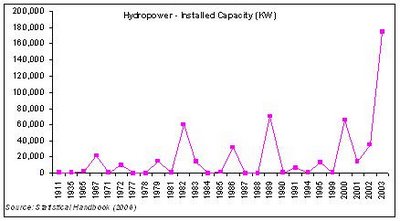
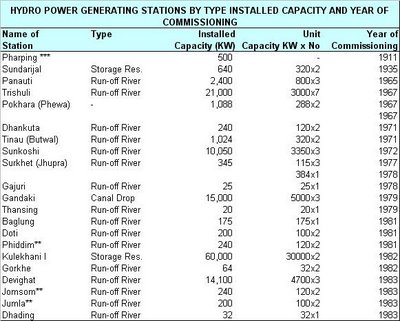
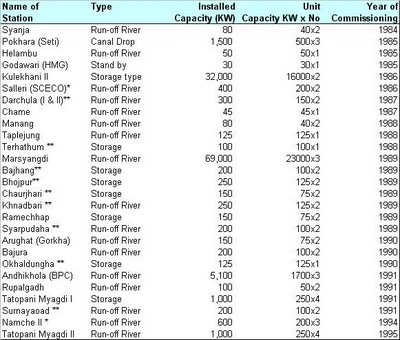
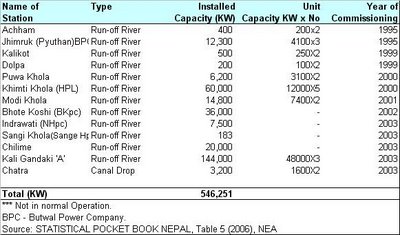
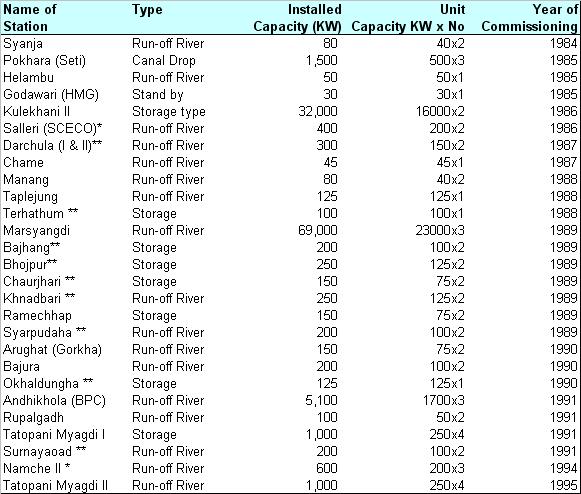
Hydro Power Generating Stations By Type Installed Capacity And Year Of Commissioning
[please click on the picture for larger version]
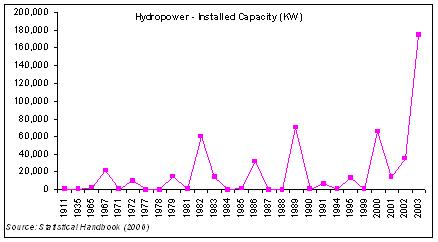
Nepal is very rich in water resources. The potential amount of hydropower generation according to experts is around 83,000 MW but only 1/2 of that or 42,000 MW can be feasibly exploited. The actual production is lot lower (around 1% of 42,000 MW). According to a recent news story, "The country's run-of-river projects that can produce 440 MW in total when run at full capacity produced only 230 MW Saturday due to a sharp decline in water level in the rivers. The peak demand these days is 640 MW. The power availability at the moment is owed to 40 MW produced by the country's thermal plants and 85 MW being imported from India." (please click here for the story)
Hydro Power Generating Stations By Type Installed Capacity And Year Of Commissioning
[please click on the picture for larger version]
Nepal is very rich in water resources. The potential amount of hydropower generation according to experts is around 83,000 MW but only 1/2 of that or 42,000 MW can be feasibly exploited. The actual production is lot lower (around 1% of 42,000 MW). According to a recent news story, "The country's run-of-river projects that can produce 440 MW in total when run at full capacity produced only 230 MW Saturday due to a sharp decline in water level in the rivers. The peak demand these days is 640 MW. The power availability at the moment is owed to 40 MW produced by the country's thermal plants and 85 MW being imported from India." (please click here for the story)


EconSpeak: When Maoists’ Rhetoric Collides With Nepal’s Economic Reality
EconSpeak: When Maoists’ Rhetoric Collides With Nepal’s Economic Reality
Commentary by NepaliEconomy.com
The successful conclusion of the Constituent Assembly (CA) election on April 10 2008, and the resounding victory of the Maoists over Nepali Congress (NC) and UML, and the emergence of MPRF as a major political force in the eastern Tarai mark a tectonic shift in Nepali politics. The Maoists, given their electoral success will certainly lead the new interim government with the mandate to draft a new constitution. The process could take about two years. Assuming that everything goes smoothly (big if), there will be a new election to elect a permanent government. The Maoists leaders are confident that they will win that also, and at this point it is hard to argue otherwise. Now the Maoists are in the cockpit of the country, so to speak, they will have to start delivering on their economic promises and take the country to the Promised Land. That won't be easy and how the Maoists navigate the challenges ahead will likely shape the political as well economic life of the country for years to come.
The knee jerk response of the business community following the Maoist victory exposed their deep-seated worry. The NEPSE fell more than 5% following the election results although it has recovered some of the losses. There have been rumors of capital flight out of the country principally to India. The FNCCI is concerned enough to call on business community to unite to protect its interests. The international community was also caught off-guard by the Maoists' achievement and is still somewhat shell-shocked. While respecting the outcome of the election they have not whole-heartedly embraced the Maoists.
The subdued reaction from domestic and international economic players to their triumph has not gone unnoticed by the Maoist leadership. They are making an extra effort to reassure the skeptics. Dr. Baburam Bhattarai, the chief ideologue of the party gave an extensive interview to the Nepali Times to ally fears about their intentions vis-à-vis the economy. He articulated such moderate views that it would be hard for sensible folks to raise qualms about them. He explicitly ruled out collectivism and nationalization, and his advocacy for greater government role in the economy should be expected given his party's leftist tendencies. He advocated land reform although did not provide the details. He promised to protect domestic industries but did not discourage foreign investment especially large-scale ones, which according to him would be done using BOOT (build-own-operate-transfer) model. He assured that the labor agitations by the Maoist-affiliated unions were things of the past. He pledged to end corruption and leakage in the system.
Dr. Bhattarai's assurance could have been taken at a face value but for three reasons. First, there was one ominous comment in Dr. Bhattarai's interview. He said, "Revolution means a radical rapid change in the socio-economic structure, that can happen through violent or non-violent means. At some point in a revolution, violent means need to be adopted." I am not sure what he meant. Can we infer that if the Maoists do not achieve their revolutionary goals, whatever they are, peacefully they are going to resort to violence? He did not get the opportunity to answer that question but there are reasons to be concerned. In an interaction sponsored by the BBC couple of days later, he said in no uncertain terms that the Maoists will first fulfill their political goals and then their economic goals. Does that mean that he will deploy the YCL as well as the state machinery and the legal monopoly of violence at their disposable against any political, administrative, societal, judicial or other type of impediments (perceived or real)?
Second, there are contradictions between Dr. Bhattarai's current positions and his earlier ones. In an earlier incarnation, as a revolutionary leader, he wrote 40-point demands to then HMG government led by Sher B Deuba. The Deuba government tragically ignored them and that triggered the 10-year insurgency. Now the Maoists have realized many of their political demands, are they going to take steps to fulfill their economic demands as well? If so, they have to realize that there are many contradictions between their past and present pronouncements. For instance,
#4, Gorkha recruiting centers should be closed and decent jobs should be arranged for the recruits. Does this also apply to people working in the Middle East and the SE Asia?
#6, The monopoly of foreign capital in Nepal's industry, trade and economic sector should be stopped. How does this square with foreign investment especially the ones done using BOOT model?
#28, Brokers and commission agents should have their property confiscated and that money should be invested in industry. #35) Education for profit (private schools?) should be completely stopped. How do they square with free enterprise economy?
Third, the Maoists have made many outlandish economic promises (in their 40-point demands and in recent CA election manifesto), which will be hard, if not impossible to attain especially in the context of Nepal. For instance, they promised to increase per capita income from $270 to $3,000 in 10 years. That is 27% a year growth in per capital income and 30% GDP growth if we include 2% growth in population. No country, especially resource poor has achieved such feat. Secondly, they promised to increase hydro production by 10,000 MWH in 10 years. Using the rule of thumb of 1MW costs $1 million, that requires $1 billion investment a year, possible but very unlikely. Finally they want to make Nepal a developed country in 20 years and highly developed one in forty years.
The Maoists' economic goals and promises will certainly collide with the reality that is Nepal. Needless to say, most of Nepal's economic woes are either structural (rural underemployment, load-shedding, water shortages) or beyond its control (high food, energy and fertilizer prices), and there are no obvious quick fixes for them. The Maoists will certainly find it very difficult, if not impossible to meet the high benchmark they have set for especially if they start alienating domestic businesses, the intelligentsia, and influential foreign countries. When they finally realize their own limitation, how are they going to respond? Are they going to accept it and try to reset the expectations of their cadres and supporters to more manageable levels? Will their cadres accept anything less than full promulgation of the Maoists programs given that their party is in power and that they have sacrificed their blood for that cause? Will the tension between the moderate top and the radical bottom tea apart the movement? Or will the Maoist leadership try to placate the impatient and disillusioned troops and make up for their own shortcomings by inventing a scapegoat and unleasing radical socio-economic programs i.e. Nepal's versions of Great Leap Forward and Cultural Revolution? The answers to these questions will have profound long-term impact.
Despite all the big question marks, we must give the Maoists the benefits of the doubt but not a blank check. After all they have morphed from radical revolutionaries to the dominant political party in just two years, and they have the mandate from the people. There are still many internal contradictions that they need to sort out. Probably the best reason why they should be given a fair chance is because so-called mainstream parties have lost all credibility in the eyes of Nepalese people. In 15-years of their rule, they never missed an opportunity to waste peoples' mandates and disappoint their hopes and aspiration.
Commentary by NepaliEconomy.com
The successful conclusion of the Constituent Assembly (CA) election on April 10 2008, and the resounding victory of the Maoists over Nepali Congress (NC) and UML, and the emergence of MPRF as a major political force in the eastern Tarai mark a tectonic shift in Nepali politics. The Maoists, given their electoral success will certainly lead the new interim government with the mandate to draft a new constitution. The process could take about two years. Assuming that everything goes smoothly (big if), there will be a new election to elect a permanent government. The Maoists leaders are confident that they will win that also, and at this point it is hard to argue otherwise. Now the Maoists are in the cockpit of the country, so to speak, they will have to start delivering on their economic promises and take the country to the Promised Land. That won't be easy and how the Maoists navigate the challenges ahead will likely shape the political as well economic life of the country for years to come.
The knee jerk response of the business community following the Maoist victory exposed their deep-seated worry. The NEPSE fell more than 5% following the election results although it has recovered some of the losses. There have been rumors of capital flight out of the country principally to India. The FNCCI is concerned enough to call on business community to unite to protect its interests. The international community was also caught off-guard by the Maoists' achievement and is still somewhat shell-shocked. While respecting the outcome of the election they have not whole-heartedly embraced the Maoists.
The subdued reaction from domestic and international economic players to their triumph has not gone unnoticed by the Maoist leadership. They are making an extra effort to reassure the skeptics. Dr. Baburam Bhattarai, the chief ideologue of the party gave an extensive interview to the Nepali Times to ally fears about their intentions vis-à-vis the economy. He articulated such moderate views that it would be hard for sensible folks to raise qualms about them. He explicitly ruled out collectivism and nationalization, and his advocacy for greater government role in the economy should be expected given his party's leftist tendencies. He advocated land reform although did not provide the details. He promised to protect domestic industries but did not discourage foreign investment especially large-scale ones, which according to him would be done using BOOT (build-own-operate-transfer) model. He assured that the labor agitations by the Maoist-affiliated unions were things of the past. He pledged to end corruption and leakage in the system.
Dr. Bhattarai's assurance could have been taken at a face value but for three reasons. First, there was one ominous comment in Dr. Bhattarai's interview. He said, "Revolution means a radical rapid change in the socio-economic structure, that can happen through violent or non-violent means. At some point in a revolution, violent means need to be adopted." I am not sure what he meant. Can we infer that if the Maoists do not achieve their revolutionary goals, whatever they are, peacefully they are going to resort to violence? He did not get the opportunity to answer that question but there are reasons to be concerned. In an interaction sponsored by the BBC couple of days later, he said in no uncertain terms that the Maoists will first fulfill their political goals and then their economic goals. Does that mean that he will deploy the YCL as well as the state machinery and the legal monopoly of violence at their disposable against any political, administrative, societal, judicial or other type of impediments (perceived or real)?
Second, there are contradictions between Dr. Bhattarai's current positions and his earlier ones. In an earlier incarnation, as a revolutionary leader, he wrote 40-point demands to then HMG government led by Sher B Deuba. The Deuba government tragically ignored them and that triggered the 10-year insurgency. Now the Maoists have realized many of their political demands, are they going to take steps to fulfill their economic demands as well? If so, they have to realize that there are many contradictions between their past and present pronouncements. For instance,
#4, Gorkha recruiting centers should be closed and decent jobs should be arranged for the recruits. Does this also apply to people working in the Middle East and the SE Asia?
#6, The monopoly of foreign capital in Nepal's industry, trade and economic sector should be stopped. How does this square with foreign investment especially the ones done using BOOT model?
#28, Brokers and commission agents should have their property confiscated and that money should be invested in industry. #35) Education for profit (private schools?) should be completely stopped. How do they square with free enterprise economy?
Third, the Maoists have made many outlandish economic promises (in their 40-point demands and in recent CA election manifesto), which will be hard, if not impossible to attain especially in the context of Nepal. For instance, they promised to increase per capita income from $270 to $3,000 in 10 years. That is 27% a year growth in per capital income and 30% GDP growth if we include 2% growth in population. No country, especially resource poor has achieved such feat. Secondly, they promised to increase hydro production by 10,000 MWH in 10 years. Using the rule of thumb of 1MW costs $1 million, that requires $1 billion investment a year, possible but very unlikely. Finally they want to make Nepal a developed country in 20 years and highly developed one in forty years.
The Maoists' economic goals and promises will certainly collide with the reality that is Nepal. Needless to say, most of Nepal's economic woes are either structural (rural underemployment, load-shedding, water shortages) or beyond its control (high food, energy and fertilizer prices), and there are no obvious quick fixes for them. The Maoists will certainly find it very difficult, if not impossible to meet the high benchmark they have set for especially if they start alienating domestic businesses, the intelligentsia, and influential foreign countries. When they finally realize their own limitation, how are they going to respond? Are they going to accept it and try to reset the expectations of their cadres and supporters to more manageable levels? Will their cadres accept anything less than full promulgation of the Maoists programs given that their party is in power and that they have sacrificed their blood for that cause? Will the tension between the moderate top and the radical bottom tea apart the movement? Or will the Maoist leadership try to placate the impatient and disillusioned troops and make up for their own shortcomings by inventing a scapegoat and unleasing radical socio-economic programs i.e. Nepal's versions of Great Leap Forward and Cultural Revolution? The answers to these questions will have profound long-term impact.
Despite all the big question marks, we must give the Maoists the benefits of the doubt but not a blank check. After all they have morphed from radical revolutionaries to the dominant political party in just two years, and they have the mandate from the people. There are still many internal contradictions that they need to sort out. Probably the best reason why they should be given a fair chance is because so-called mainstream parties have lost all credibility in the eyes of Nepalese people. In 15-years of their rule, they never missed an opportunity to waste peoples' mandates and disappoint their hopes and aspiration.
Baburam Bhattarai - "Radical democrat"
Baburam Bhattarai - "Radical democrat"
Nepali Times, 16-Apr-08
Baburam Bhattarai pointed to a bouquet in his study and said: ?People who never looked at us before are coming here to give me flowers.? Flanked by portraits of Marx, Lenin, Stalin and Mao, the chief ideologue of the Maoists spoke to Nepali Times on Tuesday about sleepless nights, his party's economic agenda and about whether he'd been offered the prime ministership.

Nepali Times: How does it feel to arrive here after the long journey from a village in Gorkha?
Baburam Bhattarai: There is a deep sense of responsibility, and that comes from the fact that I was born in an ordinary village family, my mother can't read or write, my father is a farmer. As a child I used to tend livestock and help in the farm, and when I went to high school I had to carry water and cook for myself. From that to be able to go to a good school and be educated, and to have that contrast in one lifetime is fascinating in a way. But now we have been brought to this position where we have to try to resolve issues of national importance, there are enormous aspirations, there is lots to do, but we have very little time and resources. It makes us somewhat anxious, thinking about whether we can do it or not. There are sleepless nights, getting up at three in the morning and not being able to go back to sleep.
But luckily we have a lot of experience, we engaged in open politics, then we went underground for ten years and engaged in an armed struggle. This gives us the capacity to deal with challenges. Personally I have always been very committed and that is why I think we can handle the challenges before us.
Did you ever have a sense of destiny? That this is where you wanted to go.
No, I didn't. You were born and raised here in the city, but as a child in my village there was no way I could imagine I would ever end up where I am now. Even the background of (my wife) Hisilaji is different, and when we take our daughter to my home village she is surprised at the conditions there. If I hadn't had the chance to have the schooling I did, I am sure I would still be there.
I used to get very emotional back then when I saw the poverty, discrimination and disparities all around me in the village. And what was I going to do about it, those feelings did touch me at an early age. But what are the ways to deal with it, how can these problems be solved, I started thinking about those things in my college days when I finished architecture and started working on my PhD in JNU where I analysed the problems from a Marxist perspective.
Marx said there is always a combination of necessity and chance. I had a realisation about the social conditions of my community. I knew that the feudal monarchy had to be ended. But I never knew how it was going to happen, how we were going to go about it, who would come to the forefront to lead it.
This week when the first results started coming in, weren't you surprised?
Not so much. You are all in the media, you do political analysis, I have the feeling you may have been a bit out of touch with the reality in the countryside. The ground had shifted in the past 10 years of conflict. The marginalised and deprived women, janajatis and Dalits were really suffering, and city-based people couldn't really understand how bad things were. There was much talk how the Maoists were spreading terror and fear, but we understood what was happening in the hinterland. We used to go back and forth from Gorkha and Rolpa.
We were convinced the people wanted change, and we knew they would let us lead them. We knew we'd be the largest party, but we didn't know exactly how many seats we would win. That is why we were surprised that everyone, including the media doubted us. The middle class and the city elite were shocked by the result because they'd never understood what was happening in the villages.
Everyone got it wrong. We have been meeting members of the diplomatic community this past week, and they have told us that there was intelligence failure. But we are people who fought a war, for us getting things wrong by a minute or by a metre was a question of life or death, so we had told our cadre to carry out a very concrete analysis for the elections.
The really oppressed groups like the Tamangs and Tharus voted for us in large numbers. In the Tamang belt we have won 24 of the 27 seats and in the Tharuwan, of the 22 seats we have won 20. Of the 24 women who have won, 20 are Maoist women. But even the traditionally-vacillating urban middle class, the 20-30 percent, who make up their minds at the last moment came over to our side.
Was the price the Nepali people had to pay in terms of lives lost and destruction in the revolution worth all this?
We are still in a revolution. The elections were part of our revolution. It's not just an armed struggle that is a revolution. Revolution means a radical rapid change in the socio-economic structure, that can happen through violent or non-violent means. At some point in a revolution, violent means need to be adopted. This election was part of the revolution to end the feudal monarchy. If we hadn't waged the People's War to weaken the state and empower the masses, the conditions would not have been created for the elections alone to achieve the goal.
So, it's not true that we abandoned the bullet to come to the ballot. We used both the bullet and the ballot in this revolution. You couldn't win with only bullets, and you couldn't win with only the ballot. Nepal's revolution has been completed in this unique manner.
After a ten year war, 15,000 killed, don't you think these elections were like coming back to square one?
No. If you don't mind, that is where you are wrong. This was a constituent assembly election. Earlier elections were parliamentary elections granted by a king. There was no structural change, sovereignty was not with the people. This time we are drafting a new constitution. And it wasn't possible without an armed struggle.
There are reports of widespread threats and intimidation by your cadre during the election camapaign?
It is possible that happened in some places. But it would not be possible to do it from Jhapa to Kanchanpur and from villages to the cities. The main factor is that the people wanted change, and they wanted relative change and to give a chance to a new party.
When are you going to turn your attention to the economy?
Our goal is economic development. For an economic revolution to succeed, we have to complete this political revolution by writing a new constitution. There is of course the need to provide immediate relief. There are the victims of the war, those affected by inflation, corruption those issues need to be addressed urgently. But the foundations also need to be laid for structural changes required for an economic transformation.
Can these things be achieved in two years? How will you deal with inflation?
Unless you pay attention to the structural reforms in the economy, superficial interventions won't help. You can give subsidies and get over the immediate problem, but we also have to address the roots of the crisis which is that a subsistence agricultural economy on which two-thirds of our population depends. That will not lead to economic development. There has to be a total transformation of the economy.
Second, we need massive job creation for which we need investment in hydropower, tourism and its optimum utilisation. This will lay the foundation for longterm economic development.
Your election manifesto also talks about land reform. What kind of land reform are you talking about?
The simple universal principle of land-reform is land to the tiller. In the mountains, the owners are also tillers but in the Tarai there is a lot of absentee landlordism and productivity is low. There has to be redistribution and modernisation of the methods of cultivation.
But Mao's collectivisation and the kolkhozes of the Soviet Union which led to famines and were a disaster. Can we afford to experiment?
There has been some exaggeration here. In China and Russia there may have been some problems, but in other Third World countries it worked. And if the Chinese and the Russians hadn't totally dismantled the feudal structures, they wouldn't have achieved the growth that they have today.
When we say we want to end feudalism, we don't mean we want to end private ownership. Our economic development is in our language bourgeoise democratic revolution, in other words, collectivisation, socialisation and nationalisation is not our current agenda. All we mean to say is that for a weak and backward economy like ours the state must play a facilitating and regulatory role. Without monetary and tax policies foreign interests may be more dominant, so the state has to protect the domestic private sector and the free market.
Yet, the business community is not yet comfortable with the Maoist win mainly because of their experience over the past two years. Do you have words of assurance for them?
We would like to assure everyone that once the Maoists come (into government) the investment climate will be even more favourable. There shouldn't be any unnecessary misunderstanding about that. The rumours in the press about our intention are wrong, there are reports of capital flight, but this shouldn't happen. And the other aspect is that once there is political stability, the investment climate will be even better. Our other agenda is economic development and for this we want to mobilise domestic resources and capital, and also welcome private foreign direct investment. The only thing we ask is to be allowed to define our national priorities.
We want to fully assure international investors already in Nepal that we welcome them here, and we will work to make the investment climate even better than it is now. Just watch, the labour-mangement climate will improve in our time in office. What happened in the past two years with the unions happened during a transition phase, but the business sector also hasn't identified the other factors that are causing them losses.
What do you mean by national industrial capitalism?
Local development is important. Every state wants to give priority or protection to its own industry. Otherwise why have a state? When we allow foreign direct investment we will give priority to those who have a local partnership. That way the national entrepreneurial class will also develop and the national economy will benefit.
How about the hydropower deals that have already been agreed on?
The ones that have been signed needn't have been done in a hush-hush manner, after all we were in an interim period and we could agreed on it collectively. By agreeing to these projects a day before we returned to government has aroused suspicions. But we understand that big hydro projects are not possible without foreign investment. The deals could have been negotiated in a more open manner. If there have been major irregularities, we need to investigate them, correct the decision-making process but we don't want to discourage investors by shutting down projects.
The time has come to deliver on the promises. There are very high expectations.
That is true, but the bigger challenge is to maintain national unity. Let's have political competition, but for the next 10-15 years let's cooperate, let's agree on a common minimum program. That will bring political stability, allow us to make optimum use of our domestic resources and bring in investment and make progress in the elimination of absolute poverty. If we can achieve these things in a fairly short timeframe, it will give the people patience and lay the groundwork for further development.
Our main worry now is the culture of disunity that results in political instability. All the parties must work together until the new constitution is written. The parties shouldn't react emotionally and say they'll leave the government.
Have you been offered the prime ministership?
(Laughs) Can't say now. We have been advocating a presidential system, but need to make provision for that, and then we will divide up our work among us depending on who is more capable of completing the task at hand. As we say, it is everyone according to their need and their capacity. Because of my interest in development planning, maybe my work will be in that field.
Everything is reaching a crisis point. There are big expectations and hope, people need to see immediate changes?
The first thing we want to stop is corruption and leakage. That itself will bring big relief to the people. Like Marx said, if everyone lived in huts people are satisfied. It is when someone builds a village among the hovels that there is expectation. We have to meet basic needs of people first, that is our priority. Our economic agenda has growth with employment. Like our plans for infrastructure development, this creates immediate jobs and also gets things built.We have to take advantage of the fact that we are located between China and India. These two countries are the next two superpowers and we are in the middle. In the past we were seen as a buffer state, now we can be a vibrant bridge between them and benefit from the comparative advantage. For this we need infrastructure development and connectivity on both sides. For this we have the labour and for capital we can raise the money from the wasted investment in unproductive sectors. For large-scale investment we will have to rely on outside investors and for that we can use the BOOT model.
Your party has served in government in the interim period. You understand it from within, which aspects of it would you like to change?
One thing is that there is no coordination between ministries. Everyone is doing their own thing, that just won't do. They should be operating according to the state's main policies and coordinating activities. Secondly, the bureaucracy is lethargic and corruption-ridden. Unless that is changed the ministries won't be effective. A lot of ministries overlap, and we need to restructure them.
Your own subject is urban planning. How are you going to control this unplanned centralized growth in Kathmandu?
You see on this map the various federal units, we need to spread out the economic activity so jobs are available outside Kathmandu. The fast track highway (to Hetauda) will shift the population out, and we have to plan the growth of Kathmandu properly with zoning and the outer ring road. Nowhere in the world is urban growth as unplanned as it is here.
With all these problems, do you think the other parties just gave up and said let the Maoists handle it?
(Laughs). Maybe. Maybe they think let's see how the Maoists do it. The cynical ones would probably say it.
Nepali Times, 16-Apr-08
Baburam Bhattarai pointed to a bouquet in his study and said: ?People who never looked at us before are coming here to give me flowers.? Flanked by portraits of Marx, Lenin, Stalin and Mao, the chief ideologue of the Maoists spoke to Nepali Times on Tuesday about sleepless nights, his party's economic agenda and about whether he'd been offered the prime ministership.

Nepali Times: How does it feel to arrive here after the long journey from a village in Gorkha?
Baburam Bhattarai: There is a deep sense of responsibility, and that comes from the fact that I was born in an ordinary village family, my mother can't read or write, my father is a farmer. As a child I used to tend livestock and help in the farm, and when I went to high school I had to carry water and cook for myself. From that to be able to go to a good school and be educated, and to have that contrast in one lifetime is fascinating in a way. But now we have been brought to this position where we have to try to resolve issues of national importance, there are enormous aspirations, there is lots to do, but we have very little time and resources. It makes us somewhat anxious, thinking about whether we can do it or not. There are sleepless nights, getting up at three in the morning and not being able to go back to sleep.
But luckily we have a lot of experience, we engaged in open politics, then we went underground for ten years and engaged in an armed struggle. This gives us the capacity to deal with challenges. Personally I have always been very committed and that is why I think we can handle the challenges before us.
Did you ever have a sense of destiny? That this is where you wanted to go.
No, I didn't. You were born and raised here in the city, but as a child in my village there was no way I could imagine I would ever end up where I am now. Even the background of (my wife) Hisilaji is different, and when we take our daughter to my home village she is surprised at the conditions there. If I hadn't had the chance to have the schooling I did, I am sure I would still be there.
I used to get very emotional back then when I saw the poverty, discrimination and disparities all around me in the village. And what was I going to do about it, those feelings did touch me at an early age. But what are the ways to deal with it, how can these problems be solved, I started thinking about those things in my college days when I finished architecture and started working on my PhD in JNU where I analysed the problems from a Marxist perspective.
Marx said there is always a combination of necessity and chance. I had a realisation about the social conditions of my community. I knew that the feudal monarchy had to be ended. But I never knew how it was going to happen, how we were going to go about it, who would come to the forefront to lead it.
This week when the first results started coming in, weren't you surprised?
Not so much. You are all in the media, you do political analysis, I have the feeling you may have been a bit out of touch with the reality in the countryside. The ground had shifted in the past 10 years of conflict. The marginalised and deprived women, janajatis and Dalits were really suffering, and city-based people couldn't really understand how bad things were. There was much talk how the Maoists were spreading terror and fear, but we understood what was happening in the hinterland. We used to go back and forth from Gorkha and Rolpa.
We were convinced the people wanted change, and we knew they would let us lead them. We knew we'd be the largest party, but we didn't know exactly how many seats we would win. That is why we were surprised that everyone, including the media doubted us. The middle class and the city elite were shocked by the result because they'd never understood what was happening in the villages.
Everyone got it wrong. We have been meeting members of the diplomatic community this past week, and they have told us that there was intelligence failure. But we are people who fought a war, for us getting things wrong by a minute or by a metre was a question of life or death, so we had told our cadre to carry out a very concrete analysis for the elections.
The really oppressed groups like the Tamangs and Tharus voted for us in large numbers. In the Tamang belt we have won 24 of the 27 seats and in the Tharuwan, of the 22 seats we have won 20. Of the 24 women who have won, 20 are Maoist women. But even the traditionally-vacillating urban middle class, the 20-30 percent, who make up their minds at the last moment came over to our side.
Was the price the Nepali people had to pay in terms of lives lost and destruction in the revolution worth all this?
We are still in a revolution. The elections were part of our revolution. It's not just an armed struggle that is a revolution. Revolution means a radical rapid change in the socio-economic structure, that can happen through violent or non-violent means. At some point in a revolution, violent means need to be adopted. This election was part of the revolution to end the feudal monarchy. If we hadn't waged the People's War to weaken the state and empower the masses, the conditions would not have been created for the elections alone to achieve the goal.
So, it's not true that we abandoned the bullet to come to the ballot. We used both the bullet and the ballot in this revolution. You couldn't win with only bullets, and you couldn't win with only the ballot. Nepal's revolution has been completed in this unique manner.
After a ten year war, 15,000 killed, don't you think these elections were like coming back to square one?
No. If you don't mind, that is where you are wrong. This was a constituent assembly election. Earlier elections were parliamentary elections granted by a king. There was no structural change, sovereignty was not with the people. This time we are drafting a new constitution. And it wasn't possible without an armed struggle.
There are reports of widespread threats and intimidation by your cadre during the election camapaign?
It is possible that happened in some places. But it would not be possible to do it from Jhapa to Kanchanpur and from villages to the cities. The main factor is that the people wanted change, and they wanted relative change and to give a chance to a new party.
When are you going to turn your attention to the economy?
Our goal is economic development. For an economic revolution to succeed, we have to complete this political revolution by writing a new constitution. There is of course the need to provide immediate relief. There are the victims of the war, those affected by inflation, corruption those issues need to be addressed urgently. But the foundations also need to be laid for structural changes required for an economic transformation.
Can these things be achieved in two years? How will you deal with inflation?
Unless you pay attention to the structural reforms in the economy, superficial interventions won't help. You can give subsidies and get over the immediate problem, but we also have to address the roots of the crisis which is that a subsistence agricultural economy on which two-thirds of our population depends. That will not lead to economic development. There has to be a total transformation of the economy.
Second, we need massive job creation for which we need investment in hydropower, tourism and its optimum utilisation. This will lay the foundation for longterm economic development.
Your election manifesto also talks about land reform. What kind of land reform are you talking about?
The simple universal principle of land-reform is land to the tiller. In the mountains, the owners are also tillers but in the Tarai there is a lot of absentee landlordism and productivity is low. There has to be redistribution and modernisation of the methods of cultivation.
But Mao's collectivisation and the kolkhozes of the Soviet Union which led to famines and were a disaster. Can we afford to experiment?
There has been some exaggeration here. In China and Russia there may have been some problems, but in other Third World countries it worked. And if the Chinese and the Russians hadn't totally dismantled the feudal structures, they wouldn't have achieved the growth that they have today.
When we say we want to end feudalism, we don't mean we want to end private ownership. Our economic development is in our language bourgeoise democratic revolution, in other words, collectivisation, socialisation and nationalisation is not our current agenda. All we mean to say is that for a weak and backward economy like ours the state must play a facilitating and regulatory role. Without monetary and tax policies foreign interests may be more dominant, so the state has to protect the domestic private sector and the free market.
Yet, the business community is not yet comfortable with the Maoist win mainly because of their experience over the past two years. Do you have words of assurance for them?
We would like to assure everyone that once the Maoists come (into government) the investment climate will be even more favourable. There shouldn't be any unnecessary misunderstanding about that. The rumours in the press about our intention are wrong, there are reports of capital flight, but this shouldn't happen. And the other aspect is that once there is political stability, the investment climate will be even better. Our other agenda is economic development and for this we want to mobilise domestic resources and capital, and also welcome private foreign direct investment. The only thing we ask is to be allowed to define our national priorities.
We want to fully assure international investors already in Nepal that we welcome them here, and we will work to make the investment climate even better than it is now. Just watch, the labour-mangement climate will improve in our time in office. What happened in the past two years with the unions happened during a transition phase, but the business sector also hasn't identified the other factors that are causing them losses.
What do you mean by national industrial capitalism?
Local development is important. Every state wants to give priority or protection to its own industry. Otherwise why have a state? When we allow foreign direct investment we will give priority to those who have a local partnership. That way the national entrepreneurial class will also develop and the national economy will benefit.
How about the hydropower deals that have already been agreed on?
The ones that have been signed needn't have been done in a hush-hush manner, after all we were in an interim period and we could agreed on it collectively. By agreeing to these projects a day before we returned to government has aroused suspicions. But we understand that big hydro projects are not possible without foreign investment. The deals could have been negotiated in a more open manner. If there have been major irregularities, we need to investigate them, correct the decision-making process but we don't want to discourage investors by shutting down projects.
The time has come to deliver on the promises. There are very high expectations.
That is true, but the bigger challenge is to maintain national unity. Let's have political competition, but for the next 10-15 years let's cooperate, let's agree on a common minimum program. That will bring political stability, allow us to make optimum use of our domestic resources and bring in investment and make progress in the elimination of absolute poverty. If we can achieve these things in a fairly short timeframe, it will give the people patience and lay the groundwork for further development.
Our main worry now is the culture of disunity that results in political instability. All the parties must work together until the new constitution is written. The parties shouldn't react emotionally and say they'll leave the government.
Have you been offered the prime ministership?
(Laughs) Can't say now. We have been advocating a presidential system, but need to make provision for that, and then we will divide up our work among us depending on who is more capable of completing the task at hand. As we say, it is everyone according to their need and their capacity. Because of my interest in development planning, maybe my work will be in that field.
Everything is reaching a crisis point. There are big expectations and hope, people need to see immediate changes?
The first thing we want to stop is corruption and leakage. That itself will bring big relief to the people. Like Marx said, if everyone lived in huts people are satisfied. It is when someone builds a village among the hovels that there is expectation. We have to meet basic needs of people first, that is our priority. Our economic agenda has growth with employment. Like our plans for infrastructure development, this creates immediate jobs and also gets things built.We have to take advantage of the fact that we are located between China and India. These two countries are the next two superpowers and we are in the middle. In the past we were seen as a buffer state, now we can be a vibrant bridge between them and benefit from the comparative advantage. For this we need infrastructure development and connectivity on both sides. For this we have the labour and for capital we can raise the money from the wasted investment in unproductive sectors. For large-scale investment we will have to rely on outside investors and for that we can use the BOOT model.
Your party has served in government in the interim period. You understand it from within, which aspects of it would you like to change?
One thing is that there is no coordination between ministries. Everyone is doing their own thing, that just won't do. They should be operating according to the state's main policies and coordinating activities. Secondly, the bureaucracy is lethargic and corruption-ridden. Unless that is changed the ministries won't be effective. A lot of ministries overlap, and we need to restructure them.
Your own subject is urban planning. How are you going to control this unplanned centralized growth in Kathmandu?
You see on this map the various federal units, we need to spread out the economic activity so jobs are available outside Kathmandu. The fast track highway (to Hetauda) will shift the population out, and we have to plan the growth of Kathmandu properly with zoning and the outer ring road. Nowhere in the world is urban growth as unplanned as it is here.
With all these problems, do you think the other parties just gave up and said let the Maoists handle it?
(Laughs). Maybe. Maybe they think let's see how the Maoists do it. The cynical ones would probably say it.
Fourty Point Demands of the United People's Front
Fourty Point Demands of the United People's Front
4 February, 1996
Right Honourable Prime Minister
Prime Minister's Office,
Singha Darbar, Kathmandu
Sub: Memorandum
Sir,
It has been six years since the autocratic monarchical partyless Panchayat system was ended by the 1990 People's Movement and a constitutional monarchical multiparty parliamentary system established. During this period state control has been exercised by a tripartite interim government, a single-party government of the Nepali Congress, a minority government of UML and a present Nepali Congress-RPP-Sadbhavana coalition. That, instead of making progress, The situation of the country and the people is going downhill is evident from the fact that Nepal has slid to being the second poorest country in the world; people living below the absolute poverty line has gone up to 71 per cent; the number of unemployed has reached more than 10 per cent while the number of people who are semi-employed or in disguised employment has crossed 60 per cent; the country is on the verge of bankruptcy due to rising foreign loans and deficit trade; economic and cultural encroachment within the country by foreign, and especially Indian, expansionists is increasing by the day; the gap between the rich and the poor and between towns and villages is growing wider. On the other hand, parliamentary parties that have formed the government by various means have shown that they are more interested in remaining in power with the blessings of foreign imperialist and expansionist masters than in the welfare of the country and the people. This is clear from their blindly adopting so-called privatisation and liberalisation to fulfill the interests of all imperialists and from the recent 'national consensus' reached in handing over the rights over Nepal's water resources to Indian expansionists. Since 6 April, 1992, the United People's Front has been involved in various struggles to fulfill relevant demands related to nationalism, democracy and livelihood, either by itself or with others. But rather than fulfilling those demands, the governments formed at different times have violently suppressed the agitators and taken the lives of hundreds; the most recent example of this is the armed police operation in Rolpa a few months back. In this context, we would like to once again present to the current coalition government demands related to nationalism, democracy and livelihood, which have been raised in the past and many of which have become relevant in the present context.
Our demands
Concerning nationality
1. All discriminatory treaties, including the 1950 Nepal-India Treaty, should be abrogated.
2. The so-called Integrated Mahakali Treaty concluded on 29 January, 1996 should be repealed immediately, as it is designed to conceal the disastrous Tanakpur Treaty and allows Indian imperialist monopoly over Nepal's water resources.
3. The open border between Nepal and India should be regulated, controlled and systematised. All vehicles with Indian licence plates should be banned from Nepal.
4. The Gurkha/Gorkha Recruitment Centres should be closed. Nepali citizens should be provided dignified employment in the country.
5. Nepali workers should be given priority in different sectors. A 'work permit' system should be strictly implemented if foreign workers are required in the country.
6. The domination of foreign capital in Nepali industries, business and finance should be stopped.
7. An appropriate customs policy should be devised and implemented so that economic development helps the nation become self-reliant.
8. The invasion of imperialist and colonial culture should be banned. Vulgar Hindi films, videos and magazines should be immediately outlawed.
9. The invasion of colonial and imperial elements in the name of NGOs and INGOs should be stopped.
Concerning people's democracy
10. A new constitution should be drafted by representatives elected for the establishment of a people's democratic system.
11. All special privileges of the king and the royal family should be abolished.
12. The army, the police and the bureaucracy should be completely under people's control.
13. All repressive acts, including the Security Act, should be repealed.
14. Everyone arrested extra-judicially for political reasons or revenge in Rukum, Rolpa, Jajarkot, Gorkha, Kabhrc, Sindhupalchowk. Sindhuli, Dhanusa, Ramechhap, and so on, should be immediately released. All false cases should be immediately withdrawn.
15. The operation of armed police, repression and state-sponsored terror should be immediately stopped.
16. The whereabouts of citizens who disappeared in police custody at different times, namely Dilip Chaudhary, Bhuwan Thapa Magar, Prabhakar Subedi and others, should be investigated and those responsible brought to justice. The families of victims should be duly compensated.
17. All those killed during the People's Movement should be declared martyrs. The families of the martyrs and those injured and deformed should be duly compensated, and the murderers brought to justice.
18. Nepal should be declared a secular nation.
19. Patriarchal exploitation and discrimination against women should be stopped. Daughters should be allowed to have equal access to paternal property as sons.
20. All racial exploitation and suppression should be stopped. Where ethnic communities are in the majority, they should be allowed to form their own autonomous governments.
21. Discrimination against downtrodden and backward people should be stopped. The system of untouchability should be eliminated.
22. All languages and dialects should be given equal opportunities to prosper. The right to education in the mother tongue up to higher-secondary level should be guaranteed.
23. The right to expression and freedom of press and publication should be guaranteed. The government mass media should be completely autonomous.
24. Academic and professional freedom of scholars, writers, artists and cultural workers should be guaranteed.
25. Regional discrimination between the hills and the tarai should be eliminated. Backward areas should be given regional autonomy. Rural and urban areas should be treated at par.
26. Local bodies should be empowered and appropriately equipped.
Concerning livelihood
27. Land should belong to 'tenants'. Land under the control of the feudal system should be confiscated and distributed to the landless and the homeless.
28. The property of middlemen and comprador capitalists should be confiscated and nationalised. Capital lying unproductive should be invested to promote industrialisation.
29. Employment should be guaranteed for all. Until such time as employment can be arranged, an unemployment allowance should be provided.
30. A minimum wage for workers in industries, agriculture and so on should be fixed and strictly implemented.
31. The homeless should be rehabilitated. No one should be ' relocated until alternative infrastructure is guaranteed.
32. Poor farmers should be exempt from loan repayments. Loans taken by small farmers from the Agricultural Development Bank should be written off. Appropriate provisions should be made to provide loans for small farmers.
33. Fertiliser and seeds should be easily available and at a cheap rate. Farmers should be provided with appropriate prices and markets for their produce.
34. People in flood and drought-affected areas should be provided with appropriate relief materials.
35. Free health services, and free and scientific education should be available to all. The commercialisation of education should be stopped.
36. Inflation should be checked. Wages should be increased proportionate to inflation. Essential goods should be cheaply and easily available to everyone.
37. Drinking water, roads and electricity should be provided to all villagers.
38. Domestic and cottage industries should be protected and promoted.
39. Corruption, smuggling, black marketing, bribery, and the practices of middlemen and so on should be eliminated.
40. Orphans, the disabled, the elderly and children should be duly honoured and protected.
We would like to request the present coalition government to immediately initiate steps to fulfill these demands which are inextricably linked with the Nepali nation and the life of the people. If there are no positive indications towards this from the government by 17 February, 1996, we would like to inform you that we will be forced to adopt the path of armed struggle against the existing state power.
Thank you.
Dr Baburam Bhattarai
Chairman
Central Committee, United People's Front, Nepal
4 February, 1996
Right Honourable Prime Minister
Prime Minister's Office,
Singha Darbar, Kathmandu
Sub: Memorandum
Sir,
It has been six years since the autocratic monarchical partyless Panchayat system was ended by the 1990 People's Movement and a constitutional monarchical multiparty parliamentary system established. During this period state control has been exercised by a tripartite interim government, a single-party government of the Nepali Congress, a minority government of UML and a present Nepali Congress-RPP-Sadbhavana coalition. That, instead of making progress, The situation of the country and the people is going downhill is evident from the fact that Nepal has slid to being the second poorest country in the world; people living below the absolute poverty line has gone up to 71 per cent; the number of unemployed has reached more than 10 per cent while the number of people who are semi-employed or in disguised employment has crossed 60 per cent; the country is on the verge of bankruptcy due to rising foreign loans and deficit trade; economic and cultural encroachment within the country by foreign, and especially Indian, expansionists is increasing by the day; the gap between the rich and the poor and between towns and villages is growing wider. On the other hand, parliamentary parties that have formed the government by various means have shown that they are more interested in remaining in power with the blessings of foreign imperialist and expansionist masters than in the welfare of the country and the people. This is clear from their blindly adopting so-called privatisation and liberalisation to fulfill the interests of all imperialists and from the recent 'national consensus' reached in handing over the rights over Nepal's water resources to Indian expansionists. Since 6 April, 1992, the United People's Front has been involved in various struggles to fulfill relevant demands related to nationalism, democracy and livelihood, either by itself or with others. But rather than fulfilling those demands, the governments formed at different times have violently suppressed the agitators and taken the lives of hundreds; the most recent example of this is the armed police operation in Rolpa a few months back. In this context, we would like to once again present to the current coalition government demands related to nationalism, democracy and livelihood, which have been raised in the past and many of which have become relevant in the present context.
Our demands
Concerning nationality
1. All discriminatory treaties, including the 1950 Nepal-India Treaty, should be abrogated.
2. The so-called Integrated Mahakali Treaty concluded on 29 January, 1996 should be repealed immediately, as it is designed to conceal the disastrous Tanakpur Treaty and allows Indian imperialist monopoly over Nepal's water resources.
3. The open border between Nepal and India should be regulated, controlled and systematised. All vehicles with Indian licence plates should be banned from Nepal.
4. The Gurkha/Gorkha Recruitment Centres should be closed. Nepali citizens should be provided dignified employment in the country.
5. Nepali workers should be given priority in different sectors. A 'work permit' system should be strictly implemented if foreign workers are required in the country.
6. The domination of foreign capital in Nepali industries, business and finance should be stopped.
7. An appropriate customs policy should be devised and implemented so that economic development helps the nation become self-reliant.
8. The invasion of imperialist and colonial culture should be banned. Vulgar Hindi films, videos and magazines should be immediately outlawed.
9. The invasion of colonial and imperial elements in the name of NGOs and INGOs should be stopped.
Concerning people's democracy
10. A new constitution should be drafted by representatives elected for the establishment of a people's democratic system.
11. All special privileges of the king and the royal family should be abolished.
12. The army, the police and the bureaucracy should be completely under people's control.
13. All repressive acts, including the Security Act, should be repealed.
14. Everyone arrested extra-judicially for political reasons or revenge in Rukum, Rolpa, Jajarkot, Gorkha, Kabhrc, Sindhupalchowk. Sindhuli, Dhanusa, Ramechhap, and so on, should be immediately released. All false cases should be immediately withdrawn.
15. The operation of armed police, repression and state-sponsored terror should be immediately stopped.
16. The whereabouts of citizens who disappeared in police custody at different times, namely Dilip Chaudhary, Bhuwan Thapa Magar, Prabhakar Subedi and others, should be investigated and those responsible brought to justice. The families of victims should be duly compensated.
17. All those killed during the People's Movement should be declared martyrs. The families of the martyrs and those injured and deformed should be duly compensated, and the murderers brought to justice.
18. Nepal should be declared a secular nation.
19. Patriarchal exploitation and discrimination against women should be stopped. Daughters should be allowed to have equal access to paternal property as sons.
20. All racial exploitation and suppression should be stopped. Where ethnic communities are in the majority, they should be allowed to form their own autonomous governments.
21. Discrimination against downtrodden and backward people should be stopped. The system of untouchability should be eliminated.
22. All languages and dialects should be given equal opportunities to prosper. The right to education in the mother tongue up to higher-secondary level should be guaranteed.
23. The right to expression and freedom of press and publication should be guaranteed. The government mass media should be completely autonomous.
24. Academic and professional freedom of scholars, writers, artists and cultural workers should be guaranteed.
25. Regional discrimination between the hills and the tarai should be eliminated. Backward areas should be given regional autonomy. Rural and urban areas should be treated at par.
26. Local bodies should be empowered and appropriately equipped.
Concerning livelihood
27. Land should belong to 'tenants'. Land under the control of the feudal system should be confiscated and distributed to the landless and the homeless.
28. The property of middlemen and comprador capitalists should be confiscated and nationalised. Capital lying unproductive should be invested to promote industrialisation.
29. Employment should be guaranteed for all. Until such time as employment can be arranged, an unemployment allowance should be provided.
30. A minimum wage for workers in industries, agriculture and so on should be fixed and strictly implemented.
31. The homeless should be rehabilitated. No one should be ' relocated until alternative infrastructure is guaranteed.
32. Poor farmers should be exempt from loan repayments. Loans taken by small farmers from the Agricultural Development Bank should be written off. Appropriate provisions should be made to provide loans for small farmers.
33. Fertiliser and seeds should be easily available and at a cheap rate. Farmers should be provided with appropriate prices and markets for their produce.
34. People in flood and drought-affected areas should be provided with appropriate relief materials.
35. Free health services, and free and scientific education should be available to all. The commercialisation of education should be stopped.
36. Inflation should be checked. Wages should be increased proportionate to inflation. Essential goods should be cheaply and easily available to everyone.
37. Drinking water, roads and electricity should be provided to all villagers.
38. Domestic and cottage industries should be protected and promoted.
39. Corruption, smuggling, black marketing, bribery, and the practices of middlemen and so on should be eliminated.
40. Orphans, the disabled, the elderly and children should be duly honoured and protected.
We would like to request the present coalition government to immediately initiate steps to fulfill these demands which are inextricably linked with the Nepali nation and the life of the people. If there are no positive indications towards this from the government by 17 February, 1996, we would like to inform you that we will be forced to adopt the path of armed struggle against the existing state power.
Thank you.
Dr Baburam Bhattarai
Chairman
Central Committee, United People's Front, Nepal
Monday, April 14, 2008
Roundup of Economic & Business News (Apr 1 - Apr 12)
Apr 1
Contractors demand compensation for increased construction costs (ekantipur.com)
Nepal’s handicraft exports down 10pc (ekantipur.com)
Apr 2
Five-day govt holiday for poll (ekantipur.com)
ADB warns of food crisis, high inflation (ekantipur.com)
Tourist arrivals on steady upswing (ekantipur.com)
Travel agencies stop selling Qatar Airways tickets (ekantipur.com)
ADB projects Nepal's GDP growth at 3.8 percent (Nepalnews.com)
Apr 3
Nepalis buying more silver despite rising world prices (ekantipur.com)
Monthly oil loss touches record Rs 1.3b (ekantipur.com)
Program to improve access for Nepali products (ekantipur.com)
Nepal gets 6th life insurance company (ekantipur.com)
Apr 4
Industrial output records negative growth rate (ekantipur.com)
Govt for S Asian pact to benefit workers (ekantipur.com)
NT shares to be allotted after polls (ArthaExpress.com)
Apr 5
Promoters' shares help stock market rebound (ekantipur.com)
Import duty scrap by India worries Nepali ghee industry (ekantipur.com)
Apr 6
Dr Kamal Krishna Joshi: 'Quality education requires more investment' (ekantipur.com)
Apr 7
Building costs grow double-digit (ekantipur.com)
‘Scrap import tax on vegetable ghee, oil raw materials’ (ekantipur.com)
Apr 8
Vegetables costlier as days become warmer (ekantipur.com)
Lift import tax on vegetable ghee raw materials: CNI (ekantipur.com)
21 global firms show interest on Budhi Ganadki Project (WaterPower Magazine)
Apr 9
Forex reserve on upward trajectory (ekantipur.com)
Industries announce paid holiday (ekantipur.com)
Apr 10
Rising consumption pushes up imports (ekantipur.com)
Youths hopeful of economic growth after CA polls (ArthaExpress.com)
ANALYSIS-After poll, job creation key to cement Nepali peace (Reuters)
Apr 11
Overseas trade through eastern region declines (ekantipur.com)
FlyYeti.com takes off for Doha (CAPA)
Contractors demand compensation for increased construction costs (ekantipur.com)
Nepal’s handicraft exports down 10pc (ekantipur.com)
Apr 2
Five-day govt holiday for poll (ekantipur.com)
ADB warns of food crisis, high inflation (ekantipur.com)
Tourist arrivals on steady upswing (ekantipur.com)
Travel agencies stop selling Qatar Airways tickets (ekantipur.com)
ADB projects Nepal's GDP growth at 3.8 percent (Nepalnews.com)
Apr 3
Nepalis buying more silver despite rising world prices (ekantipur.com)
Monthly oil loss touches record Rs 1.3b (ekantipur.com)
Program to improve access for Nepali products (ekantipur.com)
Nepal gets 6th life insurance company (ekantipur.com)
Apr 4
Industrial output records negative growth rate (ekantipur.com)
Govt for S Asian pact to benefit workers (ekantipur.com)
NT shares to be allotted after polls (ArthaExpress.com)
Apr 5
Promoters' shares help stock market rebound (ekantipur.com)
Import duty scrap by India worries Nepali ghee industry (ekantipur.com)
Apr 6
Dr Kamal Krishna Joshi: 'Quality education requires more investment' (ekantipur.com)
Apr 7
Building costs grow double-digit (ekantipur.com)
‘Scrap import tax on vegetable ghee, oil raw materials’ (ekantipur.com)
Apr 8
Vegetables costlier as days become warmer (ekantipur.com)
Lift import tax on vegetable ghee raw materials: CNI (ekantipur.com)
21 global firms show interest on Budhi Ganadki Project (WaterPower Magazine)
Apr 9
Forex reserve on upward trajectory (ekantipur.com)
Industries announce paid holiday (ekantipur.com)
Apr 10
Rising consumption pushes up imports (ekantipur.com)
Youths hopeful of economic growth after CA polls (ArthaExpress.com)
ANALYSIS-After poll, job creation key to cement Nepali peace (Reuters)
Apr 11
Overseas trade through eastern region declines (ekantipur.com)
FlyYeti.com takes off for Doha (CAPA)
Friday, April 11, 2008
Weekly Data
Weekly Data
The IMF came out with the April 2008 edison of the World Economic Outlook. Some of the interesting economic variables from the report.

The IMF came out with the April 2008 edison of the World Economic Outlook. Some of the interesting economic variables from the report.

IATA Enters Nepal Scaring Small Travel Agencies
IATA Enters Nepal Scaring Small Travel Agencies
(New Business Age, March 2008)
The scenario of travel agency industry in Nepal is about to take a big change with International Air Transport Association (IATA) entering into this market. Some of the industry analysts claim that the mushrooming and unregulated travel agency industry might finally take a more regulated and systematic shape with the entry of IATA. However, the criteria IATA has set for the travel agencies to get IATA membership have scared many smaller travel agencies. They allege that these criteria are hard for them to fulfil and are rather made for the benefit of larger travel agencies which will not help a healthy growth of the industry.
The point of the small players seems logical on the cursory look. Very few of the travel agencies know what IATA is and why it is here for. Without clarifying the market about its roles and its responsibilities, it seems unfair for IATA to ask all travel agencies to be its member within May 31, 2008. Moreover, the criteria it has set for the travel agencies to be eligible for the membership seems to be hard and some even claim that it is literally robbing them. For instance, the 7% commission that agencies used to get earlier from airlines for each ticket sold is falling down to 5% after the entry of IATA.
While applying for the IATA membership, a travel agency has to translate all the official documents of the organization into English and send it to India along with the draft for the application fee. This work would have been easier had the IATA an office set up here in Kathmandu. Moreover, the application fee is Rs. 13,000, which is non-refundable. Then IATA sends its employees for inspection who check, among other things, whether the agency keeps important documents like passports and tickets in enclosures that have concrete walls.
Another criterion requires the agency to have at least two employees who are equipped with IATA training certificate. For this purpose, IATA provides training facilities to the interested members of travel agencies but the fee charged is hefty. And the small travel agencies have objected strongly to it. “The heavy training fee gives us an impression that IATA is coming here more for profit than for helping to regulate the market,” says Raju Dhakal Managing Director of Sea Link, a travel agency.
According to his argument, if IATA is here for a noble cause, it should provide necessary trainings on a regular basis. “It is wrong to hope that travel agencies can carry out their duties regularly simply with a certificate of training. There are examples of mistakes made in e-ticketing by even large travel agencies that already are members of IATA. This clearly shows that one-time training is not enough,” he adds.
After being selected as the official member of IATA, each travel agency has to give bank guarantee of $10,000 which again is felt quite expensive.
Some people point out that IATA will stop the peculiar practice of smaller travel agencies under which they book the seats way too early and sell them off later in an inflated price. But the managers of smaller travel agencies say that IATA need not bother about this. “If it really wishes, this problem can be solved mutually through Global Distribution System (GDS) and the airline itself. If there is false booking, time limit can be fixed by which if the ticket is not confirmed the booking can be cancelled,” adds Dhakal giving the example of Etihad Air which follows this practice. If rules like this are followed by every airline, chances of such black marketing in tickets can be avoided, he says.
However, there are some positive aspects of IATA as well. “With its entrance, many international airlines have entered Nepal”, says Saugesh Shrestha, Head of Ticketing Department of Shangrila Tours. “It fights for the interests of airlines across the globe, challenging unreasonable rules and charges, holding regulators and governments to account and striving for sensible regulation. IATA’s aim is to help airlines help themselves by simplifying processes and increasing passenger convenience while reducing costs and improving efficiency.”
Though IATA has not run its activities in full fledge in Nepal, its missions and objectives surely will prove beneficial for the travel industry in the long run, view some industry analysts. Once it starts full-fledged operation here, there will be virtually no relationship of travel agencies with airlines. Agencies will have to buy ticket stocks from IATA. Moreover, there will be special tickets made for IATA member airlines where there will be the list of the prices as well. As such, no travel agency can charge price at random, it is hoped.
Another major positive development that IATA will bring would be in credit control. Currently, travel agencies often issue tickets on credit as a result of which there is delay in payment to the airlines. This problem would reduce sharply as travel agencies will have to pay weekly to IATA for issuing tickets. “International identity and world wide connectivity is another positive aspect of being the member of IATA”, says Kamal Magar, who manages the Nepal office of Malaysian Airlines.
Nevertheless some people point out that the benefits that the IATA member travel agencies are getting are not worth the price they have paid for. There are currently 43 IATA member travel agencies operating in Nepal but many of them say that they have not felt even a marginal difference in operation except for the change in billing system and the authorization to book the tickets of Qatar Airways.
It shows that IATA has not been able to win the trust of all the players in Nepal’s travel agency industry. Larger players have already been its members while smaller ones are yet to be convinced of the benefits. “IATA on the long run is good for the country. Since many international airlines are entering into Nepal, we need such global organization to come and regulate the market. However, it should stretch the deadline it has set for travel agencies to be its member. It should realize that small players need some time to get themselves prepared to be its member and during this preparation time, it should disseminate the information regarding what IATA is and how can it make a positive difference to the industry,” says Sudip Shrestha, Assistant Officer of Marcopolo Travels. He adds, “It seems unfair for IATA to impose such a short deadline without making all the players aware about what it is and how can travel agencies benefit after being its member. Since IATA is not yet registered with the Nepal government, it doesn’t even pay any tax and neither does it employ Nepali people, it seems as if it is here to collect small change from the wallets of smaller travel agencies rather than for a noble cause it claims.”
By Bibek Subedi and Manish Bikram Shah
(New Business Age, March 2008)
The scenario of travel agency industry in Nepal is about to take a big change with International Air Transport Association (IATA) entering into this market. Some of the industry analysts claim that the mushrooming and unregulated travel agency industry might finally take a more regulated and systematic shape with the entry of IATA. However, the criteria IATA has set for the travel agencies to get IATA membership have scared many smaller travel agencies. They allege that these criteria are hard for them to fulfil and are rather made for the benefit of larger travel agencies which will not help a healthy growth of the industry.
The point of the small players seems logical on the cursory look. Very few of the travel agencies know what IATA is and why it is here for. Without clarifying the market about its roles and its responsibilities, it seems unfair for IATA to ask all travel agencies to be its member within May 31, 2008. Moreover, the criteria it has set for the travel agencies to be eligible for the membership seems to be hard and some even claim that it is literally robbing them. For instance, the 7% commission that agencies used to get earlier from airlines for each ticket sold is falling down to 5% after the entry of IATA.
While applying for the IATA membership, a travel agency has to translate all the official documents of the organization into English and send it to India along with the draft for the application fee. This work would have been easier had the IATA an office set up here in Kathmandu. Moreover, the application fee is Rs. 13,000, which is non-refundable. Then IATA sends its employees for inspection who check, among other things, whether the agency keeps important documents like passports and tickets in enclosures that have concrete walls.
Another criterion requires the agency to have at least two employees who are equipped with IATA training certificate. For this purpose, IATA provides training facilities to the interested members of travel agencies but the fee charged is hefty. And the small travel agencies have objected strongly to it. “The heavy training fee gives us an impression that IATA is coming here more for profit than for helping to regulate the market,” says Raju Dhakal Managing Director of Sea Link, a travel agency.
According to his argument, if IATA is here for a noble cause, it should provide necessary trainings on a regular basis. “It is wrong to hope that travel agencies can carry out their duties regularly simply with a certificate of training. There are examples of mistakes made in e-ticketing by even large travel agencies that already are members of IATA. This clearly shows that one-time training is not enough,” he adds.
After being selected as the official member of IATA, each travel agency has to give bank guarantee of $10,000 which again is felt quite expensive.
Some people point out that IATA will stop the peculiar practice of smaller travel agencies under which they book the seats way too early and sell them off later in an inflated price. But the managers of smaller travel agencies say that IATA need not bother about this. “If it really wishes, this problem can be solved mutually through Global Distribution System (GDS) and the airline itself. If there is false booking, time limit can be fixed by which if the ticket is not confirmed the booking can be cancelled,” adds Dhakal giving the example of Etihad Air which follows this practice. If rules like this are followed by every airline, chances of such black marketing in tickets can be avoided, he says.
However, there are some positive aspects of IATA as well. “With its entrance, many international airlines have entered Nepal”, says Saugesh Shrestha, Head of Ticketing Department of Shangrila Tours. “It fights for the interests of airlines across the globe, challenging unreasonable rules and charges, holding regulators and governments to account and striving for sensible regulation. IATA’s aim is to help airlines help themselves by simplifying processes and increasing passenger convenience while reducing costs and improving efficiency.”
Though IATA has not run its activities in full fledge in Nepal, its missions and objectives surely will prove beneficial for the travel industry in the long run, view some industry analysts. Once it starts full-fledged operation here, there will be virtually no relationship of travel agencies with airlines. Agencies will have to buy ticket stocks from IATA. Moreover, there will be special tickets made for IATA member airlines where there will be the list of the prices as well. As such, no travel agency can charge price at random, it is hoped.
Another major positive development that IATA will bring would be in credit control. Currently, travel agencies often issue tickets on credit as a result of which there is delay in payment to the airlines. This problem would reduce sharply as travel agencies will have to pay weekly to IATA for issuing tickets. “International identity and world wide connectivity is another positive aspect of being the member of IATA”, says Kamal Magar, who manages the Nepal office of Malaysian Airlines.
Nevertheless some people point out that the benefits that the IATA member travel agencies are getting are not worth the price they have paid for. There are currently 43 IATA member travel agencies operating in Nepal but many of them say that they have not felt even a marginal difference in operation except for the change in billing system and the authorization to book the tickets of Qatar Airways.
It shows that IATA has not been able to win the trust of all the players in Nepal’s travel agency industry. Larger players have already been its members while smaller ones are yet to be convinced of the benefits. “IATA on the long run is good for the country. Since many international airlines are entering into Nepal, we need such global organization to come and regulate the market. However, it should stretch the deadline it has set for travel agencies to be its member. It should realize that small players need some time to get themselves prepared to be its member and during this preparation time, it should disseminate the information regarding what IATA is and how can it make a positive difference to the industry,” says Sudip Shrestha, Assistant Officer of Marcopolo Travels. He adds, “It seems unfair for IATA to impose such a short deadline without making all the players aware about what it is and how can travel agencies benefit after being its member. Since IATA is not yet registered with the Nepal government, it doesn’t even pay any tax and neither does it employ Nepali people, it seems as if it is here to collect small change from the wallets of smaller travel agencies rather than for a noble cause it claims.”
By Bibek Subedi and Manish Bikram Shah
Subscribe to:
Posts (Atom)