Looks like Nepal is not yet out of the woods economically despite great optimism following initiation of the peace process.
Govt lowers growth rate- Supplementary budget on agenda
TKP, Feb 15, 2007
Amid lingering political turmoil, the government on Thursday scaled-down economic growth rate and clearly hinted at bringing out a supplementary budget to adjust ballooning unplanned expenditures.
The mid-term evaluation of budget for the current fiscal year released today also lowered the projected economic growth rate for the running fiscal year to 3.8 percent from the annual target of 5 percent.
Finance minister Dr Ram Sharan Mahat blamed continuing messy industrial environment and poor performance of agriculture sector for the less-than-targeted economic growth.
Dr Mahat also said the government will be compelled to bring a supplementary budget in the last quarter if the government fails to mobilize additional foreign assistance needed for the ongoing peace process.
“The demand of non-budgetary expenditures has scaled up to a record Rs 15.65 billion and most of them are essential for the ongoing peace process. If we cannot mobilize huge foreign assistance through the newly formed 'Peace Fund' then we have no option other than to adjust expenditures through a supplementary budget,” he said. However, he made it clear that the proposed supplementary budget will not change tax rates.
The mid-term evaluation report stated that the Ministry of Home alone has demanded almost Rs 10 billion worth of non-budgetary expenditure followed by Rs 1.53 billion by Election Commission and Rs 1.58 billion by Ministry of Water Resources.
According to preliminary estimates, the total recurrent expenditure is expected to increase by 5 percent while the total capital expenditure is expected to remain at just 85 percent of the total earmark. The total expenditure is expected to remain about 97 percent of the earmarked Rs 143.91 billion. The government for the current fiscal year has earmarked Rs 83.77 billion for recurrent and Rs 44.96 billion for capital expenditure.
Likewise, the government has also lowered the planned mobilization of foreign grants and loans to Rs 19.19 billion and Rs 14.95 billion from its annual estimate of Rs 23.73 billion and Rs 16.91 billion respectively.
According to the report, total foreign assistance mobilization is expected to be less by Rs 6.50 billion during the current fiscal year. “We are still trying to mobilize maximum assistances as possible and I am optimistic we will be able to meet the target,” he said. The government slightly upscaled the target of revenue mobilization to Rs 85.90 billion from previous budgetary target of Rs 85.37 billion.
Referring to low expenditure of capital expenditure, which mainly finances development activities, Dr Mahat blamed pessimistic performance of major development projects and politically inactive local bodies for the low absorption of capital expenditures. “The government doubled the grants to local bodies in the expectation that they will push forward their activities. However, they remained inactivate mainly due to lack of political consensus at the local level,” Dr Mahat said.
Sunday, February 18, 2007

Saturday, February 17, 2007
Roundup of Economic & Business News (Feb 3 - Feb 16)
Feb 3
Petrol crisis deepens (eKantipur.com)
Feb 4
Water supply dips with daily power cuts (eKantipur.com)
Commentary
‘We are glad to serve the nation’ (CEO of Standard Chartered Bank) (eKantipur.com)
Feb 5
Remittance inflow up by 42 percent (eKantipur.com)
Garment export to US plunges by 54 pc (eKantipur.com)
Tourism industry hit hard by fuel crunch (Nepalnews.com)
Feb 6
NOC supplies 600 tons of cooking gas (eKantipur.com)
Dairy farmers losing Rs 600,000 per day (eKantipur.com)
200,000 carpet workers rendered jobless (eKantipur.com)
China Southern makes maiden landing at TIA (eKantipur.com)
Feb 7
Sales down as unrest continues (eKantipur.com)
IT Park fails to lure quality bidders (eKantipur.com)
Land-property transaction act in the offing (Nepalnews.com)
Feb 8
Software to end red tape (eKantipur.com)
ISG urges Maoists to cease violence (eKantipur.com)
14 companies compete for 1, 302 MW survey license (Nepalbiznews.com)
Feb 9
Entrepreneurs estimate worth Rs. 18 b loss during Terai unrest (Nepalbiznews.com)
New venture launched in ICT sector (Nepalbiznews.com)
Indian Power Ministry wants to tap Nepal's hydro potentials (Nepalnews.com)
Feb 10
WB holds assessment interaction (Nepalbiznews.com)
Feb 11
WB holds assessment interaction (Nepalbiznews.com)
Minister Mahat rules out national investment (Nepalbiznews.com)
Commentary
Negative travel advisories slowing recovery (eKantipur.com)
The economic cost of strikes (eKantipur.com)
Feb 12
NOC resumes petrol supply to private pumps (Nepalbiznews.com)
US aid cut by 26% (eKantipur.com)
Huge budget spent on cantonments: Dr Mahat (eKantipur.com)
A dozen airports to be upgraded (eKantipur.com)
‘Rs 25b foreign aid after Janaandolan II’ (eKantipur.com)
Feb 13
Up to 7 hrs power cut a day (eKantipur.com)
Labor export up by 12 percent (eKantipur.com)
Exports dip with deteriorating industrial relations (eKantipur.com)
‘Terai unrest costs economy Rs 29b’ (eKantipur.com)
News Brief (NLIC proposes 20 percent dividend, NT to expand its reach) (eKantipur.com)
Our economic policy will be liberal and independent: Prachanda (Nepalbiznews.com)
Nepse delists 13 companies from stock exchange (Nepalbiznews.com)
Khanal leads MAN (Nepalbiznews.com)
Maoists want democratic republic with mixed economy, radical land reform: Prachanda
Feb 14
Govt unveils competition law (eKantipur.com)
Carpet industry seeks int'l certification (eKantipur.com)
Tourists increased by 5.8 pc in January (Nepalbiznews.com)
Laxmi Bank announces online remittance service (Nepalnews.com)
Feb 15
NEA campaign to reduce power use (eKantipur.com)
Govt lowers growth rate (eKantipur.com)
Nepal Bank CEO quits (eKantipur.com)
News Brief (UTL starts operation in Birgunj, FNCCI pleads for sufficient power supply)
Banda affects life, three injured in clash (Nepalbiznews.com)
Regulatory obstacles for investment climate discussed (Nepalbiznews.com)
Feb 16
World Bank MD emphasizes reforms (eKantipur.com)
Soaring margin lending raises risk for banks (eKantipur.com)
Supplementary budget on agenda to adjust non budgetary expenditure (Nepalbiznews.com)
(Nepalnews.com) (eKantipur.com)
Petrol crisis deepens (eKantipur.com)
Feb 4
Water supply dips with daily power cuts (eKantipur.com)
Commentary
‘We are glad to serve the nation’ (CEO of Standard Chartered Bank) (eKantipur.com)
Feb 5
Remittance inflow up by 42 percent (eKantipur.com)
Garment export to US plunges by 54 pc (eKantipur.com)
Tourism industry hit hard by fuel crunch (Nepalnews.com)
Feb 6
NOC supplies 600 tons of cooking gas (eKantipur.com)
Dairy farmers losing Rs 600,000 per day (eKantipur.com)
200,000 carpet workers rendered jobless (eKantipur.com)
China Southern makes maiden landing at TIA (eKantipur.com)
Feb 7
Sales down as unrest continues (eKantipur.com)
IT Park fails to lure quality bidders (eKantipur.com)
Land-property transaction act in the offing (Nepalnews.com)
Feb 8
Software to end red tape (eKantipur.com)
ISG urges Maoists to cease violence (eKantipur.com)
14 companies compete for 1, 302 MW survey license (Nepalbiznews.com)
Feb 9
Entrepreneurs estimate worth Rs. 18 b loss during Terai unrest (Nepalbiznews.com)
New venture launched in ICT sector (Nepalbiznews.com)
Indian Power Ministry wants to tap Nepal's hydro potentials (Nepalnews.com)
Feb 10
WB holds assessment interaction (Nepalbiznews.com)
Feb 11
WB holds assessment interaction (Nepalbiznews.com)
Minister Mahat rules out national investment (Nepalbiznews.com)
Commentary
Negative travel advisories slowing recovery (eKantipur.com)
The economic cost of strikes (eKantipur.com)
Feb 12
NOC resumes petrol supply to private pumps (Nepalbiznews.com)
US aid cut by 26% (eKantipur.com)
Huge budget spent on cantonments: Dr Mahat (eKantipur.com)
A dozen airports to be upgraded (eKantipur.com)
‘Rs 25b foreign aid after Janaandolan II’ (eKantipur.com)
Feb 13
Up to 7 hrs power cut a day (eKantipur.com)
Labor export up by 12 percent (eKantipur.com)
Exports dip with deteriorating industrial relations (eKantipur.com)
‘Terai unrest costs economy Rs 29b’ (eKantipur.com)
News Brief (NLIC proposes 20 percent dividend, NT to expand its reach) (eKantipur.com)
Our economic policy will be liberal and independent: Prachanda (Nepalbiznews.com)
Nepse delists 13 companies from stock exchange (Nepalbiznews.com)
Khanal leads MAN (Nepalbiznews.com)
Maoists want democratic republic with mixed economy, radical land reform: Prachanda
Feb 14
Govt unveils competition law (eKantipur.com)
Carpet industry seeks int'l certification (eKantipur.com)
Tourists increased by 5.8 pc in January (Nepalbiznews.com)
Laxmi Bank announces online remittance service (Nepalnews.com)
Feb 15
NEA campaign to reduce power use (eKantipur.com)
Govt lowers growth rate (eKantipur.com)
Nepal Bank CEO quits (eKantipur.com)
News Brief (UTL starts operation in Birgunj, FNCCI pleads for sufficient power supply)
Banda affects life, three injured in clash (Nepalbiznews.com)
Regulatory obstacles for investment climate discussed (Nepalbiznews.com)
Feb 16
World Bank MD emphasizes reforms (eKantipur.com)
Soaring margin lending raises risk for banks (eKantipur.com)
Supplementary budget on agenda to adjust non budgetary expenditure (Nepalbiznews.com)
(Nepalnews.com) (eKantipur.com)
Saturday, February 03, 2007
Weekly Data Highlight
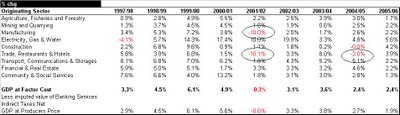
GDP by Industry
[for enlarged version, please click on the picture]
Nepal is obviously an agricultural economy. Agricultural sector makes up more than 2/3rd of the economy (first chart). The simple accounting rule says that the sector has to grow to have the aggregate economy grow fast. The sad thing is that the growth has averaged 3.0% in the past 9 years (second chart). That got to change if Nepal want to see 8.0%+ growth rates like its neighboring India & China.
The other interesting observation is that mining is a very small part of Nepal's economy. I thought give its geological location, it would be rich in minerals, oh well!

[for enlarged version, please click on the picture]
Nepal is obviously an agricultural economy. Agricultural sector makes up more than 2/3rd of the economy (first chart). The simple accounting rule says that the sector has to grow to have the aggregate economy grow fast. The sad thing is that the growth has averaged 3.0% in the past 9 years (second chart). That got to change if Nepal want to see 8.0%+ growth rates like its neighboring India & China.
The other interesting observation is that mining is a very small part of Nepal's economy. I thought give its geological location, it would be rich in minerals, oh well!


Foreign Firms Find Rough Passage to India
Foreign Firms Find Rough Passage to India
Barriers, Rules Taint Allure of Partnerships As Entry Point to Fast-Growing Market
By PETER WONACOTT in New Delhi and ERIC BELLMAN in Mumbai
WSJ, February 1, 2007
International companies including the likes of Wal-Mart Stores Inc. and Fiat SpA are rushing to India through joint ventures with local businesses. But the history of such partnerships offers a warning to newcomers that despite its torrid growth and rising urban middle class, India can be a tough market for foreigners to crack.
This hasn't just hurt those seeking a foothold in this huge and potentially lucrative market. The barriers -- legal, cultural and logistical -- also pose a burden for the Indian economy, depriving it of investment in key areas needed to sustain the country's rapid growth and spread the benefits.
Dozens of ventures forged by foreign and Indian firms have bogged down, and in many cases dissolved, since New Delhi began opening the country's economy in the early 1990s. Some ended because the Indian government has gradually allowed foreign companies to operate alone in some industries. But many others have been hobbled by differences between partners, clashes over expansion plans or the competing interests of the companies.
Danone SA, for instance, is facing resistance from the Wadia Group, its Indian joint-venture partner in the Kolkata-based cookie maker Britannia Industries Ltd. The Wadia Group has taken Danone to court in Mumbai to try to stop the French company from investing in another Indian company on its own. Britannia is 25% owned by the Wadia family and 25% owned by Danone through a holding company in the U.K.; the rest is publicly held. Both sides say the disagreement won't derail their partnership.
Joint ventures remain mandatory for foreign companies looking to enter huge areas of India's fast-growing economy, including retailing, consumer banking, telecommunications and media. The ability of foreign and Indian companies to navigate the potential pitfalls will have a big impact on the momentum of India's rapid expansion. Already, some foreign companies are reluctant to push hard into India because of the poor track record of partnerships.
The world's second-most populous nation after China, with an estimated 300 million of its billion people considered middle class, India's economy has grown an average of 8% in each of the past three years. The Indian government predicts foreign direct investment will hit $12 billion for the fiscal year ending March 31, a fraction of the $69.4 billion of foreign investment in China last year. India needs to attract more money from abroad if it is going to reach its target of $350 billion of public and private infrastructure investment during the next five years.
"Anyone that gets into a joint venture [in India] should assume it will fail and should be comfortable with the terms of what happens when it does fail," says John Band, president of Zoom Cortex, a financial consultancy in Mumbai.
Even Indian companies that once welcomed foreign partners are now reluctant. During the 1990s, Modicorp, a family-controlled Indian conglomerate, lined up alliances with Motorola Inc., Walt Disney Co. and Xerox Corp., among others. Modicorp's chairman, B.K. Modi, earned the moniker "Mr. JV."
Since then, about a dozen of his joint ventures -- including those with the three U.S. companies -- have dissolved either because of government rule changes that meant partnerships were no longer required or because of disagreements with his partners.
Mr. Modi now views joint ventures as a recipe for friction and an obstacle to building Indian brands. He recalls being advised years ago against such set-ups by Azim Premji, founder of Wipro Ltd., the Indian technology giant, because Mr. Premji believed foreign companies would overshadow Indian partners and their fledgling brands. "He said, 'You will regret it,' " Mr. Modi said. "Later, I did."
Of 25 major joint ventures between foreign and Indian companies established from 1993 to 2003, three survived, according to a 2005 study by consultants McKinsey & Co. The study said most ran into trouble because the local partner couldn't invest enough to expand the business quickly to match the ambitions of the foreign company.
Some have worked out well for both sides. In 1984, Japan's Honda Motor Co. joined forces with Indian bicycle maker Hero Cycles Ltd., which is controlled by the Munjal family, to form motorcycle maker Hero Honda Motors Ltd. Honda owns 26% and the Munjal family owns 26% of Hero Honda, and the rest of the company is held by the public. Hero Honda dominates the Indian motorcycle market with a share of about 50%. It builds about three million motorcycles and scooters a year and Hero Honda says it is planning to ramp up capacity to more than five million during the next three years.
But many others have foundered. Guardian Industries of Auburn Hills, Michigan, set up a float-glass plant in India in 1989 with an arm of the Modi family empire. The closely held glassmaker is now embroiled in a case with its financially troubled partner Modi Rubber Ltd. before the Delhi High Court. The government had given Guardian permission to expand in India, despite Modi Rubber's objections, after the rules were changed to allow foreign companies to establish glass factories without partners. But Modi Rubber has thus far stalled the expansion even as Guardian's global competitors arrive.
A spokesman for Guardian declined to comment. V.K Modi, vice chairman of Modi Rubber, didn't respond to written questions seeking comment. B.K. Modi said the dispute is in the process of being resolved.
Many foreign companies, where they can, are splitting from their joint ventures to go it alone. Goldman Sachs Group and Merrill Lynch & Co., have separated from their partners in the past year to set up independent operations after the government eased restrictions in the investment-banking industry. Merrill Lynch bought most of its joint-venture stake in DSP Merrill Lynch for about $500 million. Goldman Sachs sold its stake in its successful joint venture with Kotak Mahindra Bank Ltd. for about $75 million.
But even in areas where the government has relaxed restrictions on foreign investment, existing partnerships continue to create headaches. When a foreign firm seeks to establish an independent unit separate from an existing joint venture, a government rule known as Press Note 1 requires the foreign company to first obtain a "no-objection certificate" from its Indian partner if the independent unit plans to be in the same business.
That has upset the plans of Japanese auto-parts maker Takata Corp. to establish an independent unit in India. Takata in 2000 established a joint venture with Abhishek Auto Industries to make seat belts and power windows. The government no longer limits foreign participation to joint ventures in the industry, but Abhishek has refused to grant Takata permission to proceed with an independent business there, according to Dhiraj Dhar Gupta, a spokesman for Abhishek. A Takata spokesman in Tokyo declined comment.
And in many important sectors, partnerships remain mandatory. Wal-Mart, for instance, has struck a partnership with Bharti Enterprises Ltd., the group that runs one of India's largest wireless-communications network. While Bharti will own the retail stores, which can't be controlled by foreign investors, Wal-Mart will provide the wholesale and logistics support -- two industries in which foreign control is permitted. Wal-Mart rivals Tesco PLC of the U.K. and Carrefour SA of France also are seeking partners in India.
In August, The Wall Street Journal, published by Dow Jones & Co., entered an agreement with HT Media Ltd., the parent company of the Hindustan Times, to provide articles and other content to HT's new business newspaper, Mint, which launches today. An earlier proposed joint venture between Dow Jones and the Times of India newspaper expired in 2004 because anticipated changes in the rules governing foreign ownership of media didn't happen, according to a Dow Jones spokesman in Hong Kong.
A joint venture between Hong Kong's Hutchison Telecommunications Ltd. and the Mumbai-based Ruia family, meanwhile, has been riven by friction to the point where Hutchison has put its stake up for sale. The partners have acknowledged differences, but maintain the potential split is a strategic business decision. Still, the Ruia family's company, Essar, raised eyebrows with moves to create a telecom network outside the joint venture. And Hutchison angered its Indian partner by not informing Essar before it sold a slice of parent Hutchison Telecommunications to Egypt's Orascom Telecom Holdings SAE.
Barriers, Rules Taint Allure of Partnerships As Entry Point to Fast-Growing Market
By PETER WONACOTT in New Delhi and ERIC BELLMAN in Mumbai
WSJ, February 1, 2007
International companies including the likes of Wal-Mart Stores Inc. and Fiat SpA are rushing to India through joint ventures with local businesses. But the history of such partnerships offers a warning to newcomers that despite its torrid growth and rising urban middle class, India can be a tough market for foreigners to crack.
This hasn't just hurt those seeking a foothold in this huge and potentially lucrative market. The barriers -- legal, cultural and logistical -- also pose a burden for the Indian economy, depriving it of investment in key areas needed to sustain the country's rapid growth and spread the benefits.
Dozens of ventures forged by foreign and Indian firms have bogged down, and in many cases dissolved, since New Delhi began opening the country's economy in the early 1990s. Some ended because the Indian government has gradually allowed foreign companies to operate alone in some industries. But many others have been hobbled by differences between partners, clashes over expansion plans or the competing interests of the companies.
Danone SA, for instance, is facing resistance from the Wadia Group, its Indian joint-venture partner in the Kolkata-based cookie maker Britannia Industries Ltd. The Wadia Group has taken Danone to court in Mumbai to try to stop the French company from investing in another Indian company on its own. Britannia is 25% owned by the Wadia family and 25% owned by Danone through a holding company in the U.K.; the rest is publicly held. Both sides say the disagreement won't derail their partnership.
Joint ventures remain mandatory for foreign companies looking to enter huge areas of India's fast-growing economy, including retailing, consumer banking, telecommunications and media. The ability of foreign and Indian companies to navigate the potential pitfalls will have a big impact on the momentum of India's rapid expansion. Already, some foreign companies are reluctant to push hard into India because of the poor track record of partnerships.
The world's second-most populous nation after China, with an estimated 300 million of its billion people considered middle class, India's economy has grown an average of 8% in each of the past three years. The Indian government predicts foreign direct investment will hit $12 billion for the fiscal year ending March 31, a fraction of the $69.4 billion of foreign investment in China last year. India needs to attract more money from abroad if it is going to reach its target of $350 billion of public and private infrastructure investment during the next five years.
"Anyone that gets into a joint venture [in India] should assume it will fail and should be comfortable with the terms of what happens when it does fail," says John Band, president of Zoom Cortex, a financial consultancy in Mumbai.
Even Indian companies that once welcomed foreign partners are now reluctant. During the 1990s, Modicorp, a family-controlled Indian conglomerate, lined up alliances with Motorola Inc., Walt Disney Co. and Xerox Corp., among others. Modicorp's chairman, B.K. Modi, earned the moniker "Mr. JV."
Since then, about a dozen of his joint ventures -- including those with the three U.S. companies -- have dissolved either because of government rule changes that meant partnerships were no longer required or because of disagreements with his partners.
Mr. Modi now views joint ventures as a recipe for friction and an obstacle to building Indian brands. He recalls being advised years ago against such set-ups by Azim Premji, founder of Wipro Ltd., the Indian technology giant, because Mr. Premji believed foreign companies would overshadow Indian partners and their fledgling brands. "He said, 'You will regret it,' " Mr. Modi said. "Later, I did."
Of 25 major joint ventures between foreign and Indian companies established from 1993 to 2003, three survived, according to a 2005 study by consultants McKinsey & Co. The study said most ran into trouble because the local partner couldn't invest enough to expand the business quickly to match the ambitions of the foreign company.
Some have worked out well for both sides. In 1984, Japan's Honda Motor Co. joined forces with Indian bicycle maker Hero Cycles Ltd., which is controlled by the Munjal family, to form motorcycle maker Hero Honda Motors Ltd. Honda owns 26% and the Munjal family owns 26% of Hero Honda, and the rest of the company is held by the public. Hero Honda dominates the Indian motorcycle market with a share of about 50%. It builds about three million motorcycles and scooters a year and Hero Honda says it is planning to ramp up capacity to more than five million during the next three years.
But many others have foundered. Guardian Industries of Auburn Hills, Michigan, set up a float-glass plant in India in 1989 with an arm of the Modi family empire. The closely held glassmaker is now embroiled in a case with its financially troubled partner Modi Rubber Ltd. before the Delhi High Court. The government had given Guardian permission to expand in India, despite Modi Rubber's objections, after the rules were changed to allow foreign companies to establish glass factories without partners. But Modi Rubber has thus far stalled the expansion even as Guardian's global competitors arrive.
A spokesman for Guardian declined to comment. V.K Modi, vice chairman of Modi Rubber, didn't respond to written questions seeking comment. B.K. Modi said the dispute is in the process of being resolved.
Many foreign companies, where they can, are splitting from their joint ventures to go it alone. Goldman Sachs Group and Merrill Lynch & Co., have separated from their partners in the past year to set up independent operations after the government eased restrictions in the investment-banking industry. Merrill Lynch bought most of its joint-venture stake in DSP Merrill Lynch for about $500 million. Goldman Sachs sold its stake in its successful joint venture with Kotak Mahindra Bank Ltd. for about $75 million.
But even in areas where the government has relaxed restrictions on foreign investment, existing partnerships continue to create headaches. When a foreign firm seeks to establish an independent unit separate from an existing joint venture, a government rule known as Press Note 1 requires the foreign company to first obtain a "no-objection certificate" from its Indian partner if the independent unit plans to be in the same business.
That has upset the plans of Japanese auto-parts maker Takata Corp. to establish an independent unit in India. Takata in 2000 established a joint venture with Abhishek Auto Industries to make seat belts and power windows. The government no longer limits foreign participation to joint ventures in the industry, but Abhishek has refused to grant Takata permission to proceed with an independent business there, according to Dhiraj Dhar Gupta, a spokesman for Abhishek. A Takata spokesman in Tokyo declined comment.
And in many important sectors, partnerships remain mandatory. Wal-Mart, for instance, has struck a partnership with Bharti Enterprises Ltd., the group that runs one of India's largest wireless-communications network. While Bharti will own the retail stores, which can't be controlled by foreign investors, Wal-Mart will provide the wholesale and logistics support -- two industries in which foreign control is permitted. Wal-Mart rivals Tesco PLC of the U.K. and Carrefour SA of France also are seeking partners in India.
In August, The Wall Street Journal, published by Dow Jones & Co., entered an agreement with HT Media Ltd., the parent company of the Hindustan Times, to provide articles and other content to HT's new business newspaper, Mint, which launches today. An earlier proposed joint venture between Dow Jones and the Times of India newspaper expired in 2004 because anticipated changes in the rules governing foreign ownership of media didn't happen, according to a Dow Jones spokesman in Hong Kong.
A joint venture between Hong Kong's Hutchison Telecommunications Ltd. and the Mumbai-based Ruia family, meanwhile, has been riven by friction to the point where Hutchison has put its stake up for sale. The partners have acknowledged differences, but maintain the potential split is a strategic business decision. Still, the Ruia family's company, Essar, raised eyebrows with moves to create a telecom network outside the joint venture. And Hutchison angered its Indian partner by not informing Essar before it sold a slice of parent Hutchison Telecommunications to Egypt's Orascom Telecom Holdings SAE.
Friday, February 02, 2007
Roundup of Economic & Business News (Jan 26 - Feb 2)
Jan 28
Stock market cools (eKantipur.com)
Gold price climbs, rupee gains (eKantipur.com)
Frost freezes farmers' earnings (eKantipur.com)
South Korea to permit Nepali workers (Nepalnews.com)
‘Economy must now get priority’ (The Himalayan Times)
Jan 29
Nepal in for round-the-year power cuts (eKantipur.com)
S. Korea likely to enlist Nepal as source country (Nepalbiznews.com)
“Village should be the priority of development” (Nepalbiznews.com)
NEA to impose up to 12 hours of load shedding daily by April (Nepalbiznews.com)
IOC threatens Nepal of cutting fuel supply Biz News (Nepalbiznews.com)
6-hour per day load shedding from mid-February (Nepalnews.com)
Commentary
Milk consumers not getting value for money (Interview) (eKantipur.com)
Jan 30
Extra flights fail to rescue stranded passengers (eKantipur.com)
Terai unrest worsens petrol shortage (eKantipur.com)
NEPSE suspends trading of NCC Bank (eKantipur.com)
Petrol shortage in capital, eastern and mid regions (Nepalbiznews.com)
Nepalgunj riots damaged property worth over Rs. 78 m: Report (Nepalbiznews.com)
Nepal gets its ‘commodities exchange’ (The Himalayan Times)
Jan 31
Car-crazy Catmandu (eKantipur.com)
Terai agitation cripples industries (eKantipur.com)
NT's Mahottari branch closes counter (eKantipur.com)
Petroleum dealers seek clearance of dues (eKantipur.com)
Commentary
Foreign employment in South Korea (eKantipur.com)
Feb 1
Banda cripples life in eastern districts (eKantipur.com)
Melamchi cost may drop by $94m (eKantipur.com)
NPC allocates Rs 63b for reconstruction (eKantipur.com)
SAARC countries to launch regional stock index (eKantipur.com)
BIMSTEC meet on easing travel from today (eKantipur.com)
Manpower agencies closed in protest (eKantipur.com)
Terai Unrest renders 4 hundreds industries closed in eastern Nepal (Nepalbiznews.com)
NT turns mobile phones hi-tech (The Himalayan Times)
BizNews Brief (IME in forex trading, Baglung Fair-2063) (The Himalayan Times)
Commentary
Globalization and higher education in India (eKantipur.com)
Is Nepal suffering from capital flight? (The Himalayan Times)
Feb 2
Fuel shortage worsens in Valley (eKantipur.com)
UTL to expand mobile coverage (eKantipur.com)
Cathay Pacific to start flights to Nepal (eKantipur.com)
Stone suppliers evade revenue in Kapilwastu Biz News (Nepalbiznews.com)
Stock market cools (eKantipur.com)
Gold price climbs, rupee gains (eKantipur.com)
Frost freezes farmers' earnings (eKantipur.com)
South Korea to permit Nepali workers (Nepalnews.com)
‘Economy must now get priority’ (The Himalayan Times)
Jan 29
Nepal in for round-the-year power cuts (eKantipur.com)
S. Korea likely to enlist Nepal as source country (Nepalbiznews.com)
“Village should be the priority of development” (Nepalbiznews.com)
NEA to impose up to 12 hours of load shedding daily by April (Nepalbiznews.com)
IOC threatens Nepal of cutting fuel supply Biz News (Nepalbiznews.com)
6-hour per day load shedding from mid-February (Nepalnews.com)
Commentary
Milk consumers not getting value for money (Interview) (eKantipur.com)
Jan 30
Extra flights fail to rescue stranded passengers (eKantipur.com)
Terai unrest worsens petrol shortage (eKantipur.com)
NEPSE suspends trading of NCC Bank (eKantipur.com)
Petrol shortage in capital, eastern and mid regions (Nepalbiznews.com)
Nepalgunj riots damaged property worth over Rs. 78 m: Report (Nepalbiznews.com)
Nepal gets its ‘commodities exchange’ (The Himalayan Times)
Jan 31
Car-crazy Catmandu (eKantipur.com)
Terai agitation cripples industries (eKantipur.com)
NT's Mahottari branch closes counter (eKantipur.com)
Petroleum dealers seek clearance of dues (eKantipur.com)
Commentary
Foreign employment in South Korea (eKantipur.com)
Feb 1
Banda cripples life in eastern districts (eKantipur.com)
Melamchi cost may drop by $94m (eKantipur.com)
NPC allocates Rs 63b for reconstruction (eKantipur.com)
SAARC countries to launch regional stock index (eKantipur.com)
BIMSTEC meet on easing travel from today (eKantipur.com)
Manpower agencies closed in protest (eKantipur.com)
Terai Unrest renders 4 hundreds industries closed in eastern Nepal (Nepalbiznews.com)
NT turns mobile phones hi-tech (The Himalayan Times)
BizNews Brief (IME in forex trading, Baglung Fair-2063) (The Himalayan Times)
Commentary
Globalization and higher education in India (eKantipur.com)
Is Nepal suffering from capital flight? (The Himalayan Times)
Feb 2
Fuel shortage worsens in Valley (eKantipur.com)
UTL to expand mobile coverage (eKantipur.com)
Cathay Pacific to start flights to Nepal (eKantipur.com)
Stone suppliers evade revenue in Kapilwastu Biz News (Nepalbiznews.com)
Is Nepal suffering from capital flight?
Is Nepal suffering from capital flight?
Prakriti Prasad
The Himalayan Times, Feb 1 2007
Stories of royalists, armymen and a powerful section of the business community siphoning off money from Nepal for investments outside the country have been doing the rounds in recent times.
While the fear of confiscation of property post the Jan Andolan II period is understood to be the reason behind royalists routing their money out of Nepal, continuing insecurity, extortions and rising labour problems apparently are goading the business community to invest abroad, primarily to India.
Although an accepted fact by most industry insiders, capital flight from Nepal remains a hush-hush affair.
The Act on Prohibition of Investment Abroad ensures ‘not a single penny can be invested outside without the permission of the Central Bank,’ points out Ram Prasad Adhikari, executive director of the research wing of the Nepal Rastra Bank. “Even to open liaison offices outside Nepal, NRB’s permission is mandatory,” he adds.
Interestingly, while the NRB official maintains there’s no evidence of capital flight from Nepal, the market is full of stories about Nepali business houses setting up construction and real estate interests in Dubai, hotels in Colombo and Maldives, steel factory in Orissa or a noodle factory in Sikkim. Some travel entrepreneurs are said to have invested even in restaurants in Delhi.
Most of these investments are apparently being made in the name of relatives or using dual citizenship, in case of India as marriages between Indians and Nepalis is an old practice.
According to insiders, while the pace of investments outside Nepal was very high till about six months back, it may have come down after the peace accord.
“Till about 10 months back the scenario was totally negative. But now we can see light at the end of the tunnel as we are moving towards stable politics,” quips Rajendra Khetan, director Khetan group.
What about his company’s plans to set up a factory of Mayo’s noodles in India? “Certainly not without proper clearance,” Khetan answers.
“We plan to come up with a noodles factory in Bhairahawa to cater to western Nepal as well as bordering Indian markets. While we are looking at setting up banking and insurance branches in India with due permission from both governments, in the manufacturing sector we feel there is ample scope for diversification within Nepal,” he adds.
Given the opportunity, the company would be keen to set up a noodles factory in Delhi or north India, confesses Khetan.
“All that we are asking of the government is to guarantee peace and a safe working environment, and we will ensure the country grows at a double digit,” gushes Shekhar Golchha, executive director, Golcha organisation which employs 13,000 people and claims to be the largest employers after the government of Nepal.
While Golchha concedes almost everybody is exploring opportunities outside Nepal, he claims to be a strong believer in the huge potentials of this economy.
“After this transition phase, we are bound to hit a golden period,” he says, “Doing business in Nepal is a different ball game as there are better returns on investment here unlike other countries.”
Even as most businessmen are optimistic about Nepal’s future and predict a 90 per cent de-escalation in insurgency in the next three months and solution to the Tarai problem, others are busy shifting their business interests to India.
“There’s been no talk on economic agenda or sustainable development in the past six months,” says one on condition of anonymity.
Another claims, “For businessmen, there can be no barriers. The Nepali market is not a competitive one as the size of the market is so small. There’s no market for industrial investments which explains why there are so few multi-nationals here.”
Meanwhile, NRB’s Adhikari feels the sense of restlessness in the business community abut operating in a restricted market has been sensed by the government.
“The government will be seriously thinking of liberalising its policies to allow at least limited amounts of investment abroad,” he points out.
Prakriti Prasad
The Himalayan Times, Feb 1 2007
Stories of royalists, armymen and a powerful section of the business community siphoning off money from Nepal for investments outside the country have been doing the rounds in recent times.
While the fear of confiscation of property post the Jan Andolan II period is understood to be the reason behind royalists routing their money out of Nepal, continuing insecurity, extortions and rising labour problems apparently are goading the business community to invest abroad, primarily to India.
Although an accepted fact by most industry insiders, capital flight from Nepal remains a hush-hush affair.
The Act on Prohibition of Investment Abroad ensures ‘not a single penny can be invested outside without the permission of the Central Bank,’ points out Ram Prasad Adhikari, executive director of the research wing of the Nepal Rastra Bank. “Even to open liaison offices outside Nepal, NRB’s permission is mandatory,” he adds.
Interestingly, while the NRB official maintains there’s no evidence of capital flight from Nepal, the market is full of stories about Nepali business houses setting up construction and real estate interests in Dubai, hotels in Colombo and Maldives, steel factory in Orissa or a noodle factory in Sikkim. Some travel entrepreneurs are said to have invested even in restaurants in Delhi.
Most of these investments are apparently being made in the name of relatives or using dual citizenship, in case of India as marriages between Indians and Nepalis is an old practice.
According to insiders, while the pace of investments outside Nepal was very high till about six months back, it may have come down after the peace accord.
“Till about 10 months back the scenario was totally negative. But now we can see light at the end of the tunnel as we are moving towards stable politics,” quips Rajendra Khetan, director Khetan group.
What about his company’s plans to set up a factory of Mayo’s noodles in India? “Certainly not without proper clearance,” Khetan answers.
“We plan to come up with a noodles factory in Bhairahawa to cater to western Nepal as well as bordering Indian markets. While we are looking at setting up banking and insurance branches in India with due permission from both governments, in the manufacturing sector we feel there is ample scope for diversification within Nepal,” he adds.
Given the opportunity, the company would be keen to set up a noodles factory in Delhi or north India, confesses Khetan.
“All that we are asking of the government is to guarantee peace and a safe working environment, and we will ensure the country grows at a double digit,” gushes Shekhar Golchha, executive director, Golcha organisation which employs 13,000 people and claims to be the largest employers after the government of Nepal.
While Golchha concedes almost everybody is exploring opportunities outside Nepal, he claims to be a strong believer in the huge potentials of this economy.
“After this transition phase, we are bound to hit a golden period,” he says, “Doing business in Nepal is a different ball game as there are better returns on investment here unlike other countries.”
Even as most businessmen are optimistic about Nepal’s future and predict a 90 per cent de-escalation in insurgency in the next three months and solution to the Tarai problem, others are busy shifting their business interests to India.
“There’s been no talk on economic agenda or sustainable development in the past six months,” says one on condition of anonymity.
Another claims, “For businessmen, there can be no barriers. The Nepali market is not a competitive one as the size of the market is so small. There’s no market for industrial investments which explains why there are so few multi-nationals here.”
Meanwhile, NRB’s Adhikari feels the sense of restlessness in the business community abut operating in a restricted market has been sensed by the government.
“The government will be seriously thinking of liberalising its policies to allow at least limited amounts of investment abroad,” he points out.
Thursday, February 01, 2007
Financial Sector FDI and Host Countries: New and Old Lessons
Financial Sector FDI and Host Countries: New and Old Lessons
Linda S. Goldberg
New York Fed, Jan 2007
The 1990s saw a dramatic rise in foreign direct investment (FDI) into the financial sectors of emerging economies. Many of these countries consequently had banking sectors owned largely by foreign institutions.
An understanding of how financial sector FDI affects host markets is crucial for countries formulating policy with respect to foreign banks, observes author Goldberg. However, there is relatively little research on the topic.
The author suggests that studies on “real-side” FDI—investment into manufacturing and primary resource industries—offer insight that also applies to the financial sectors of host countries. The implications of real-side FDI into emerging markets are well documented by research.
Goldberg’s analysis of the literature finds that foreign direct investment generally has positive effects on host countries, with some effects being particularly notable in financial service industries. Among the findings supporting her conclusion are:
* FDI is typically associated with improved allocative efficiency when, for example, foreign investors enter industries with high entry barriers and then reduce local monopolistic distortions. The presence of foreign producers can also increase technical efficiency, as heightened competition may spur local firms to use existing resources more effectively.
* Higher rates of technology transfer and higher wages can be linked to FDI. While there is evidence of technological improvements from FDI and a presumption that such investment will stimulate growth, the strength of these effects is disputed. In addition, FDI into host countries can lead to higher wages, although these effects are limited to foreign-owned production facilities and do not spill over more broadly.
* Foreign direct investment by well-regulated and well-supervised countries can support emerging market institutional development and governance, improve a host country’s mix of financial services and risk management tools, and potentially reduce the incidence of sharp crises associated with financial underdevelopment in emerging markets.
For full article, please click here.
Linda S. Goldberg
New York Fed, Jan 2007
The 1990s saw a dramatic rise in foreign direct investment (FDI) into the financial sectors of emerging economies. Many of these countries consequently had banking sectors owned largely by foreign institutions.
An understanding of how financial sector FDI affects host markets is crucial for countries formulating policy with respect to foreign banks, observes author Goldberg. However, there is relatively little research on the topic.
The author suggests that studies on “real-side” FDI—investment into manufacturing and primary resource industries—offer insight that also applies to the financial sectors of host countries. The implications of real-side FDI into emerging markets are well documented by research.
Goldberg’s analysis of the literature finds that foreign direct investment generally has positive effects on host countries, with some effects being particularly notable in financial service industries. Among the findings supporting her conclusion are:
* FDI is typically associated with improved allocative efficiency when, for example, foreign investors enter industries with high entry barriers and then reduce local monopolistic distortions. The presence of foreign producers can also increase technical efficiency, as heightened competition may spur local firms to use existing resources more effectively.
* Higher rates of technology transfer and higher wages can be linked to FDI. While there is evidence of technological improvements from FDI and a presumption that such investment will stimulate growth, the strength of these effects is disputed. In addition, FDI into host countries can lead to higher wages, although these effects are limited to foreign-owned production facilities and do not spill over more broadly.
* Foreign direct investment by well-regulated and well-supervised countries can support emerging market institutional development and governance, improve a host country’s mix of financial services and risk management tools, and potentially reduce the incidence of sharp crises associated with financial underdevelopment in emerging markets.
For full article, please click here.
Subscribe to:
Posts (Atom)