The key political developments were
a) Promulgation of the Interim Constitution – 2063 on January 15.
b) The onset of unrest and violence in terai region led by the Madhesi People's Right Forum (MPRF) following the promulgation of the interim constitution.
c) The dissolution of Maoists’ People’s Government on January 18.
The key economic developments were
a) The actuate shortage of electric power in the country leading to record amount of load shedding.
b) Dismal economic news – worsening trade balance, declining foreign employment and lack of FDI – continues unabated.
c) Political instability continues to wreck havoc on Nepal’s economy. On the inaugural day of “Visit Pokhara Year”, there was chakka jam in Pokhara and parts of Pritivi highway. The National Federation of Nepal Transport Entrepreneurs froze the nation’s highways with 3-day long transportation strke.
d) On the positive news, “Nepal Telecom (NT) is planning to distribute an additional 3.5 million mobile phone lines in the country within the next three years, thereby tripling the total teledensity to 16 lines per 100 people” and Nepal opened its first commodity exchange.
Key Political News
Prachanda directs cadres to allow police, VDC secys in villages (Jan 03, 2007)
Three royalist groups unite (Jan 10, 2007)
Eights parties 'agree' to share 48 parliamentary seats (Jan 10, 2007)
Maoists choose their MPs for interim parliament (Jan 12, 2007)
Jwala Singh demands separate, independent Terai state (Jan 15, 2007)
HoR promulgates interim constitution, dissolves itself (Jan 15, 2007)
MPRF protest interim constitution; calls Madhesh bandh (Jan 16, 2007)
Over two dozen MPRF activists arrested in the capital (Jan 16, 2007)
Nemwang, Yadav to remain Speaker, Dy Speaker; Maoists to get senior DPM's post (Jan 17, 2007)
Government releases Rs. 70 million to Maoists (Jan 18, 2007)
Maoists announce to dissolve all of their people's govt units (Jan 18, 2007)
Prime Minister will administer oath of office to Chief Justice (Jan 18, 2007)
CPN-UML elects Nepal as party leader in interim legislature (Jan 18, 2007)
Madhesi activists call indefinite vehicular strike in Janakpur (Jan 18, 2007)
One killed in Lahan over MPRF protests, administration clamps curfew (Jan 19, 2007)
Voters' registration to begin from January 23 (Jan 20, 2007)
12-hour curfew imposed in Lahan as unrest continues (Jan 22, 2007)
Koirala re-elected as NC parliamentary leader (Jan 23, 2007)
MJF protesters shut down Biratnagar (Jan 24, 2007)
Curfew clamped in Janakpur (Jan 24, 2007)
Government to remove King’s picture from notes (Jan 25, 2007)
Curfew clamped in Birgunj, Biratnagar, Janakpur and Siraha (Jan 25, 2007)
Rautahat tense; Madhav Nepal’s ancestral house vandalised (Jan 26, 2007)
Terai unrest may delay CA polls: CEC Pokhrel (Jan 27, 2007)
Curfew re-imposed in Birgunj, Lahan; bandh hits life in Terai districts (Jan 27, 2007)
Indigenous community expresses solidarity with Madhesi movement (Jan 28, 2007)
Curfew imposed in Gaur; protests continue in terai (Jan 28, 2007)
Another protester killed in police firing in Bara (Jan 28, 2007)
Janakpur, Birgunj and Kalaiya under curfew (Jan 29, 2007)
Tripathy resigns amid Terai crisis (Jan 29, 2007)
One protester killed in Biratnagar; curfew imposed (Jan 30, 2007)
Thapa, Mandal arrested for 'instigating' violence in Terai; other royalists under watch (Jan 30, 2007)
Bandh hits normal life in eastern districts (Jan 31, 2007)
Police Sub-inspector, protester killed in Biratnagar (Jan 31, 2007)
PM calls for talks to resolve all problems; Nepal will have federal system after CA polls (Jan 31, 2007)
Key Business News
Mid Marsyangdi builder issues notice to resume work (Jan 5, 2007)
NT acquires bandwidth from Indian firms (Jan 6, 2007)
Power cuts 8 hrs a week (Jan 7, 2007)
Business registration to go online (Jan 9, 2007)
NT reduces Internet tariff by 83 pc (Jan 11, 2007)
NEA to issue bonds to raise fund (Jan 12, 2007)
Chilime power plant resumes operation (Jan 12, 2007)
High-level committee for PEs privatization (Jan 18, 2007)
Export slips, import grows in first four month: NRB (Jan 18, 2007)
Foreign employment declines by 5 pc (Jan 19, 2007)
Transport entrepreneurs call nationwide strike (Jan 22, 2007)
FDI commitment nosedives by 80 pc (Jan 22, 2007)
NT to distribute 3.5m mobile lines by 2010 (Jan 24, 2007)
Transporters end their strike (Jan 24, 2007)
3 hrs per day power cut from Friday (Jan 25, 2007)
South Korea to permit Nepali workers (Jan 28, 2007)
Nepal in for round-the-year power cuts (Jan 29, 2007)
Terai unrest worsens petrol shortage (Jan 30, 2007)
Nepal gets its ‘commodities exchange’ (Jan 30, 2007)
Terai agitation cripples industries (Jan 31, 2007)
Wednesday, January 31, 2007

Saturday, January 27, 2007
Weekly Data Highlight
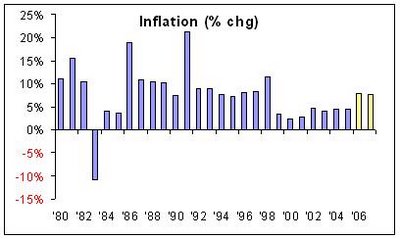
Macro Indicators [GDP growth, Inflation, Current Account Balance)
[for enlarged version, please click on the picture]
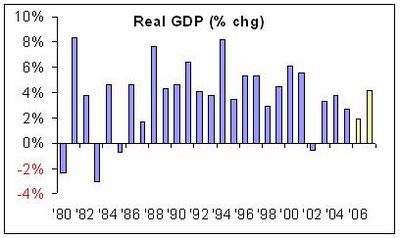
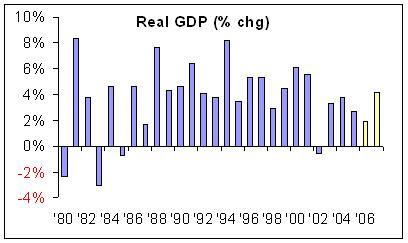
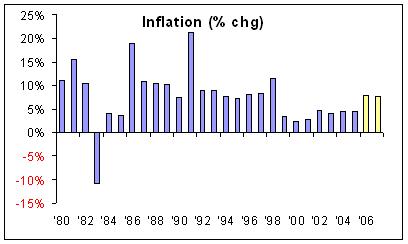
Nepal's economy seems to be stabilizing following massive political upheaval post-2001 Royal massacre. The IMF expects the real GDP to grow at 1.9% in 2006 and 4.2% in 2007. For a country as small and as poor as Nepal (GDP per capita of $322 in 2005), such "Hindu rate of growth" is unacceptable. If large economies like India and China can achieve double-digit growth rates, Nepal certainly can!!!
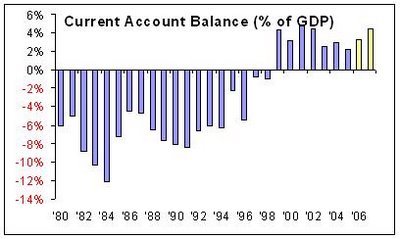
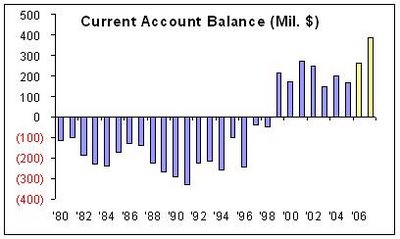
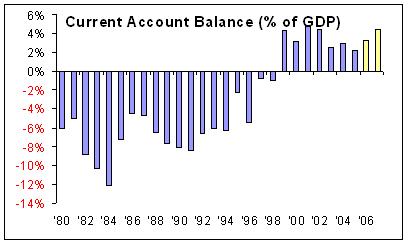
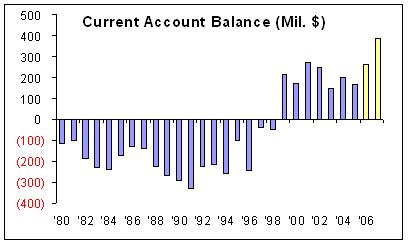
Nepal's current account balance shows that the country is a remittance-based economy. According to the IMF, current account surplus is going to reach 4.5% of GDP in 2007. Given that Nepal is running a huge trade deficit in goods (see Government secretary expresses concern over huge trade deficit) it must be the service sector trade (i.e. foreign remittances) that's bailing her out. But how sustainable is that in the long-run?
[for enlarged version, please click on the picture]
Nepal's economy seems to be stabilizing following massive political upheaval post-2001 Royal massacre. The IMF expects the real GDP to grow at 1.9% in 2006 and 4.2% in 2007. For a country as small and as poor as Nepal (GDP per capita of $322 in 2005), such "Hindu rate of growth" is unacceptable. If large economies like India and China can achieve double-digit growth rates, Nepal certainly can!!!
Nepal's current account balance shows that the country is a remittance-based economy. According to the IMF, current account surplus is going to reach 4.5% of GDP in 2007. Given that Nepal is running a huge trade deficit in goods (see Government secretary expresses concern over huge trade deficit) it must be the service sector trade (i.e. foreign remittances) that's bailing her out. But how sustainable is that in the long-run?
Friday, January 26, 2007
Roundup of Economic & Business News (Jan 20 - Jan 26)
Jan 20
NT to introduce WCDMA, GPRS (eKantipur.com)
Govt to double investment on infrastructure (eKantipur.com)
ADBL to issue shares this year (eKantipur.com)
VDCs wait for telephone extended (The Himalayan Times)
Jan 21
Cold takes toll of potato farming (eKantipur.com)
Rupee firms against dollar, gold dips` (eKantipur.com)
NATO denounces transport strike (Nepalbiznews.com)
Vehicular standstill cripples life across the nation (Nepalbiznews.com)
Fresh legislation on customs on anvil (The Himalayan Times)
Jan 22
Chakkajam brings nation to a halt (eKantipur.com)
Pro-Maoist unions lock Dhulikhel hotels (eKantipur.com)
Yamaha's new showroom in Kantipath (eKantipur.com)
Commentary
Country needs more development banks (Interview with Dr Bhola Nath Chalise) (eKantipur.com)
‘RBB: A bank of opportunity’ (Interview with Bruce F Henderson) (eKantipur.com)
Jan 23
FDI commitment nosedives by 80 pc (eKantipur.com)
Hotels in Dhulikhel reopen (eKantipur.com)
Imported rice irks Nepali farmers (eKantipur.com)
‘Prioritize energy sector’ (eKantipur.com)
Makwanpur exports leap (eKantipur.com)
BizNews Brief (Sky shoes in market, Nepal-Ireland chamber of commerce established, NATO condemns strikes) (eKantipur.com)
Entrepreneurs end transport strike (Nepalbiznews.com)
Jan 24
NT to distribute 3.5m mobile lines by 2010 (eKantipur.com)
Banks asked to enter rural areas (eKantipur.com)
Tatopani Customs opens as strike ends (Nepalnews.com)
FM Dr Mahat happy over RBB reforms (The Himalayan Times)
Jan 25
Nepali movies of benchmark standards launched (eKantipur.com)
3 hrs per day power cut from Friday (eKantipur.com)
Transport entrepreneurs clinch major gains (eKantipur.com)
Maoists ask farmers not to repay loans (eKantipur.com)
BizNews Brief (FNCCI, Labor Court sign MoU, MTA concerned over strikes) (eKantipur.com)
Power cut duration extended by 13 hours per week (Nepalbiznews.com)
New notes to feather Buddha (Nepalbiznews.com)
Government secretary expresses concern over huge trade deficit (Nepalnews.com)
Indian assistance of 5.1 crore (Nepalnews.com)
‘Tourism sector needs satellite accounting’ (The Himalayan Times)
Cargo trucks stranded at Biratnagar (The Himalayan Times)
Joint efforts urged to curb unofficial trade (The Himalayan Times)
Commentary
Promote FDI (eKantipur.com)
Jan 26
NOC loss lessens to Rs 5.4m (eKantipur.com)
Nepal-Pak sign a document on agriculture development (Nepalbiznews.com)
NEA imposes crippling hours of load shedding (Nepalnews.com)
Commentary
Labor market distortion (eKantipur.com)
NT to introduce WCDMA, GPRS (eKantipur.com)
Govt to double investment on infrastructure (eKantipur.com)
ADBL to issue shares this year (eKantipur.com)
VDCs wait for telephone extended (The Himalayan Times)
Jan 21
Cold takes toll of potato farming (eKantipur.com)
Rupee firms against dollar, gold dips` (eKantipur.com)
NATO denounces transport strike (Nepalbiznews.com)
Vehicular standstill cripples life across the nation (Nepalbiznews.com)
Fresh legislation on customs on anvil (The Himalayan Times)
Jan 22
Chakkajam brings nation to a halt (eKantipur.com)
Pro-Maoist unions lock Dhulikhel hotels (eKantipur.com)
Yamaha's new showroom in Kantipath (eKantipur.com)
Commentary
Country needs more development banks (Interview with Dr Bhola Nath Chalise) (eKantipur.com)
‘RBB: A bank of opportunity’ (Interview with Bruce F Henderson) (eKantipur.com)
Jan 23
FDI commitment nosedives by 80 pc (eKantipur.com)
Hotels in Dhulikhel reopen (eKantipur.com)
Imported rice irks Nepali farmers (eKantipur.com)
‘Prioritize energy sector’ (eKantipur.com)
Makwanpur exports leap (eKantipur.com)
BizNews Brief (Sky shoes in market, Nepal-Ireland chamber of commerce established, NATO condemns strikes) (eKantipur.com)
Entrepreneurs end transport strike (Nepalbiznews.com)
Jan 24
NT to distribute 3.5m mobile lines by 2010 (eKantipur.com)
Banks asked to enter rural areas (eKantipur.com)
Tatopani Customs opens as strike ends (Nepalnews.com)
FM Dr Mahat happy over RBB reforms (The Himalayan Times)
Jan 25
Nepali movies of benchmark standards launched (eKantipur.com)
3 hrs per day power cut from Friday (eKantipur.com)
Transport entrepreneurs clinch major gains (eKantipur.com)
Maoists ask farmers not to repay loans (eKantipur.com)
BizNews Brief (FNCCI, Labor Court sign MoU, MTA concerned over strikes) (eKantipur.com)
Power cut duration extended by 13 hours per week (Nepalbiznews.com)
New notes to feather Buddha (Nepalbiznews.com)
Government secretary expresses concern over huge trade deficit (Nepalnews.com)
Indian assistance of 5.1 crore (Nepalnews.com)
‘Tourism sector needs satellite accounting’ (The Himalayan Times)
Cargo trucks stranded at Biratnagar (The Himalayan Times)
Joint efforts urged to curb unofficial trade (The Himalayan Times)
Commentary
Promote FDI (eKantipur.com)
Jan 26
NOC loss lessens to Rs 5.4m (eKantipur.com)
Nepal-Pak sign a document on agriculture development (Nepalbiznews.com)
NEA imposes crippling hours of load shedding (Nepalnews.com)
Commentary
Labor market distortion (eKantipur.com)
Wednesday, January 24, 2007
Personality - Mahesh Chandra Regmi
The death of a People’s Historian
by Pratyoush Onta
Himal Magazine, circa 2003
Mahesh Chandra Regmi, one of Nepal’s fore most historians, died in the early hours of 10 July 2003. Born in Kathmandu in December 1929 to a family of musicians (who played the sitar), Regmi obtained school level education at home before completing four years of BA education at Kathmandu’s Trichandra College, then affiliated with Patna University. After trying out his hand in book and cloth trade in Calcutta, Regmi returned to Nepal just before the end of the Rana regime in February 1951. He began his professional life with the Nepali government in the immediate aftermath of the demise of the Rana oligarchy. He worked for the Department of Industries for several years before being dismissed for unspecified reasons in late 1955. Looking for something to do, he met an American academic who was researching the agricultural system of Nepal and was looking for someone to translate some documents into English. In an interview done in August 1992 by the German anthropologist Martin Gaenszle, Regmi recalled, “These were mainly reports of the land reforms commission of 1952-53. I tried to translate them and I got interested in this thing, one thing led to another and in 1957 I started this thing”. The ‘thing’ he was referring to was the Regmi Research Centre Pvt Ltd.
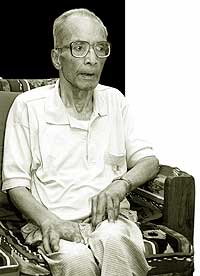 As the University of California scholar Leo E Rose remarked in the mid-1970s, Regmi’s decision to start a private research centre, “was almost inconceivable in Nepal at that time”, especially because there were no “assured sources of financial support from either the government of Nepal, a Nepali educational institution, or a foreign foundation”. Regmi’s initiative, Rose continued, “was indicative not only of a proclivity for entrepreneurship rare in Nepal but also of an independence of mind and a dedication to scholarship”. In the 46 years between taking that important decision and his death, Regmi demonstrated that independence and dedication with ample evidence. He contributed immensely to the field of historical research in Nepal, a field in which he had arrived accidentally and for which he was not formally trained.
Regmi functioned as a solitary historian at the Regmi Research Centre (sometimes called Institute), administratively helped by a small group of non-academic assistants, including, in the later years, his brother Rabish C Regmi and son Suresh C Regmi. Individuals such as Shankar M Amatya and Krishna M Arjyal helped Regmi go through thousands of documents held at the Records Office (‘Lagat Phant’) of the Department of Land Revenue in the Ministry of Finance, the Ministry of Foreign Affairs, the library of the Ministry of Law and Justice, the Department of Survey, offices under the Guthi Corporation which look after the lands that once paid for the upkeep of Kathmandu’s temples and other public structures, and the Pashupati-nath Temple. Documents from the above-mentioned sources were collected most intensively in the 1960s and the 1970s and were transcribed into thick volumes. These volumes, which were later referred to as the Regmi Research Collections, filled up the shelf space in his study and became Regmi’s personal archive based on which he produced 14 books on the economic and political history of 18th and 19th century Nepal.
The first of these books was Some Aspects of Land Reform in Nepal (1960). It was followed by the four-volume study entitled Land Tenure and Taxation in Nepal (1963, 1964, 1965, 1968, Institute of International Studies, University of California at Berkeley; reprinted in a single volume in 1978 by Ratna Pustak Bhandar, Kathmandu). In 1971, Regmi published “A Study in Nepali Economic History 1768-1846” in the Bibliotheca Himalayica series (started by late HK Kuloy) of the Manjusri Publishing House and five years later, the University of California Press published his Landownership in Nepal. These two works along with the earlier four-volume study established Regmi as a world-class scholar and in 1977 he became the first Nepali to receive the Ramon Magsaysay Award, receiving it for the “journalism, literature, and creative communication arts” category. The award was granted to him in recognition of his “chronicling of Nepal’s past and present, enabling his people to discover their origins and delineating national options”.
Regmi published two books in the next two years: Thatched Huts & Stucco Palaces: Peasants and Landlords in 19th Century Nepal (1978, Vikas) and Readings in Nepali Economic History (1979, Kishor Vidya Niketan). In the decade of the 1980s, he published The State and Economic Surplus (1984, Nath Publishing House) and An Economic History of Nepal, 1846-1901 (1988, Nath Publishing House). In the following decade Regmi published Kings and Political Leaders of the Gorkhali Empire 1768-1814 (1995, Orient Long-man), and Imperial Gorkha: An Account of Gorkhali Rule in Kumaun 1791-1815 (1999, Adroit). His last book Nepal: An Historical Miscellany (2002, Adroit) is a collection of various primary and secondary texts, translated into English from the original Nepali with additional commentary. At least ten of Regmi’s books are of outstanding quality and it is certain that they will continue to be the most influential texts of economic history of 18th and 19th century Nepal for at least another generation.
Contributions to Nepali History
In the aftermath of the end of the Rana regime in 1951, historical studies of Nepal had emerged from a variety of knowledge-production sites. The dominant trend was to write political history, a situation that was no different than in the rest of the Subcontinent or elsewhere. It was only in the 1960s that history-writing internationally broke away from an obsession with narrowly-defined political history as the subject of historical inquiry. Regmi chose to join this new international trend. As he stated in the preface to his 1971 book, in not confining his “attention to wars, dynastic chronologies and political intrigues in Kathmandu as a fitting, and indeed, the only subject-matter of historical study” he had “set up a precedent in Nepali historiography”.
Regmi‘s inquiry into the economic aspects of the Nepali people‘s lives during the 18th and 19th centuries began with a focus on the territorial expansion of the principality of Gorkha from the 1740s. By the early 19th century, Gorkha rulers had managed to expand their territories by many hundred-folds and Regmi attributed their success to the clever strategy of linking the new lands acquired through conquest to the sustainability of their army. The land-military complex forged during the expansion period lasting up to 1814 had different intriguing aspects that Regmi proceeded to describe in many of his books.
The variety of schemes under which the state owned, appropriated and distributed land and its resources was Regmi’s main subject of detailed study in the 1960s, which resulted in the four volumes on land tenure and taxation. In the next decade, he extended this work by producing an updated succinct volume in the form of his 1976 book, Landownership in Nepal where he also presented his preliminary views on the impact of land reform policies enacted by King Mahendra’s Panchayati state in the 1960s. In the other two full-length studies published in the 1970s, Regmi was concerned with, first, the “the economic policies and programs followed by the Gorkhali rulers to mobilize human and material resources” for territorial acquisition (1971), and, second, the agrarian relations developed by the Ranas during the first half of their century-plus rule between 1846 and 1951 (1978). In combination, they described the complexity of an agriculture-based polity and the rise of the centralised agrarian bureaucracy, and suggested why the Nepali peasantry, burdened with fulfilling the exploitative designs of the ruling elites and their functionaries, was poor. In other words, these three books by Regmi became the master texts for anyone trying to find the answer to the question, “Why is Nepal poor?”
In the two full-length studies he published in the 1980s, Regmi continued his description of the state’s mechanisms for resource extraction through production and trade in the early part of the 19th century (the 1984 book) and the various fiscal measures enacted by it in the second half of the same century (1998). In the 1990s however, we saw a small shift in his focus and he admitted as much. After reminding his readers in the prologue to his 1995 work that he had begun his historical inquiries by focusing on the economic aspects of the Nepali polity, he stated: “A quarter-century of on-going research and meditation has led me to modify that belief. The overarching importance of the economy is, no doubt, a truth, but nevertheless only a partial truth. I now realize that too exclusive an attention to economic history can be as misleading as too much concentration on politics”.
Accordingly in the last two full studies that he published, Regmi proceeded to examine the political class that took the decision to expand the kingdom of Gorkha into what eventually became an empire. In Kings and Political Leaders (1995) Regmi explored the motivations of the leadership for the expansion of the Gorkhali kingdom, and in Imperial Gorkha (1999) he delved into the “policies and programmes followed by the Gorkhali rulers to control and administer the provinces of that Empire”, in places like Kumaon which remained under Gorkhali control for 25 years.
All in all, Regmi’s corpus has helped us to understand the politics of Nepal’s rulers from the 1740s to the early 1900s on the one hand, and the impact their policies had on the lives of the ordinary people of Nepal, on the other. In helping us comprehend the poverty of Nepal’s peasantry and the ‘Stucco Palaces’ of its “parasitic groups” of rulers, Regmi firmly established himself as a people’s historian.
That is not to say that his work does not have limitations. His work, completely based on official sources, relies too heavily on the extractive categories of the Shah state and Rana agrarian bureaucracy. As this writer noted in an article in 1994, when viewed from below and begun with the experiences of people occupying various social positions, possibly radically different understandings of the effects of Gorkhali and Rana structures of power and institutions of rule could emerge. Regmi was aware of the possibility of this criticism and tried to forestall it by writing in the preface to his 1971 book, “It is, of course, true that these records are wholly official, so that they present the official rather than the people’s point of view on socio-economic questions. But this defect is more apparent than real, for frankness is an outstanding characteristic of most of these documents”.
Apart from his works, Regmi’s contribution to producing raw materials necessary for further historical research is immense. This would be obvious to any reader of the Regmi Research Series and some of his other periodicals in which he identified and provided translations of Nepali source materials. The documents archived in Regmi Research Collections were all microfilmed as part of the Nepal-German Manuscript Preservation Project and are now accessible to researchers at the National Archives of Nepal and also in Germany. The value of these documents has increased since the massive fire at the Singha Darbar secretariat in 1973 destroyed some of the originals.
As he pioneered the field of economic history in Nepal, there is no reason to look for native intellectual sources that preceded Regmi (both scholars and works) and may have influenced his work. In terms of his analytic orientation, he clearly preferred to distinguish himself from those Nepali historians who were obsessed with recording facts in the “history as it really happened” mode. He argued that the main business of history was interpretation. In his early works, to elaborate this position, he often quoted from philosophers of history such as RG Collingwood and EH Carr. One also finds many references in his books to works by international scholars on the peasantry. It is also possible, from the way Regmi conceptualised the growth of the central agrarian bureaucracy in Nepal, that he was influenced by Irfan Habib’s 1963 classic The Agrarian Sytem of Mughal India.
Paying for His Work
Regmi’s decision to open a private research institute in Nepal of the late 1950s was definitely extremely bold. So the question remains, how did he finance his scholarly operation? Regmi’s lifetime work was mainly supported through the sale of several services, most of which have by now been abandoned. These included the Nepal Press Digest (weekly summaries in English from the Nepali language press), the Nepal Press Report (daily summaries of the Nepali press), the Nepal Recorder (translations of Nepali laws), Nepal Miscellaneous Series and the monthly Regmi Research Series.
Among these, the first four contained information that was useful to both native and foreign academics and members of the expatriate ‘development’ community in Nepal. The Series, which lasted from 1969 to 1989 contained English translations of important historical documents from the Regmi Research Collection and short historical analyses - often drafts of narratives that later appeared elsewhere - written by Regmi himself. It also contained short articles written by others, often translated from their original Nepali into English. This periodical was of interest mainly to serious researchers of Nepali society. In the 1992 interview by Gaenszle, Regmi justified his decision to discontinue the Series in December 1989: “Well, the first thing was that it was selling only about forty copies, forty subscriptions. It did not generate enough resources to hire people, assistants, things like that. That was the main problem. Another problem was that I couldn’t find anyone with the competence to translate the old documents in the style I used. So it was a one-man show”. After crossing the age of 60, he added, he didn’t “want to work nine hours a day. That’s not the goal of life. And then I decided to concentrate on my own writing, not just to give up the Regmi Research Series and sit quietly, playing with my grandchildren. What I want to do is spend more time on my own work”.
In the beginning of his career, Regmi’s work was supported by the University of California at Berkeley through facilitation by Leo E Rose. The latter had come into contact with Regmi in 1957 when he had come to Nepal to do research on its diplomatic history. Berkeley’s grant to Regmi in 1960 was processed through its Institute of International Studies and it allowed him to work on the magisterial four-volume study of land-tenure and taxation. These volumes were published by the Institute between 1963 and 1968. However this connection also brought some controversy for Regmi when it was revealed that the Institute’s Himalayan Border Country Research Project through which Rose had channeled funds to him in the mid-1960s was funded by the Advanced Research Projects Agency of the US Defense Department. This sinister university-government connection was discovered in India in 1968. The revelation led the Indian government to immediately terminate the Project’s involvement in its Himalayan regions.
When asked about this connection by Gaenszle in 1992, Regmi said, ‘I said: look, I don’t know, I get paid for doing research on Nepal, I don’t care where the money comes from….They gave me a grant, they never told me what to do. They said: You (can) do what you want to do. And I said I want to do land tenure and taxation in Nepal. It started with a one volume project, one became two, two became three, three became four. So they financed all that”. The Institute’s grant for Regmi was discontinued in 1969 when the Himalayan borders project was scrapped. However Regmi continued to cherish his friendship with Rose long after this controversy and thanked him on numerous occasions in many of his books for the support given.
The 1977 Ramon Magsaysay Award, granted to Regmi near the middle of his career as a historian, also came at a crucial juncture in his life. Apart from the international recognition which, as Regmi has acknowledged, “bolstered both his self-confidence and his credibility”, the award carried a grant of USD 20,000. This gave him enough economic security to continue with his research and publications, including his 1979 book Readings in Nepali Economic History and some of his periodicals. As Regmi told this writer, but for the Magsaysay Award, the Regmi Research Series would have been discontinued even earlier than 1989.
The Legacy
Although at times Regmi allowed certain historians such as Fr Ludwig F Stiller, (celebrated author of, among others, The Rise of the House of Gorkha (1973) and The Silent Cry: The People of Nepal, 1816-1839 (1976)) to make extensive use of his original document collection, it seems fair to say that Regmi was not particularly interested in reproducing his “school” of Nepali historiography. It is not clear whether he ever sought to mentor members from the next generation of Nepali historians, but it seemed clear that by the early 1990s, when this writer met him, he seemed little interested. Neither was he interested in socialising with other Nepali academics, some of whom he thought did not deserve the reputation they had garnered on the basis of pedestrian work.
Regmi resisted most invitations to participate in other academic forums or seminars, and he rarely contributed articles to journals other than his own. As far as this writer knows, apart from an article published in Asian Survey in the early 1960s, and two articles published in Contributions to Nepalese Studies in 1975 and 1976, Regmi did not publish elsewhere, preferring instead to invest his energies in writing his books and producing his periodicals. Scholars (including this writer) who approached him for contributions often felt frustrated by his unwillingness to accede. In later years, it was also difficult to engage him in conversation, for Parkinson’s disease had begun to take its toll. He would answer specific questions and then revert back to recalling his past work and current obsessions.
In a rare appearance in a 1990 seminar entitled Kathmandu city and the Guthi system today, Regmi presented a paper highlighting the adverse impact on the civic life of Kathmandu resulting from the disappearance or institutional violations of this native mode of endowment-based philanthropy. But this presentation by the foremost scholar of the Guthi system began and ended with an apology. He stated, “The research has been inadequate and the presentation sketchy. The saving grace is that my aim in this paper has been to stimulate thought, not to present cut and dried solutions. If, therefore, the points I have made here provoke you to sit up and think on how we may be able to preserve and build on the initiative and liberality of our ancestors in using a portion of their wealth to construct and maintain temples, shrines, and other public assets in this city of ours, my efforts will not have gone waste”.
Some of the obituaries published since his death have lamented the fact that the wealth of insights Regmi had produced in his research works had not been used by the Nepali state. But Regmi hiimself was much more modest about the use of his work for Nepal’s development. This he made clear in a short write-up in Himal in 1993 titled “Why I write Economic History”: “I do not feel that there is any need for me to make an attempt to justify my research and writings on the economic history of Nepal in terms of their relevance to the mundane issues of economic development and political evolution. For me, far more inspiring and ennobling has been the feeling of participation, at whatsoever elementary level it may be, in the eternal quest for knowledge. In the course of exploring and recording a previously unknown and uncharted aspect of the history of the Nepali people and, therefore, of mankind as a whole, I have the feeling of having left my footprints on the sands of time”.
Regmi could provide us with historical narratives of previously uncharted aspects of Nepal’s past precisely because he showed no interest in the gimmickry embedded in medals and national honours. His spiritual quest in academia was made possible in part by his fierce independence of mind and dedication, and in part by the fact that he could work in his modest study without the distractions provided by vacuous honours and recognitions. Regmi’s footprints will be with us for a long time to come.
by Pratyoush Onta
Himal Magazine, circa 2003
Mahesh Chandra Regmi, one of Nepal’s fore most historians, died in the early hours of 10 July 2003. Born in Kathmandu in December 1929 to a family of musicians (who played the sitar), Regmi obtained school level education at home before completing four years of BA education at Kathmandu’s Trichandra College, then affiliated with Patna University. After trying out his hand in book and cloth trade in Calcutta, Regmi returned to Nepal just before the end of the Rana regime in February 1951. He began his professional life with the Nepali government in the immediate aftermath of the demise of the Rana oligarchy. He worked for the Department of Industries for several years before being dismissed for unspecified reasons in late 1955. Looking for something to do, he met an American academic who was researching the agricultural system of Nepal and was looking for someone to translate some documents into English. In an interview done in August 1992 by the German anthropologist Martin Gaenszle, Regmi recalled, “These were mainly reports of the land reforms commission of 1952-53. I tried to translate them and I got interested in this thing, one thing led to another and in 1957 I started this thing”. The ‘thing’ he was referring to was the Regmi Research Centre Pvt Ltd.
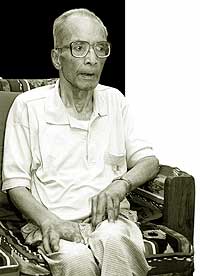 As the University of California scholar Leo E Rose remarked in the mid-1970s, Regmi’s decision to start a private research centre, “was almost inconceivable in Nepal at that time”, especially because there were no “assured sources of financial support from either the government of Nepal, a Nepali educational institution, or a foreign foundation”. Regmi’s initiative, Rose continued, “was indicative not only of a proclivity for entrepreneurship rare in Nepal but also of an independence of mind and a dedication to scholarship”. In the 46 years between taking that important decision and his death, Regmi demonstrated that independence and dedication with ample evidence. He contributed immensely to the field of historical research in Nepal, a field in which he had arrived accidentally and for which he was not formally trained.
Regmi functioned as a solitary historian at the Regmi Research Centre (sometimes called Institute), administratively helped by a small group of non-academic assistants, including, in the later years, his brother Rabish C Regmi and son Suresh C Regmi. Individuals such as Shankar M Amatya and Krishna M Arjyal helped Regmi go through thousands of documents held at the Records Office (‘Lagat Phant’) of the Department of Land Revenue in the Ministry of Finance, the Ministry of Foreign Affairs, the library of the Ministry of Law and Justice, the Department of Survey, offices under the Guthi Corporation which look after the lands that once paid for the upkeep of Kathmandu’s temples and other public structures, and the Pashupati-nath Temple. Documents from the above-mentioned sources were collected most intensively in the 1960s and the 1970s and were transcribed into thick volumes. These volumes, which were later referred to as the Regmi Research Collections, filled up the shelf space in his study and became Regmi’s personal archive based on which he produced 14 books on the economic and political history of 18th and 19th century Nepal.
The first of these books was Some Aspects of Land Reform in Nepal (1960). It was followed by the four-volume study entitled Land Tenure and Taxation in Nepal (1963, 1964, 1965, 1968, Institute of International Studies, University of California at Berkeley; reprinted in a single volume in 1978 by Ratna Pustak Bhandar, Kathmandu). In 1971, Regmi published “A Study in Nepali Economic History 1768-1846” in the Bibliotheca Himalayica series (started by late HK Kuloy) of the Manjusri Publishing House and five years later, the University of California Press published his Landownership in Nepal. These two works along with the earlier four-volume study established Regmi as a world-class scholar and in 1977 he became the first Nepali to receive the Ramon Magsaysay Award, receiving it for the “journalism, literature, and creative communication arts” category. The award was granted to him in recognition of his “chronicling of Nepal’s past and present, enabling his people to discover their origins and delineating national options”.
Regmi published two books in the next two years: Thatched Huts & Stucco Palaces: Peasants and Landlords in 19th Century Nepal (1978, Vikas) and Readings in Nepali Economic History (1979, Kishor Vidya Niketan). In the decade of the 1980s, he published The State and Economic Surplus (1984, Nath Publishing House) and An Economic History of Nepal, 1846-1901 (1988, Nath Publishing House). In the following decade Regmi published Kings and Political Leaders of the Gorkhali Empire 1768-1814 (1995, Orient Long-man), and Imperial Gorkha: An Account of Gorkhali Rule in Kumaun 1791-1815 (1999, Adroit). His last book Nepal: An Historical Miscellany (2002, Adroit) is a collection of various primary and secondary texts, translated into English from the original Nepali with additional commentary. At least ten of Regmi’s books are of outstanding quality and it is certain that they will continue to be the most influential texts of economic history of 18th and 19th century Nepal for at least another generation.
Contributions to Nepali History
In the aftermath of the end of the Rana regime in 1951, historical studies of Nepal had emerged from a variety of knowledge-production sites. The dominant trend was to write political history, a situation that was no different than in the rest of the Subcontinent or elsewhere. It was only in the 1960s that history-writing internationally broke away from an obsession with narrowly-defined political history as the subject of historical inquiry. Regmi chose to join this new international trend. As he stated in the preface to his 1971 book, in not confining his “attention to wars, dynastic chronologies and political intrigues in Kathmandu as a fitting, and indeed, the only subject-matter of historical study” he had “set up a precedent in Nepali historiography”.
Regmi‘s inquiry into the economic aspects of the Nepali people‘s lives during the 18th and 19th centuries began with a focus on the territorial expansion of the principality of Gorkha from the 1740s. By the early 19th century, Gorkha rulers had managed to expand their territories by many hundred-folds and Regmi attributed their success to the clever strategy of linking the new lands acquired through conquest to the sustainability of their army. The land-military complex forged during the expansion period lasting up to 1814 had different intriguing aspects that Regmi proceeded to describe in many of his books.
The variety of schemes under which the state owned, appropriated and distributed land and its resources was Regmi’s main subject of detailed study in the 1960s, which resulted in the four volumes on land tenure and taxation. In the next decade, he extended this work by producing an updated succinct volume in the form of his 1976 book, Landownership in Nepal where he also presented his preliminary views on the impact of land reform policies enacted by King Mahendra’s Panchayati state in the 1960s. In the other two full-length studies published in the 1970s, Regmi was concerned with, first, the “the economic policies and programs followed by the Gorkhali rulers to mobilize human and material resources” for territorial acquisition (1971), and, second, the agrarian relations developed by the Ranas during the first half of their century-plus rule between 1846 and 1951 (1978). In combination, they described the complexity of an agriculture-based polity and the rise of the centralised agrarian bureaucracy, and suggested why the Nepali peasantry, burdened with fulfilling the exploitative designs of the ruling elites and their functionaries, was poor. In other words, these three books by Regmi became the master texts for anyone trying to find the answer to the question, “Why is Nepal poor?”
In the two full-length studies he published in the 1980s, Regmi continued his description of the state’s mechanisms for resource extraction through production and trade in the early part of the 19th century (the 1984 book) and the various fiscal measures enacted by it in the second half of the same century (1998). In the 1990s however, we saw a small shift in his focus and he admitted as much. After reminding his readers in the prologue to his 1995 work that he had begun his historical inquiries by focusing on the economic aspects of the Nepali polity, he stated: “A quarter-century of on-going research and meditation has led me to modify that belief. The overarching importance of the economy is, no doubt, a truth, but nevertheless only a partial truth. I now realize that too exclusive an attention to economic history can be as misleading as too much concentration on politics”.
Accordingly in the last two full studies that he published, Regmi proceeded to examine the political class that took the decision to expand the kingdom of Gorkha into what eventually became an empire. In Kings and Political Leaders (1995) Regmi explored the motivations of the leadership for the expansion of the Gorkhali kingdom, and in Imperial Gorkha (1999) he delved into the “policies and programmes followed by the Gorkhali rulers to control and administer the provinces of that Empire”, in places like Kumaon which remained under Gorkhali control for 25 years.
All in all, Regmi’s corpus has helped us to understand the politics of Nepal’s rulers from the 1740s to the early 1900s on the one hand, and the impact their policies had on the lives of the ordinary people of Nepal, on the other. In helping us comprehend the poverty of Nepal’s peasantry and the ‘Stucco Palaces’ of its “parasitic groups” of rulers, Regmi firmly established himself as a people’s historian.
That is not to say that his work does not have limitations. His work, completely based on official sources, relies too heavily on the extractive categories of the Shah state and Rana agrarian bureaucracy. As this writer noted in an article in 1994, when viewed from below and begun with the experiences of people occupying various social positions, possibly radically different understandings of the effects of Gorkhali and Rana structures of power and institutions of rule could emerge. Regmi was aware of the possibility of this criticism and tried to forestall it by writing in the preface to his 1971 book, “It is, of course, true that these records are wholly official, so that they present the official rather than the people’s point of view on socio-economic questions. But this defect is more apparent than real, for frankness is an outstanding characteristic of most of these documents”.
Apart from his works, Regmi’s contribution to producing raw materials necessary for further historical research is immense. This would be obvious to any reader of the Regmi Research Series and some of his other periodicals in which he identified and provided translations of Nepali source materials. The documents archived in Regmi Research Collections were all microfilmed as part of the Nepal-German Manuscript Preservation Project and are now accessible to researchers at the National Archives of Nepal and also in Germany. The value of these documents has increased since the massive fire at the Singha Darbar secretariat in 1973 destroyed some of the originals.
As he pioneered the field of economic history in Nepal, there is no reason to look for native intellectual sources that preceded Regmi (both scholars and works) and may have influenced his work. In terms of his analytic orientation, he clearly preferred to distinguish himself from those Nepali historians who were obsessed with recording facts in the “history as it really happened” mode. He argued that the main business of history was interpretation. In his early works, to elaborate this position, he often quoted from philosophers of history such as RG Collingwood and EH Carr. One also finds many references in his books to works by international scholars on the peasantry. It is also possible, from the way Regmi conceptualised the growth of the central agrarian bureaucracy in Nepal, that he was influenced by Irfan Habib’s 1963 classic The Agrarian Sytem of Mughal India.
Paying for His Work
Regmi’s decision to open a private research institute in Nepal of the late 1950s was definitely extremely bold. So the question remains, how did he finance his scholarly operation? Regmi’s lifetime work was mainly supported through the sale of several services, most of which have by now been abandoned. These included the Nepal Press Digest (weekly summaries in English from the Nepali language press), the Nepal Press Report (daily summaries of the Nepali press), the Nepal Recorder (translations of Nepali laws), Nepal Miscellaneous Series and the monthly Regmi Research Series.
Among these, the first four contained information that was useful to both native and foreign academics and members of the expatriate ‘development’ community in Nepal. The Series, which lasted from 1969 to 1989 contained English translations of important historical documents from the Regmi Research Collection and short historical analyses - often drafts of narratives that later appeared elsewhere - written by Regmi himself. It also contained short articles written by others, often translated from their original Nepali into English. This periodical was of interest mainly to serious researchers of Nepali society. In the 1992 interview by Gaenszle, Regmi justified his decision to discontinue the Series in December 1989: “Well, the first thing was that it was selling only about forty copies, forty subscriptions. It did not generate enough resources to hire people, assistants, things like that. That was the main problem. Another problem was that I couldn’t find anyone with the competence to translate the old documents in the style I used. So it was a one-man show”. After crossing the age of 60, he added, he didn’t “want to work nine hours a day. That’s not the goal of life. And then I decided to concentrate on my own writing, not just to give up the Regmi Research Series and sit quietly, playing with my grandchildren. What I want to do is spend more time on my own work”.
In the beginning of his career, Regmi’s work was supported by the University of California at Berkeley through facilitation by Leo E Rose. The latter had come into contact with Regmi in 1957 when he had come to Nepal to do research on its diplomatic history. Berkeley’s grant to Regmi in 1960 was processed through its Institute of International Studies and it allowed him to work on the magisterial four-volume study of land-tenure and taxation. These volumes were published by the Institute between 1963 and 1968. However this connection also brought some controversy for Regmi when it was revealed that the Institute’s Himalayan Border Country Research Project through which Rose had channeled funds to him in the mid-1960s was funded by the Advanced Research Projects Agency of the US Defense Department. This sinister university-government connection was discovered in India in 1968. The revelation led the Indian government to immediately terminate the Project’s involvement in its Himalayan regions.
When asked about this connection by Gaenszle in 1992, Regmi said, ‘I said: look, I don’t know, I get paid for doing research on Nepal, I don’t care where the money comes from….They gave me a grant, they never told me what to do. They said: You (can) do what you want to do. And I said I want to do land tenure and taxation in Nepal. It started with a one volume project, one became two, two became three, three became four. So they financed all that”. The Institute’s grant for Regmi was discontinued in 1969 when the Himalayan borders project was scrapped. However Regmi continued to cherish his friendship with Rose long after this controversy and thanked him on numerous occasions in many of his books for the support given.
The 1977 Ramon Magsaysay Award, granted to Regmi near the middle of his career as a historian, also came at a crucial juncture in his life. Apart from the international recognition which, as Regmi has acknowledged, “bolstered both his self-confidence and his credibility”, the award carried a grant of USD 20,000. This gave him enough economic security to continue with his research and publications, including his 1979 book Readings in Nepali Economic History and some of his periodicals. As Regmi told this writer, but for the Magsaysay Award, the Regmi Research Series would have been discontinued even earlier than 1989.
The Legacy
Although at times Regmi allowed certain historians such as Fr Ludwig F Stiller, (celebrated author of, among others, The Rise of the House of Gorkha (1973) and The Silent Cry: The People of Nepal, 1816-1839 (1976)) to make extensive use of his original document collection, it seems fair to say that Regmi was not particularly interested in reproducing his “school” of Nepali historiography. It is not clear whether he ever sought to mentor members from the next generation of Nepali historians, but it seemed clear that by the early 1990s, when this writer met him, he seemed little interested. Neither was he interested in socialising with other Nepali academics, some of whom he thought did not deserve the reputation they had garnered on the basis of pedestrian work.
Regmi resisted most invitations to participate in other academic forums or seminars, and he rarely contributed articles to journals other than his own. As far as this writer knows, apart from an article published in Asian Survey in the early 1960s, and two articles published in Contributions to Nepalese Studies in 1975 and 1976, Regmi did not publish elsewhere, preferring instead to invest his energies in writing his books and producing his periodicals. Scholars (including this writer) who approached him for contributions often felt frustrated by his unwillingness to accede. In later years, it was also difficult to engage him in conversation, for Parkinson’s disease had begun to take its toll. He would answer specific questions and then revert back to recalling his past work and current obsessions.
In a rare appearance in a 1990 seminar entitled Kathmandu city and the Guthi system today, Regmi presented a paper highlighting the adverse impact on the civic life of Kathmandu resulting from the disappearance or institutional violations of this native mode of endowment-based philanthropy. But this presentation by the foremost scholar of the Guthi system began and ended with an apology. He stated, “The research has been inadequate and the presentation sketchy. The saving grace is that my aim in this paper has been to stimulate thought, not to present cut and dried solutions. If, therefore, the points I have made here provoke you to sit up and think on how we may be able to preserve and build on the initiative and liberality of our ancestors in using a portion of their wealth to construct and maintain temples, shrines, and other public assets in this city of ours, my efforts will not have gone waste”.
Some of the obituaries published since his death have lamented the fact that the wealth of insights Regmi had produced in his research works had not been used by the Nepali state. But Regmi hiimself was much more modest about the use of his work for Nepal’s development. This he made clear in a short write-up in Himal in 1993 titled “Why I write Economic History”: “I do not feel that there is any need for me to make an attempt to justify my research and writings on the economic history of Nepal in terms of their relevance to the mundane issues of economic development and political evolution. For me, far more inspiring and ennobling has been the feeling of participation, at whatsoever elementary level it may be, in the eternal quest for knowledge. In the course of exploring and recording a previously unknown and uncharted aspect of the history of the Nepali people and, therefore, of mankind as a whole, I have the feeling of having left my footprints on the sands of time”.
Regmi could provide us with historical narratives of previously uncharted aspects of Nepal’s past precisely because he showed no interest in the gimmickry embedded in medals and national honours. His spiritual quest in academia was made possible in part by his fierce independence of mind and dedication, and in part by the fact that he could work in his modest study without the distractions provided by vacuous honours and recognitions. Regmi’s footprints will be with us for a long time to come.
Wealth of Nations - What Drives High Growth Rates?
Wealth of Nations - What Drives High Growth Rates?
By MICHAEL SPENCE
Wall Street Journal, January 24, 2007
Mr. Spence, a 2001 Nobel laureate in economics, is a senior fellow at the Hoover Institution, professor emeritus of management in the Graduate School of Business at Stanford University, and chairman of the independent Commission on Growth in Developing Countries.
With China and India growing at high rates, there has been a dramatic increase in the fraction of the world's population experiencing the benefits and challenges of rapid growth. There are a number of common ingredients in the cases of sustained high growth that have been observed: a functioning market system, high levels of saving, public and private sector investment, resource mobility and the capacity to accommodate rapid change at the microeconomic level without leaving people excessively exposed to the risks inherent in creative destruction.
But it is the resources of the global economy that stand out as driving forces in
sustaining high growth. These come in three parts.
• Demand: In a relatively poor economy, demand is limited and its composition does not necessarily correspond to sectors of comparative advantage. The global economy is huge, in comparison; and at the right prices and costs, demand is, for practical purposes, unlimited.
So, once the challenge of identifying industries in which the country can invest in acquiring a comparative advantage is met, growth in exports will not be constrained by demand, and growth in the economy can occur at a rate determined by the savings and investment rates. Much of that investment in the early stages will go to the export sector, which can grow at rates high enough to pull the economy along. As we saw in Japan, Korea, Singapore and now China, the growth of exports can set in motion a process of sustained growth which is transmitted to the whole economy and could not be achieved by relying on domestic demand alone.
These are the dynamic equivalents of the gains from trade for developing countries. Developing economies are small in relation to global demand and hence they can grow and increase share without having the terms of trade turn against them (China being a possible exception because of its size). They are constrained primarily by their capacity to invest, once the growth process is started. They use underutilized or surplus resources, particularly labor, so that the growth in exports does not come at the expense of declines in other sectors. Advanced economies cannot grow at anything like these rates and the rapidly growing developing economies will eventually slow down.
• Technology: A second resource the global economy provides is know-how. This ranges from engineering and production technology to managerial expertise and knowledge of global markets -- and it does not have to be redeveloped domestically from scratch. And unlike most commodities, when knowledge is transferred from A to B, both have it.
One avenue for imported technology to travel is by foreign direct investment. But there are cases -- Japan and Korea -- in which there was significant technology absorption from the rest of the world and relatively little FDI. Here, foreign education and explicit programs aimed at learning played important roles.
• Investment: A third area in which the global economy supports higher than otherwise attainable growth is investment, or more precisely through investment beyond the capacity of the domestic economy to save. One component is FDI, typically not a large fraction of total investment (20% of overall investment would be typical). But its magnitude understates its importance, because of its role in bringing technology, know-how and access to external markets.
Beyond FDI, it is possible to invest at rates that are higher than domestic savings can provide. But this area is complex and controversial. Financial investments, unlike FDI, can be reversed easily; and if reversals are sudden, they can create exchange rate volatility, collapses in asset values, and failures in the banking system. This was observed in the currency crises of the late 1990s, and the understanding now is that imperfectly developed or informationally immature capital markets are vulnerable to volatility, and that complete openness and sudden shifts to complete convertibility of the currency may not be wise. Gradualism, experimentation and pragmatism are better guiding principles.
Substantial inbound capital in excess of savings may raise the value of the local currency and reduce the competitiveness of the nascent export sectors. An elevated level of the domestic currency or volatility will serve as a deterrent to domestic and foreign investment in export sectors.
Some public sector borrowing to finance public sector investment makes sense if the developing country's fiscal system is sufficiently well structured to ensure the future capacity to repay the debt, and if its political system is such that commitments can be kept. The record, here, is not reassuring. The high-growth cases have not involved much investment financed by foreign savings. The current trend is the opposite: toward building up reserves (modest in some cases, and very large in China). This means running surpluses on the current account (goods and services) and deficits on the capital account. That is, domestic savings exceeds investment.
As the high-growth economies become richer, the relative importance of the domestic economy as a driver of growth increases. The critical role of exports remains, but is at its highest early in the process when the domestic economy is small. Take Japan: It lost its growth momentum in the '90s in part because at its advanced stage domestic consumption is a required engine of growth. Beyond the catch-up phase, growth cannot be sustained on a healthy export sector alone.
It is hard to argue with the diagnosis of sustained high growth in the past half-century. But people do question the future applicability to developing economies that are "starting late."
The argument is that for those countries that are not resource-rich, the principal resource that they have is abundant labor, inexpensive relative to its productive value, and that the natural territory for comparative advantage is in labor-intensive manufacturing or services. For these countries, the argument goes, it is impossible to compete with China and prospectively India. One reason is that the size of China and India, and a variety of advantages that go with scale, are insurmountable. Another is that the infrastructure investments make China hypercompetitive and difficult to match. The conclusion is that one needs to wait for China and India to grow, and that at some point their incomes will rise to the point that they are no longer in labor-intensive sectors.
This argument is unlikely to be right. While China and India are formidable competitors, exchange rates can adjust to increase the competitiveness of export sectors of new entrants. In addition, while we sometimes talk about labor intensive industry as if it were one big lump, in reality there are hundreds of niches. Further, multinationals are risk-averse and unlikely to source in their supply chains in just one or two countries. Finally, China and India together now account for close to one-fifth of the U.S. economy, and they are becoming an important source of demand for exports of developing countries -- so that newcomers have expanding markets in these two rapidly growing economies.
In short, the global economy remains a resource for generating and sustaining high growth in developing countries. China and India, accounting for 40% of the world's population, are in high-growth mode and are pulling much of Asia with them. There have also been recent increases in export and overall growth in Africa, though some of that is attributable to an upsurge in commodity prices. Latin America, with the notable exception of Chile, has been stalled at lower middle-income levels, but has the human resources and other assets to shift back onto high-growth trajectories.
The prospects for developing countries are, in fact, probably more favorable now than they have been since World War II. International trade is growing faster than global GDP. The benefits of decades of learning with respect to operating global supply chains are accessible. Information and technology continues to lower transactions costs and to be a powerful integrating force. But perhaps even more important, the key players in all this -- the leaders in emerging economies who have the responsibility for building policies that support private sector entrepreneurship and that lead to sustained inclusive growth -- have a wealth of experience to rely on. No one is in the dark.
By MICHAEL SPENCE
Wall Street Journal, January 24, 2007
Mr. Spence, a 2001 Nobel laureate in economics, is a senior fellow at the Hoover Institution, professor emeritus of management in the Graduate School of Business at Stanford University, and chairman of the independent Commission on Growth in Developing Countries.
With China and India growing at high rates, there has been a dramatic increase in the fraction of the world's population experiencing the benefits and challenges of rapid growth. There are a number of common ingredients in the cases of sustained high growth that have been observed: a functioning market system, high levels of saving, public and private sector investment, resource mobility and the capacity to accommodate rapid change at the microeconomic level without leaving people excessively exposed to the risks inherent in creative destruction.
But it is the resources of the global economy that stand out as driving forces in
sustaining high growth. These come in three parts.
• Demand: In a relatively poor economy, demand is limited and its composition does not necessarily correspond to sectors of comparative advantage. The global economy is huge, in comparison; and at the right prices and costs, demand is, for practical purposes, unlimited.
So, once the challenge of identifying industries in which the country can invest in acquiring a comparative advantage is met, growth in exports will not be constrained by demand, and growth in the economy can occur at a rate determined by the savings and investment rates. Much of that investment in the early stages will go to the export sector, which can grow at rates high enough to pull the economy along. As we saw in Japan, Korea, Singapore and now China, the growth of exports can set in motion a process of sustained growth which is transmitted to the whole economy and could not be achieved by relying on domestic demand alone.
These are the dynamic equivalents of the gains from trade for developing countries. Developing economies are small in relation to global demand and hence they can grow and increase share without having the terms of trade turn against them (China being a possible exception because of its size). They are constrained primarily by their capacity to invest, once the growth process is started. They use underutilized or surplus resources, particularly labor, so that the growth in exports does not come at the expense of declines in other sectors. Advanced economies cannot grow at anything like these rates and the rapidly growing developing economies will eventually slow down.
• Technology: A second resource the global economy provides is know-how. This ranges from engineering and production technology to managerial expertise and knowledge of global markets -- and it does not have to be redeveloped domestically from scratch. And unlike most commodities, when knowledge is transferred from A to B, both have it.
One avenue for imported technology to travel is by foreign direct investment. But there are cases -- Japan and Korea -- in which there was significant technology absorption from the rest of the world and relatively little FDI. Here, foreign education and explicit programs aimed at learning played important roles.
• Investment: A third area in which the global economy supports higher than otherwise attainable growth is investment, or more precisely through investment beyond the capacity of the domestic economy to save. One component is FDI, typically not a large fraction of total investment (20% of overall investment would be typical). But its magnitude understates its importance, because of its role in bringing technology, know-how and access to external markets.
Beyond FDI, it is possible to invest at rates that are higher than domestic savings can provide. But this area is complex and controversial. Financial investments, unlike FDI, can be reversed easily; and if reversals are sudden, they can create exchange rate volatility, collapses in asset values, and failures in the banking system. This was observed in the currency crises of the late 1990s, and the understanding now is that imperfectly developed or informationally immature capital markets are vulnerable to volatility, and that complete openness and sudden shifts to complete convertibility of the currency may not be wise. Gradualism, experimentation and pragmatism are better guiding principles.
Substantial inbound capital in excess of savings may raise the value of the local currency and reduce the competitiveness of the nascent export sectors. An elevated level of the domestic currency or volatility will serve as a deterrent to domestic and foreign investment in export sectors.
Some public sector borrowing to finance public sector investment makes sense if the developing country's fiscal system is sufficiently well structured to ensure the future capacity to repay the debt, and if its political system is such that commitments can be kept. The record, here, is not reassuring. The high-growth cases have not involved much investment financed by foreign savings. The current trend is the opposite: toward building up reserves (modest in some cases, and very large in China). This means running surpluses on the current account (goods and services) and deficits on the capital account. That is, domestic savings exceeds investment.
As the high-growth economies become richer, the relative importance of the domestic economy as a driver of growth increases. The critical role of exports remains, but is at its highest early in the process when the domestic economy is small. Take Japan: It lost its growth momentum in the '90s in part because at its advanced stage domestic consumption is a required engine of growth. Beyond the catch-up phase, growth cannot be sustained on a healthy export sector alone.
It is hard to argue with the diagnosis of sustained high growth in the past half-century. But people do question the future applicability to developing economies that are "starting late."
The argument is that for those countries that are not resource-rich, the principal resource that they have is abundant labor, inexpensive relative to its productive value, and that the natural territory for comparative advantage is in labor-intensive manufacturing or services. For these countries, the argument goes, it is impossible to compete with China and prospectively India. One reason is that the size of China and India, and a variety of advantages that go with scale, are insurmountable. Another is that the infrastructure investments make China hypercompetitive and difficult to match. The conclusion is that one needs to wait for China and India to grow, and that at some point their incomes will rise to the point that they are no longer in labor-intensive sectors.
This argument is unlikely to be right. While China and India are formidable competitors, exchange rates can adjust to increase the competitiveness of export sectors of new entrants. In addition, while we sometimes talk about labor intensive industry as if it were one big lump, in reality there are hundreds of niches. Further, multinationals are risk-averse and unlikely to source in their supply chains in just one or two countries. Finally, China and India together now account for close to one-fifth of the U.S. economy, and they are becoming an important source of demand for exports of developing countries -- so that newcomers have expanding markets in these two rapidly growing economies.
In short, the global economy remains a resource for generating and sustaining high growth in developing countries. China and India, accounting for 40% of the world's population, are in high-growth mode and are pulling much of Asia with them. There have also been recent increases in export and overall growth in Africa, though some of that is attributable to an upsurge in commodity prices. Latin America, with the notable exception of Chile, has been stalled at lower middle-income levels, but has the human resources and other assets to shift back onto high-growth trajectories.
The prospects for developing countries are, in fact, probably more favorable now than they have been since World War II. International trade is growing faster than global GDP. The benefits of decades of learning with respect to operating global supply chains are accessible. Information and technology continues to lower transactions costs and to be a powerful integrating force. But perhaps even more important, the key players in all this -- the leaders in emerging economies who have the responsibility for building policies that support private sector entrepreneurship and that lead to sustained inclusive growth -- have a wealth of experience to rely on. No one is in the dark.
Milken Says Credit Could Free $100 Trillion for Poor Countries
Milken Says Credit Could Free $100 Trillion for Poor Countries
Bloomberg, 2007-01-18
By John Glover
Michael Milken, the junk bond billionaire turned philanthropist, says developing counntries could free up trillions of dollars by developing markets based on mortgages, credit cards and loans.
Poorer nations could release as much as $20 trillion for investment through securities based on mortgages, Milken will say in a speech at a conference in London today. Financial products linked to loans, bonds and credit cards could help to raise between $50 trillion and $100 trillion, according to an outline of his speech e-mailed by conference organizer BNP Paribas SA.
``Financial innovations have driven every advance of civilization since the development of banking in Mesopotamia 4,000 years ago,'' Milken, 60, will say. ``Financial technology produces more jobs, more economic development.''
Milken is credited with popularizing the market for junk bonds that now generates more than $200 billion of financing a year for non-investment grade companies worldwide. He's advocating bonds and derivatives that he says helped smaller companies in the U.S. create 58 million new jobs since 1970.
U.S. institutions sell about $1 trillion of asset-backed bonds every month, according to the Securities Industry and Financial Markets Association's Web site. More than $20 trillion of derivatives based on debt known as credit-default swaps are outstanding worldwide, according to Basel, Switzerland-based Bank for International Settlements.
Innovative Products
The U.K.'s lead in building a market for innovative financial products in the 1990s helped reduce unemployment to 4 percent from 10 percent, while the jobless rate in Europe stayed above 10 percent, Milken will tell people attending the conference on high-yield, high-risk debt.
``When the U.K. adopted financial technologies in the 1990s, things changed,'' says Milken.
Milken at Drexel Burnham Lambert Inc. helped fuel the M&A boom of the 1980s by selling bonds to newly created funds. By 1989, the junk bond market had crashed and two years later Milken was jailed for violations including securities fraud. He paid more than $1 billion in civil settlements and fines, and was banned for life from the securities industry.
Junk Bond Resurgence
Milken's work these days is focused more on health and economic research than the financial markets through organizations including the Milken Institute.
Appetite among western investors for high-risk debt has returned. Companies sold a record $151 billion of junk bonds in the U.S. and $48.4 billion in Europe last year, according to data compiled by Bloomberg. The securities are rated below Baa3 by Moody's Investors Service and BBB- by Standard & Poor's.
For developing countries, the cost to borrow has never been lower, with emerging-market bond yields at an average 1.79 percentage points over U.S. Treasury notes, according to JPMorgan Chase & Co.'s EMBI Global Diversified index.
Health care is key to development, Milken says, putting the value of ``human capital'' at $4,000 trillion worldwide. Increased life expectancy in the U.S. added $2.6 trillion a year between 1970 and 1998, according to Milken.
``Ultimately we make the effort not because of productivity gains but because each life is precious,'' he says.
Bloomberg, 2007-01-18
By John Glover
Michael Milken, the junk bond billionaire turned philanthropist, says developing counntries could free up trillions of dollars by developing markets based on mortgages, credit cards and loans.
Poorer nations could release as much as $20 trillion for investment through securities based on mortgages, Milken will say in a speech at a conference in London today. Financial products linked to loans, bonds and credit cards could help to raise between $50 trillion and $100 trillion, according to an outline of his speech e-mailed by conference organizer BNP Paribas SA.
``Financial innovations have driven every advance of civilization since the development of banking in Mesopotamia 4,000 years ago,'' Milken, 60, will say. ``Financial technology produces more jobs, more economic development.''
Milken is credited with popularizing the market for junk bonds that now generates more than $200 billion of financing a year for non-investment grade companies worldwide. He's advocating bonds and derivatives that he says helped smaller companies in the U.S. create 58 million new jobs since 1970.
U.S. institutions sell about $1 trillion of asset-backed bonds every month, according to the Securities Industry and Financial Markets Association's Web site. More than $20 trillion of derivatives based on debt known as credit-default swaps are outstanding worldwide, according to Basel, Switzerland-based Bank for International Settlements.
Innovative Products
The U.K.'s lead in building a market for innovative financial products in the 1990s helped reduce unemployment to 4 percent from 10 percent, while the jobless rate in Europe stayed above 10 percent, Milken will tell people attending the conference on high-yield, high-risk debt.
``When the U.K. adopted financial technologies in the 1990s, things changed,'' says Milken.
Milken at Drexel Burnham Lambert Inc. helped fuel the M&A boom of the 1980s by selling bonds to newly created funds. By 1989, the junk bond market had crashed and two years later Milken was jailed for violations including securities fraud. He paid more than $1 billion in civil settlements and fines, and was banned for life from the securities industry.
Junk Bond Resurgence
Milken's work these days is focused more on health and economic research than the financial markets through organizations including the Milken Institute.
Appetite among western investors for high-risk debt has returned. Companies sold a record $151 billion of junk bonds in the U.S. and $48.4 billion in Europe last year, according to data compiled by Bloomberg. The securities are rated below Baa3 by Moody's Investors Service and BBB- by Standard & Poor's.
For developing countries, the cost to borrow has never been lower, with emerging-market bond yields at an average 1.79 percentage points over U.S. Treasury notes, according to JPMorgan Chase & Co.'s EMBI Global Diversified index.
Health care is key to development, Milken says, putting the value of ``human capital'' at $4,000 trillion worldwide. Increased life expectancy in the U.S. added $2.6 trillion a year between 1970 and 1998, according to Milken.
``Ultimately we make the effort not because of productivity gains but because each life is precious,'' he says.
Friday, January 19, 2007
Weekly Data Highlight
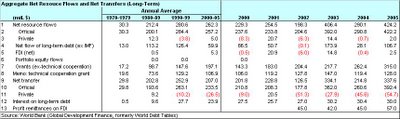
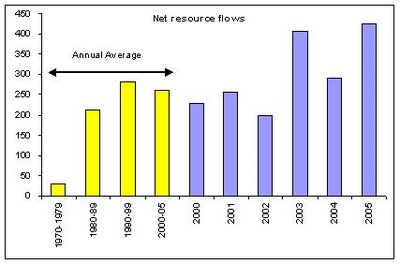
Aggregate Net Resource Flows and Net Transfers (Long-Term)
[for enlarged version, please click on the picture]
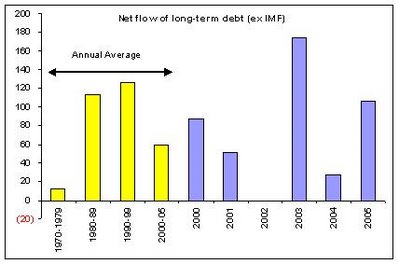
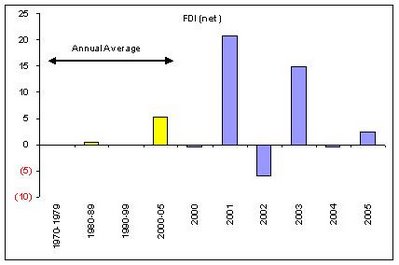
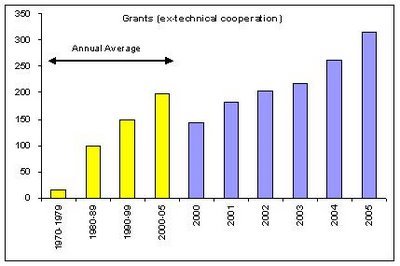
The bottom line seems to be that despite all the ho-hallas about attracting FDI, Nepal is still too dependent on foreign grants to finance its economy. Hopefully that will change with the change in the political climate of the country. Let's just hope & pray.
[for enlarged version, please click on the picture]
The bottom line seems to be that despite all the ho-hallas about attracting FDI, Nepal is still too dependent on foreign grants to finance its economy. Hopefully that will change with the change in the political climate of the country. Let's just hope & pray.
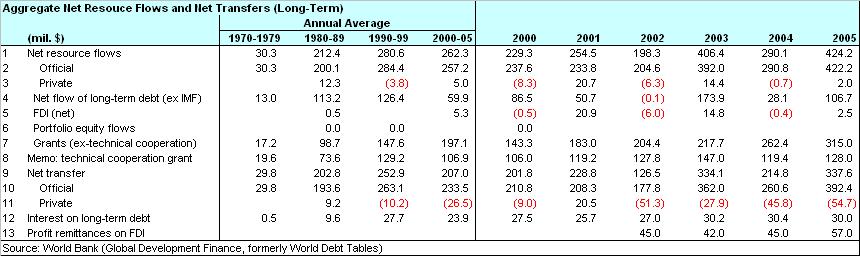
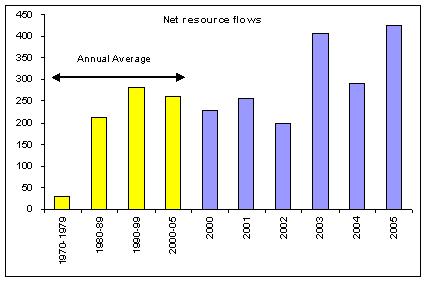
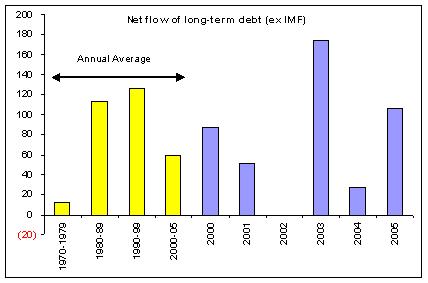
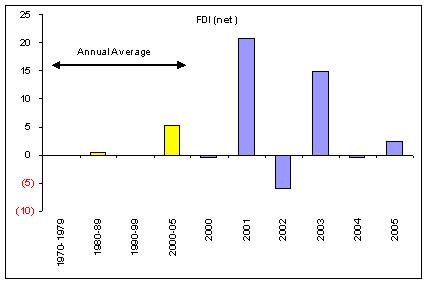
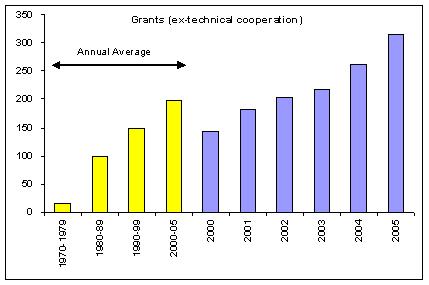
Roundup of Economic & Business News (Jan 13 - Jan 19)
Jan 13
NT acquires bandwidth from Indian firms (eKantipur.com)
Eight Nepali laborers rescued (eKantipur.com)
Tourism recovery slower than expected (eKantipur.com)
Construction works at Mid-Marsyangdi likely to resume soon (Nepalbiznews.com)
Terai Banda continues affecting life (Nepalbiznews.com)
Jan 14
Government set to rebuild infrastructure (eKantipur.com)
Business leaders call for robust policy (eKantipur.com)
Strike cripples life in Terai (Nepalbiznews.com)
Utilise enormous water resources : Minister Karki (Nepalbiznews.com)
Weekly Stock Analysis: Nepse Bounces back with 10.96 pts (Nepalbiznews.com)
Jan 15
Strike cripples terai districts for 3rd day (eKantipur.com)
Maoists padlock hydel project (eKantipur.com)
StaR City ES: lightweight but powerful bike (eKantipur.com)
BizNews Brief (SDBL to give 10 pc dividend, Sanima gets new board members, LG Time Machine TV soon in market, Crystal holds 6th AGM, MBL receives ISO certification) (eKantipur.com)
NPC to go at local level for counsel (Nepalbiznews.com)
CAN Info-Tech concludes (Nepalbiznews.com)
Commentary
‘Global Bank will offer the best service’ (Interview) (eKantipur.com)
Jan 16
Near zero bond trading at NEPSE (eKantipur.com)
EBL opens 19th branch in Nepalgunj (eKantipur.com)
Indian dairies to purchase Nepali milk (eKantipur.com)
Jan 17
Deduction for arrears pinches supply (eKantipur.com)
Surya Nepal to open garment factory (eKantipur.com)
Himalayan Tea Garden avoids (eKantipur.com)
Deduction for arrears pinches supplyeKantipur.com
Jan 18
Trading in NDB shares suspended (eKantipur.com)
High-level committee for PEs privatization (eKantipur.com)
Gorkha Beer in Hong Kong (eKantipur.com)
Export slips, import grows in first four month: NRB (Nepalbiznews.com)
Jan 19
Foreign employment declines by 5 pc (eKantipur.com)
Differences persist on bilateral investment protection agreement (BIPA) (eKantipur.com)
PM directs to solve the issue of NWSC (Nepalnews.com)
Nepalese garments to continue enjoying preferential access to Eu (Nepalnews.com)
BOK opens new branch (The Himalayan Times)
BizNews Brief (SKBL’s lucky winners, NEA to collect dues) (The Himalayan Times)
Commentary
Resolving border disputes for trade benefits (Commentary) (eKantipur.com)
NT acquires bandwidth from Indian firms (eKantipur.com)
Eight Nepali laborers rescued (eKantipur.com)
Tourism recovery slower than expected (eKantipur.com)
Construction works at Mid-Marsyangdi likely to resume soon (Nepalbiznews.com)
Terai Banda continues affecting life (Nepalbiznews.com)
Jan 14
Government set to rebuild infrastructure (eKantipur.com)
Business leaders call for robust policy (eKantipur.com)
Strike cripples life in Terai (Nepalbiznews.com)
Utilise enormous water resources : Minister Karki (Nepalbiznews.com)
Weekly Stock Analysis: Nepse Bounces back with 10.96 pts (Nepalbiznews.com)
Jan 15
Strike cripples terai districts for 3rd day (eKantipur.com)
Maoists padlock hydel project (eKantipur.com)
StaR City ES: lightweight but powerful bike (eKantipur.com)
BizNews Brief (SDBL to give 10 pc dividend, Sanima gets new board members, LG Time Machine TV soon in market, Crystal holds 6th AGM, MBL receives ISO certification) (eKantipur.com)
NPC to go at local level for counsel (Nepalbiznews.com)
CAN Info-Tech concludes (Nepalbiznews.com)
Commentary
‘Global Bank will offer the best service’ (Interview) (eKantipur.com)
Jan 16
Near zero bond trading at NEPSE (eKantipur.com)
EBL opens 19th branch in Nepalgunj (eKantipur.com)
Indian dairies to purchase Nepali milk (eKantipur.com)
Jan 17
Deduction for arrears pinches supply (eKantipur.com)
Surya Nepal to open garment factory (eKantipur.com)
Himalayan Tea Garden avoids (eKantipur.com)
Deduction for arrears pinches supplyeKantipur.com
Jan 18
Trading in NDB shares suspended (eKantipur.com)
High-level committee for PEs privatization (eKantipur.com)
Gorkha Beer in Hong Kong (eKantipur.com)
Export slips, import grows in first four month: NRB (Nepalbiznews.com)
Jan 19
Foreign employment declines by 5 pc (eKantipur.com)
Differences persist on bilateral investment protection agreement (BIPA) (eKantipur.com)
PM directs to solve the issue of NWSC (Nepalnews.com)
Nepalese garments to continue enjoying preferential access to Eu (Nepalnews.com)
BOK opens new branch (The Himalayan Times)
BizNews Brief (SKBL’s lucky winners, NEA to collect dues) (The Himalayan Times)
Commentary
Resolving border disputes for trade benefits (Commentary) (eKantipur.com)
Roundup of Economic & Business News (Jan 13 - Jan 19)
Jan 13
NT acquires bandwidth from Indian firms (eKantipur.com)
Eight Nepali laborers rescued (eKantipur.com)
Tourism recovery slower than expected (eKantipur.com)
Construction works at Mid-Marsyangdi likely to resume soon (Nepalbiznews.com)
Terai Banda continues affecting life (Nepalbiznews.com)
Jan 14
Government set to rebuild infrastructure (eKantipur.com)
Business leaders call for robust policy (eKantipur.com)
Strike cripples life in Terai (Nepalbiznews.com)
Utilise enormous water resources : Minister Karki (Nepalbiznews.com)
Weekly Stock Analysis: Nepse Bounces back with 10.96 pts (Nepalbiznews.com)
Jan 15
Strike cripples terai districts for 3rd day (eKantipur.com)
Maoists padlock hydel project (eKantipur.com)
StaR City ES: lightweight but powerful bike (eKantipur.com)
BizNews Brief (SDBL to give 10 pc dividend, Sanima gets new board members, LG Time Machine TV soon in market, Crystal holds 6th AGM, MBL receives ISO certification) (eKantipur.com)
NPC to go at local level for counsel (Nepalbiznews.com)
CAN Info-Tech concludes (Nepalbiznews.com)
Commentary
‘Global Bank will offer the best service’ (Interview) (eKantipur.com)
Jan 16
Near zero bond trading at NEPSE (eKantipur.com)
EBL opens 19th branch in Nepalgunj (eKantipur.com)
Indian dairies to purchase Nepali milk (eKantipur.com)
Jan 17
Deduction for arrears pinches supply (eKantipur.com)
Surya Nepal to open garment factory (eKantipur.com)
Himalayan Tea Garden avoids (eKantipur.com)
Deduction for arrears pinches supplyeKantipur.com
Jan 18
Trading in NDB shares suspended (eKantipur.com)
High-level committee for PEs privatization (eKantipur.com)
Gorkha Beer in Hong Kong (eKantipur.com)
Export slips, import grows in first four month: NRB (Nepalbiznews.com)
Jan 19
Foreign employment declines by 5 pc (eKantipur.com)
Differences persist on bilateral investment protection agreement (BIPA) (eKantipur.com)
PM directs to solve the issue of NWSC (Nepalnews.com)
Nepalese garments to continue enjoying preferential access to Eu (Nepalnews.com)
BOK opens new branch (The Himalayan Times)
BizNews Brief (SKBL’s lucky winners, NEA to collect dues) (The Himalayan Times)
Commentary
Resolving border disputes for trade benefits (Commentary) (eKantipur.com)
NT acquires bandwidth from Indian firms (eKantipur.com)
Eight Nepali laborers rescued (eKantipur.com)
Tourism recovery slower than expected (eKantipur.com)
Construction works at Mid-Marsyangdi likely to resume soon (Nepalbiznews.com)
Terai Banda continues affecting life (Nepalbiznews.com)
Jan 14
Government set to rebuild infrastructure (eKantipur.com)
Business leaders call for robust policy (eKantipur.com)
Strike cripples life in Terai (Nepalbiznews.com)
Utilise enormous water resources : Minister Karki (Nepalbiznews.com)
Weekly Stock Analysis: Nepse Bounces back with 10.96 pts (Nepalbiznews.com)
Jan 15
Strike cripples terai districts for 3rd day (eKantipur.com)
Maoists padlock hydel project (eKantipur.com)
StaR City ES: lightweight but powerful bike (eKantipur.com)
BizNews Brief (SDBL to give 10 pc dividend, Sanima gets new board members, LG Time Machine TV soon in market, Crystal holds 6th AGM, MBL receives ISO certification) (eKantipur.com)
NPC to go at local level for counsel (Nepalbiznews.com)
CAN Info-Tech concludes (Nepalbiznews.com)
Commentary
‘Global Bank will offer the best service’ (Interview) (eKantipur.com)
Jan 16
Near zero bond trading at NEPSE (eKantipur.com)
EBL opens 19th branch in Nepalgunj (eKantipur.com)
Indian dairies to purchase Nepali milk (eKantipur.com)
Jan 17
Deduction for arrears pinches supply (eKantipur.com)
Surya Nepal to open garment factory (eKantipur.com)
Himalayan Tea Garden avoids (eKantipur.com)
Deduction for arrears pinches supplyeKantipur.com
Jan 18
Trading in NDB shares suspended (eKantipur.com)
High-level committee for PEs privatization (eKantipur.com)
Gorkha Beer in Hong Kong (eKantipur.com)
Export slips, import grows in first four month: NRB (Nepalbiznews.com)
Jan 19
Foreign employment declines by 5 pc (eKantipur.com)
Differences persist on bilateral investment protection agreement (BIPA) (eKantipur.com)
PM directs to solve the issue of NWSC (Nepalnews.com)
Nepalese garments to continue enjoying preferential access to Eu (Nepalnews.com)
BOK opens new branch (The Himalayan Times)
BizNews Brief (SKBL’s lucky winners, NEA to collect dues) (The Himalayan Times)
Commentary
Resolving border disputes for trade benefits (Commentary) (eKantipur.com)
Friday, January 12, 2007
Roundup of Economic & Business News (Jan 5 - Jan 12)
Jan 5
NT acquires bandwidth from Indian firms (eKantipur.com)
Royalty’s salaries remain untouched (eKantipur.com)
Nepal and India to construct high- voltage transmission links (Nepalbiznews.com)
Mid Marsyangdi builder issues notice to resume work (Nepalbiznews.com)
Jan 6
Nepal Telecom acquires bandwidths via optical fiber network (Nepalbiznews.com)
Jan 7
Power cuts 8 hrs a week (eKantipur.com)
Jan 9
Business registration to go online (eKantipur.com)
Healthcare outsourcing now $300m biz, growing at 150% (The Economics Times (India))
'Indian retail to touch Rs 100,000 cr' (The Economics Times (India))
Jan 10
Women outdoing men in salon business (eKantipur.com)
Increase public investment: SAARC study (eKantipur.com)
‘Govt. to make concrete decision on NOC’s issue’ (Nepalbiznews.com)
Govt mulling over funding sick industries (Nepalbiznews.com)
Jan 11
$100 laptop for Nepali students soon (eKantipur.com)
NT reduces Internet tariff by 83 pc (eKantipur.com)
IT entrepreneurs launch Fortune Cookie Ventures (Nepalnews.com)
Jan 12
NB Bank recovers Rs 656m N (eKantipur.com)
Interim govt 'will eliminate transport syndicates' (eKantipur.com)
Pokhara Blue Bird hotel to reopen (eKantipur.com)
Maoists continue extortion from tourists (eKantipur.com)
NEA to issue bonds to raise fund (Nepalbiznews.com)
Central bank reduces NPA of NB bank to 34 percent (Nepalbiznews.com)
Terai bandh affects normal life (Nepalnews.com)
Chilime power plant resumes operation (Nepalnews.com)
NT acquires bandwidth from Indian firms (eKantipur.com)
Royalty’s salaries remain untouched (eKantipur.com)
Nepal and India to construct high- voltage transmission links (Nepalbiznews.com)
Mid Marsyangdi builder issues notice to resume work (Nepalbiznews.com)
Jan 6
Nepal Telecom acquires bandwidths via optical fiber network (Nepalbiznews.com)
Jan 7
Power cuts 8 hrs a week (eKantipur.com)
Jan 9
Business registration to go online (eKantipur.com)
Healthcare outsourcing now $300m biz, growing at 150% (The Economics Times (India))
'Indian retail to touch Rs 100,000 cr' (The Economics Times (India))
Jan 10
Women outdoing men in salon business (eKantipur.com)
Increase public investment: SAARC study (eKantipur.com)
‘Govt. to make concrete decision on NOC’s issue’ (Nepalbiznews.com)
Govt mulling over funding sick industries (Nepalbiznews.com)
Jan 11
$100 laptop for Nepali students soon (eKantipur.com)
NT reduces Internet tariff by 83 pc (eKantipur.com)
IT entrepreneurs launch Fortune Cookie Ventures (Nepalnews.com)
Jan 12
NB Bank recovers Rs 656m N (eKantipur.com)
Interim govt 'will eliminate transport syndicates' (eKantipur.com)
Pokhara Blue Bird hotel to reopen (eKantipur.com)
Maoists continue extortion from tourists (eKantipur.com)
NEA to issue bonds to raise fund (Nepalbiznews.com)
Central bank reduces NPA of NB bank to 34 percent (Nepalbiznews.com)
Terai bandh affects normal life (Nepalnews.com)
Chilime power plant resumes operation (Nepalnews.com)
Subscribe to:
Posts (Atom)