Jan 2
Nepse launches Sensitive Index (Nepalnews.com)
‘Visit Pokhara year 2007’ formally begins (Nepalnews.com)
Jan 3
Air passenger movement hits record (eKantipur.com)
Parliament passes bill to privatize valley water distribution (Nepalnews.com)
Maoists still continuing collection of taxes (Nepalnews.com)
Tourism entrepreneurs deplore Chakkajam on the inaugural day of Visit Pokhara Year (Nepalnews.com)
Melamchi Water Project may be suspended (Nepalnews.com)
Jan 4
2006 saw rise in foreign employment (eKantipur.com)
China Southern to begin flights from Jan 22 (eKantipur.com)
Nepal-India to build high-voltage transmission links (eKantipur.com)
Garment sector saw gloomy days in 2006 (eKantipur.com)
‘Microfinance mitigated impact of conflict’ (eKantipur.com)
Trade deficit rises by 15.8 pc (eKantipur.com)
KVWSDB to takeover Nepal Water Supply Corporation (Nepalbiznews.com)
Saturday, September 09, 2006

Thursday, September 07, 2006
Nepal mired in foreign debt
Nepal mired in foreign debt
Gopal Tiwari
The Himalaya Times, September 6, 2006
The outstanding foreign debt of Nepal as of July 16, 2006 has reached over Rs 234 billion which comes to over 40 per cent of the country’s total gross domestic product (GDP) that stands at Rs 583 billion, as per the preliminary figures of the Financial Comptroller General’s Office of the government.
However, in 2004-05, outstanding loans of Nepal was Rs 219 billion which stood at 43.18 per cent of the total GDP of Rs 533 billion. During 2001 and 2002, the percentage of foreign loan to the total GDP was over 50 per cent.
With this disappointing and alarming trend, Nepal seems to be moving into a ‘debt-trapped economy’ status as it has failed to increase its development expenditure in recent times. Alarmingly, recurrent expenditure has been going up in recent years.
Prof Bishwambher Pyakuryal, president of Nepal Economic Association (NEA), expressed serious concerns over the outstanding debt increase due to a lack of proper functional system in the conflict-hit economy.
Donors feel that external assistance is being siphoned off to non-development sectors which demands that the system of service delivery has to be re-thought.
Prof Pyakuryal is of the view that the government does not think seriously on conditions imposed by donors while inking agreements. It may ultimately push us towards a debt-trap.
Given such a dismal scenario, Nepal might have to enter into Highly Indebted Poor Countries (HIPC) initiative club as a ‘defaulter’, Pyakuryal feared.
Dr Rudra Suwal, economist at Central Bureau of Statistics (CBS) termed the increasing foreign loans ‘alarming’ at a time when development expenditure is also being squeezed. Even if we increase our debt servicing, it would be difficult for us to increase the capital expenditure, said Dr Suwal.
According to the ministry of finance (MoF), total debt serving in 2003-04 stood at about nine per cent of the total government expenditure. In 2004-05, debt servicing by the government came to be about eight per cent.
As per the international norms set by International Monetary Fund (IMF), debt servicing should not go beyond 10 per cent. It means that Nepal is moving towards an alarming situation.
Dr Suwal suggests that greater loans would also be a problem as it will generate a huge debt-servicing liability that means development would suffer more.
What is further troublesome is that development expenditure came to be only 26 per cent of the total expenditure in the year 2003-04. However, recurrent expenditure came to be 74 per cent. With this trend, it shows that foreign loans might have gone under ‘regular expenditure’.
During 1974-75, the situation was just the reverse. During that time, regular expenditure was 36 per cent of the total government expenditure while development expenditure was 64 per cent. During fiscal year 1994-95, regular expenditure and development expenditure were equal in terms of total expenditure.
In the context of foreign debt inflating, a dismal growth in productive investments seems apparent. With infrastructure getting extremely weak, capital expenditure would have to increase. But for the moment, it is just the reverse.
Every Nepali now owes a loan of Rs 13,000 as per the latest government figures.
Gopal Tiwari
The Himalaya Times, September 6, 2006
The outstanding foreign debt of Nepal as of July 16, 2006 has reached over Rs 234 billion which comes to over 40 per cent of the country’s total gross domestic product (GDP) that stands at Rs 583 billion, as per the preliminary figures of the Financial Comptroller General’s Office of the government.
However, in 2004-05, outstanding loans of Nepal was Rs 219 billion which stood at 43.18 per cent of the total GDP of Rs 533 billion. During 2001 and 2002, the percentage of foreign loan to the total GDP was over 50 per cent.
With this disappointing and alarming trend, Nepal seems to be moving into a ‘debt-trapped economy’ status as it has failed to increase its development expenditure in recent times. Alarmingly, recurrent expenditure has been going up in recent years.
Prof Bishwambher Pyakuryal, president of Nepal Economic Association (NEA), expressed serious concerns over the outstanding debt increase due to a lack of proper functional system in the conflict-hit economy.
Donors feel that external assistance is being siphoned off to non-development sectors which demands that the system of service delivery has to be re-thought.
Prof Pyakuryal is of the view that the government does not think seriously on conditions imposed by donors while inking agreements. It may ultimately push us towards a debt-trap.
Given such a dismal scenario, Nepal might have to enter into Highly Indebted Poor Countries (HIPC) initiative club as a ‘defaulter’, Pyakuryal feared.
Dr Rudra Suwal, economist at Central Bureau of Statistics (CBS) termed the increasing foreign loans ‘alarming’ at a time when development expenditure is also being squeezed. Even if we increase our debt servicing, it would be difficult for us to increase the capital expenditure, said Dr Suwal.
According to the ministry of finance (MoF), total debt serving in 2003-04 stood at about nine per cent of the total government expenditure. In 2004-05, debt servicing by the government came to be about eight per cent.
As per the international norms set by International Monetary Fund (IMF), debt servicing should not go beyond 10 per cent. It means that Nepal is moving towards an alarming situation.
Dr Suwal suggests that greater loans would also be a problem as it will generate a huge debt-servicing liability that means development would suffer more.
What is further troublesome is that development expenditure came to be only 26 per cent of the total expenditure in the year 2003-04. However, recurrent expenditure came to be 74 per cent. With this trend, it shows that foreign loans might have gone under ‘regular expenditure’.
During 1974-75, the situation was just the reverse. During that time, regular expenditure was 36 per cent of the total government expenditure while development expenditure was 64 per cent. During fiscal year 1994-95, regular expenditure and development expenditure were equal in terms of total expenditure.
In the context of foreign debt inflating, a dismal growth in productive investments seems apparent. With infrastructure getting extremely weak, capital expenditure would have to increase. But for the moment, it is just the reverse.
Every Nepali now owes a loan of Rs 13,000 as per the latest government figures.
China - Casino Giants Take Their Vegas Battle To Tables of Macau
Casino Giants Take Their Vegas Battle To Tables of Macau
Wynn, Sands Bet High Rollers Will Flock to Flashy Sites In Formerly Dingy Locale
Gondoliers Singing 'O Sole Mio'
By PETER SANDERS and BRUCE STANLEY
September 6, 2006
For two years, billionaire Sheldon Adelson's Las Vegas Sands Corp. has been the only U.S. casino operator to enjoy the explosive growth of gambling on this tiny nub of Chinese territory near Hong Kong. Las Vegas Sands already has one booming casino open here, and last week it staged a theatrical presentation, complete with Chinese drummers and dancers, to hype next year's opening of a much bigger and more lavish second property.
But now Mr. Adelson has company. On Wednesday, legendary American gambling mogul Steve Wynn opened his $1.2 billion Wynn Macau, a near-replica of Wynn Resorts Ltd.'s splashy Las Vegas resort. With dancing fountains and a stylish nightclub, the Wynn casino is upping the stakes on both men's bet that Macau, long known for dingy, locally operated gambling halls, is ready for high-end razzle-dazzle.
Mr. Adelson took the lead by jumping into Macau early, targeting the mass market with a super-sized casino that boasted more Las Vegas flash than anything that came before it. He now hopes to attract business conventions and lure attendees into his casinos. Mr. Wynn held back, saving his ammunition to target high rollers with deep pockets.
Along the way, the two have stumbled and collided, exporting to Chinese shores the intense rivalry they have kept up for more than 15 years in Las Vegas, where they operate sprawling megacasinos across the street from each other. Macau represents a chance for Mr. Adelson to get the upper hand on Mr. Wynn, a Las Vegas icon who is credited with reinventing the city as the head of Mirage Resorts Inc. before selling the company and starting over with Wynn Resorts.
Seated in a two-story penthouse suite atop the Sands Macao recently, the 73-year-old Mr. Adelson professed to be unconcerned about the competition. "Steve Wynn's opening here will be a nonevent," he said, ignoring his wife's gestures to keep quiet. "He's 2½ years too late."
The next day, Mr. Wynn, 64, fired back. He derided the Sands Macao as a "Wal-Mart-type" operation with an uninspired design that proves Mr. Adelson lacks the panache to go after high rollers. "Sheldon is quick to dismiss all of his Las Vegas competitors as ignorant to the ways of Chinese gamblers," he said. "But he forgets the hundreds of millions of dollars I've won [in Las Vegas] from Asian baccarat players."
The trash-talking indicates how much the gambling industry has at stake in China. Gambling is hugely popular here, and Macau, a former Portuguese colony an hour's ferry ride west of Hong Kong, is the only place in this newly prosperous country of 1.3 billion people where casinos are legal. The local, Beijing-backed government, eager for the territory to shed its reputation for seedy gambling dens, prostitution and gangland violence, broke the 40-year casino monopoly of local tycoon Stanley Ho in 2000 and began licensing outsiders. All the world's big casino companies are now seeking a foothold in the market. In 2002, Messrs. Adelson and Wynn became the first Americans to win licenses here. MGM Mirage later won a license and plans to build its own casino-resort, too.
Enormous Results
Even in its ramp-up phase, the results have been enormous. Last year, Macau attracted 10.5 million Chinese visitors, a 147% jump from just three years earlier. Thanks to legions of newly wealthy Chinese and an easing of travel restrictions, Macau's casino market has overtaken Atlantic City in size. It generated $5.6 billion in casino-gambling revenues last year, second only to the Las Vegas Strip's turnover of $6 billion.
Most of Macau's gambling revenue, about 80%, is for now generated by locally owned casinos. Many are run by Mr. Ho, including his flagship Lisboa casino, a warren of betting parlors directly across the street from Wynn Macau. The U.S. companies aim to attract a different crowd -- big spenders from the mainland and elsewhere who can gamble, and lose, much bigger sums.
It's no sure thing that Vegas-style casinos will work in Macau, where most visitors stay just for one day and usually leave their kids at home. New developments could triple the number of hotel rooms by 2009, raising fears of a glut. "This kind of resort is so untested in this market it's hard to feel overwhelmingly confident about what the outcome will be," Mr. Wynn said. "I don't feel comfortable about making blanket predictions."
Nevertheless, both Las Vegas Sands and Wynn Resorts have big plans to transform the gambling landscape here. The Sands Macao, with its vast, cathedral-like interior, is unlike any other casino here. Located on Macau's densely built main peninsula just a short walk from the ferry terminal, the Sands boasts floor shows from scantily dressed Chinese dancers to an all-female string quartet from Bulgaria. It's been a big hit: The casino recouped its investment within a little more than a year, according to industry officials. In the six months ended June 30, the Sands Macao reported $592 million in revenue, outshining the $455.3 million from the company's flagship Venetian Las Vegas. The reclusive Mr. Ho told Asian media recently that Las Vegas Sands could force some of his casinos into bankruptcy.
Mr. Adelson's biggest push is yet to come. Seeking new space to expand, he is developing an area dubbed the "Cotai Strip," a muddy stretch of reclaimed land between two small islands that are connected by bridges to Macau's main peninsula. Mr. Adelson is intent on making Cotai "Asia's Las Vegas Strip." The anchor will be the 3,000-room Venetian Macao with its giant casino and high-end shopping mall, all built to a Venice theme -- complete with man-made lagoon and Chinese gondoliers serenading customers with "O Sole Mio." (The complex will also include a convention center and 15,000-seat arena.)
Mr. Wynn is close on Mr. Adelson's heels. In addition to the Wynn Macau in Macau's crowded city center, his company plans to build two or three casinos on a 54-acre parcel on Cotai. By following his rival to Macau's new property frontier, Mr. Wynn hopes to learn from any mistakes Las Vegas Sands might make on the Cotai Strip. Mr. Adelson insists that there's no substitute for being a first-mover and says that arriving late to Cotai will be useful only "if your object is not to make money."
Sheldon Adelson is developing an area of Macau dubbed the "Cotai Strip," whose anchor will be the 3,000-room Venetian Macao and a giant casino, convention center, stadium and high-end shopping mall.
Both Las Vegas Sands and Wynn have had a tough time finding their sea legs in Macau, a one-time backwater of 453,000 people that took off economically only after Portugal handed control to China in 1999. Mr. Adelson, in particular, faced a series of high hurdles in lining up financing that would prove to local officials that he could pull off his projects.
Las Vegas Sands initially turned to a Taiwanese bank, CDIB, for financing. But Jorge Oliveira, the head of legal affairs for the Macau Gaming Commission, says the presence of former Taiwanese generals on CDIB's board made the arrangement politically unpalatable, given the tensions between China and the island it views as a renegade province.
Next Las Vegas Sands hooked up with Hong Kong-based Galaxy Casino SA, proposing a joint project in which it would have held a minority stake plus the management contract for the casino and hotel. But relations between Las Vegas Sands and Galaxy soured, and lawyers from the two companies eventually refused even to talk to each other in joint meetings with the Gaming Commission.
That spelled trouble when Galaxy won a casino license and Las Vegas Sands, with no license of its own, was left stranded. But Macau regulators, eager to upgrade Macau's image, were impressed by Mr. Adelson's past record of turning Las Vegas into a convention destination. His Cotai Strip proposal seemed a perfect fit for a neglected patch far from Macau's traditional gambling action.
Mr. Adelson constructed the cavernous Sands Macao, above, after consulting a master of feng shui, but rival Steve Wynn derided it as a "Wal-Mart type" operation with an uninspired design. Top, the Sands' main casino floor.
So Macau authorities bent their own rules and gave Las Vegas Sands the go-ahead as a "subconcession" to the license they awarded Galaxy. To avoid allegations of favoritism and make room for additional big players, they later created subconcessions under the two other licenses, effectively doubling the number of casino operators they had originally intended to permit.
Armed with his license, Mr. Adelson made an attempt to team up with Mr. Wynn. That was an odd overture given their history together. Acrimony between the men dates back to 1989, when Mr. Adelson -- who owned the computer-industry tradeshow Comdex -- expected Mr. Wynn to waive fees for using meeting facilities at the Mirage, which Mr. Wynn then operated. In later years, the men clashed over casino designs, parking facilities and bragging rights in Las Vegas.
In Macau, Mr. Adelson proposed that they build a temporary casino together on Wynn Resorts land, freeing up both companies to develop permanent gambling palaces on the planned Cotai Strip. But Mr. Wynn balked, claiming he was too busy getting his own new Las Vegas casino off the ground. So Mr. Adelson struck out on his own, deciding to quickly erect the cavernous Sands Macao casino to tap into Mr. Ho's lucrative business catering to day-trip gamblers.
Mr. Adelson tailored his product to local tastes. The Sands Macao includes a rounded, tower-like hotel structure that the company designed after consulting a master of feng shui. Images of dragons and the Great Wall of China adorn many of the casino's 1,254 slot machines. Unlike in U.S. casinos where complimentary cocktails and beer flow freely, Chinese gamblers mostly eschew alcohol at the betting tables. They drink bottled water or hot tea with milk. In another contrast, the table game is king here, while in the U.S., slots are the big moneymakers. Baccarat and the dice games "Big and Small" and "Chicken, Crab and Fish" are more popular than blackjack, craps and poker.
To Mr. Adelson's surprise, the Sands' largely mainland clientele showed much more interest in gambling than fine dining. So the casino closed one of its five restaurants and shrank the massive buffet, replacing it with more gambling. "For the time being, this is the best casino in China," gambler Deng Zhiwen said as he relaxed one afternoon at the bar. Mr. Deng, a 30-year-old government employee from the southern city of Guangzhou was making his sixth visit to the Sands. He used to patronize Mr. Ho's Lisboa casino.
Mr. Adelson's vision for Cotai is more ambitious. As he's done in Vegas, he plans to target the convention business with up to 14 name-brand hotel-casino resorts surrounding the Venetian. And he's aiming for 3 million square feet of retail space on the Cotai Strip, including 350 shops inside the Venetian alone -- more than three times the number of outlets at his resort in Vegas.
Galaxy Senior Vice President Ciaran Carruthers questions Mr. Adelson's assumptions about the appetite mainlanders will have for high-end shopping. "They're probably not going to come here for five or six Louis Vuitton shops or a Hugo Boss suit. They can get that in Shanghai or Beijing, and probably at a cheaper price," Mr. Carruthers says. Yet given that Macau charges no value-added tax on purchases of luxury goods, Mr. Adelson's idea might not prove to be such a bad bet.
Trouble Adapting
Mr. Wynn has had his own troubles adapting to Macau's idiosyncrasies. One problem that vexed him for years involved his plans to extend credit to customers. When the territory granted its gambling concessions in 2002, it still lacked a law that permitted casino operators to offer credit. Most players in Macau are lent money by the organizers of gambling junkets that bring people in. In Nevada, by contrast, regulators prefer that casinos be the ones to provide credit so that loan sharks don't prey on overextended gamblers.
Mr. Wynn wanted the right in Macau to extend credit to high rollers. So he lobbied Macau's Gaming Commission to pass a credit law similar to Nevada's. Authorities in Macau balked.
"He was very unhappy about that," and he vented his frustration as if he held "a megaphone," recalls Mr. Oliveira of Gaming Commission.
In a bit of brinksmanship, Mr. Wynn postponed breaking ground on his casino and threatened to pull out of the territory altogether. Macau finally passed a gambling credit law in 2004.
Mr. Wynn says he merely needed time to arrange financing that hinged on the legal changes, and didn't want to rush into a new resort in Macau without "doing it right, not fast." On another occasion, Mr. Oliveira recalls Mr. Wynn losing his temper over differences between the fire-safety codes in Nevada and Macau. "With Steve, there will be shouting and there will be hugs, at intervals," he says.
Mr. Wynn won praise in May when he paid $10.1 million for a Ming Dynasty vase at an auction, and then donated it to a local museum -- though for now the piece remains on display in the VIP wing of his new hotel. Mr. Adelson carps, "That's not a grand gesture, that's grandstanding."
The Wynn Macau strikes one opulent note after another, from the original Renoir hanging behind the reception desk to the Fendi, Rolex and Prada shops along the marble concourse. Chandeliers and plush carpets create a glamorous ambience for gamblers, thousands of whom poured into the resort after it opened its doors at midnight Wednesday morning.
Mr. Wynn sold a subconcession of his license for $900 million to Melco PBL, a joint venture between Melco International Development Ltd., led by Stanley Ho's son Lawrence, and Australia's Publishing & Broadcasting Ltd., run by James Packer. Mr. Packer's father, the late Kerry Packer, was a friend of Mr. Wynn. "The sale was a masterstroke," says Galaxy's Mr. Carruthers. "That puts you about as close as you can be to breaking even before you even open."
Meanwhile, competition is intensifying for everyone, with more than a dozen casino projects in the works between now and 2010. Galaxy's new flagship, the StarWorld, is set to open soon next door to the Wynn Macau. Another of Mr. Wynn's future neighbors, Stanley Ho's Grand Lisboa, is a work in process designed to resemble a lotus flower made of gold ingots. The MGM Grand should add to this downtown action in 2008.
Cotai will gain more critical mass with Galaxy's Cotai Mega Resorts and Melco PBL's extravagant City of Dreams, which -- going one up on Vegas -- bills itself as the world's first underwater casino.
Wynn, Sands Bet High Rollers Will Flock to Flashy Sites In Formerly Dingy Locale
Gondoliers Singing 'O Sole Mio'
By PETER SANDERS and BRUCE STANLEY
September 6, 2006
For two years, billionaire Sheldon Adelson's Las Vegas Sands Corp. has been the only U.S. casino operator to enjoy the explosive growth of gambling on this tiny nub of Chinese territory near Hong Kong. Las Vegas Sands already has one booming casino open here, and last week it staged a theatrical presentation, complete with Chinese drummers and dancers, to hype next year's opening of a much bigger and more lavish second property.
But now Mr. Adelson has company. On Wednesday, legendary American gambling mogul Steve Wynn opened his $1.2 billion Wynn Macau, a near-replica of Wynn Resorts Ltd.'s splashy Las Vegas resort. With dancing fountains and a stylish nightclub, the Wynn casino is upping the stakes on both men's bet that Macau, long known for dingy, locally operated gambling halls, is ready for high-end razzle-dazzle.
Mr. Adelson took the lead by jumping into Macau early, targeting the mass market with a super-sized casino that boasted more Las Vegas flash than anything that came before it. He now hopes to attract business conventions and lure attendees into his casinos. Mr. Wynn held back, saving his ammunition to target high rollers with deep pockets.
Along the way, the two have stumbled and collided, exporting to Chinese shores the intense rivalry they have kept up for more than 15 years in Las Vegas, where they operate sprawling megacasinos across the street from each other. Macau represents a chance for Mr. Adelson to get the upper hand on Mr. Wynn, a Las Vegas icon who is credited with reinventing the city as the head of Mirage Resorts Inc. before selling the company and starting over with Wynn Resorts.
Seated in a two-story penthouse suite atop the Sands Macao recently, the 73-year-old Mr. Adelson professed to be unconcerned about the competition. "Steve Wynn's opening here will be a nonevent," he said, ignoring his wife's gestures to keep quiet. "He's 2½ years too late."
The next day, Mr. Wynn, 64, fired back. He derided the Sands Macao as a "Wal-Mart-type" operation with an uninspired design that proves Mr. Adelson lacks the panache to go after high rollers. "Sheldon is quick to dismiss all of his Las Vegas competitors as ignorant to the ways of Chinese gamblers," he said. "But he forgets the hundreds of millions of dollars I've won [in Las Vegas] from Asian baccarat players."
The trash-talking indicates how much the gambling industry has at stake in China. Gambling is hugely popular here, and Macau, a former Portuguese colony an hour's ferry ride west of Hong Kong, is the only place in this newly prosperous country of 1.3 billion people where casinos are legal. The local, Beijing-backed government, eager for the territory to shed its reputation for seedy gambling dens, prostitution and gangland violence, broke the 40-year casino monopoly of local tycoon Stanley Ho in 2000 and began licensing outsiders. All the world's big casino companies are now seeking a foothold in the market. In 2002, Messrs. Adelson and Wynn became the first Americans to win licenses here. MGM Mirage later won a license and plans to build its own casino-resort, too.
Enormous Results
Even in its ramp-up phase, the results have been enormous. Last year, Macau attracted 10.5 million Chinese visitors, a 147% jump from just three years earlier. Thanks to legions of newly wealthy Chinese and an easing of travel restrictions, Macau's casino market has overtaken Atlantic City in size. It generated $5.6 billion in casino-gambling revenues last year, second only to the Las Vegas Strip's turnover of $6 billion.
Most of Macau's gambling revenue, about 80%, is for now generated by locally owned casinos. Many are run by Mr. Ho, including his flagship Lisboa casino, a warren of betting parlors directly across the street from Wynn Macau. The U.S. companies aim to attract a different crowd -- big spenders from the mainland and elsewhere who can gamble, and lose, much bigger sums.
It's no sure thing that Vegas-style casinos will work in Macau, where most visitors stay just for one day and usually leave their kids at home. New developments could triple the number of hotel rooms by 2009, raising fears of a glut. "This kind of resort is so untested in this market it's hard to feel overwhelmingly confident about what the outcome will be," Mr. Wynn said. "I don't feel comfortable about making blanket predictions."
Nevertheless, both Las Vegas Sands and Wynn Resorts have big plans to transform the gambling landscape here. The Sands Macao, with its vast, cathedral-like interior, is unlike any other casino here. Located on Macau's densely built main peninsula just a short walk from the ferry terminal, the Sands boasts floor shows from scantily dressed Chinese dancers to an all-female string quartet from Bulgaria. It's been a big hit: The casino recouped its investment within a little more than a year, according to industry officials. In the six months ended June 30, the Sands Macao reported $592 million in revenue, outshining the $455.3 million from the company's flagship Venetian Las Vegas. The reclusive Mr. Ho told Asian media recently that Las Vegas Sands could force some of his casinos into bankruptcy.
Mr. Adelson's biggest push is yet to come. Seeking new space to expand, he is developing an area dubbed the "Cotai Strip," a muddy stretch of reclaimed land between two small islands that are connected by bridges to Macau's main peninsula. Mr. Adelson is intent on making Cotai "Asia's Las Vegas Strip." The anchor will be the 3,000-room Venetian Macao with its giant casino and high-end shopping mall, all built to a Venice theme -- complete with man-made lagoon and Chinese gondoliers serenading customers with "O Sole Mio." (The complex will also include a convention center and 15,000-seat arena.)
Mr. Wynn is close on Mr. Adelson's heels. In addition to the Wynn Macau in Macau's crowded city center, his company plans to build two or three casinos on a 54-acre parcel on Cotai. By following his rival to Macau's new property frontier, Mr. Wynn hopes to learn from any mistakes Las Vegas Sands might make on the Cotai Strip. Mr. Adelson insists that there's no substitute for being a first-mover and says that arriving late to Cotai will be useful only "if your object is not to make money."
Sheldon Adelson is developing an area of Macau dubbed the "Cotai Strip," whose anchor will be the 3,000-room Venetian Macao and a giant casino, convention center, stadium and high-end shopping mall.
Both Las Vegas Sands and Wynn have had a tough time finding their sea legs in Macau, a one-time backwater of 453,000 people that took off economically only after Portugal handed control to China in 1999. Mr. Adelson, in particular, faced a series of high hurdles in lining up financing that would prove to local officials that he could pull off his projects.
Las Vegas Sands initially turned to a Taiwanese bank, CDIB, for financing. But Jorge Oliveira, the head of legal affairs for the Macau Gaming Commission, says the presence of former Taiwanese generals on CDIB's board made the arrangement politically unpalatable, given the tensions between China and the island it views as a renegade province.
Next Las Vegas Sands hooked up with Hong Kong-based Galaxy Casino SA, proposing a joint project in which it would have held a minority stake plus the management contract for the casino and hotel. But relations between Las Vegas Sands and Galaxy soured, and lawyers from the two companies eventually refused even to talk to each other in joint meetings with the Gaming Commission.
That spelled trouble when Galaxy won a casino license and Las Vegas Sands, with no license of its own, was left stranded. But Macau regulators, eager to upgrade Macau's image, were impressed by Mr. Adelson's past record of turning Las Vegas into a convention destination. His Cotai Strip proposal seemed a perfect fit for a neglected patch far from Macau's traditional gambling action.
Mr. Adelson constructed the cavernous Sands Macao, above, after consulting a master of feng shui, but rival Steve Wynn derided it as a "Wal-Mart type" operation with an uninspired design. Top, the Sands' main casino floor.
So Macau authorities bent their own rules and gave Las Vegas Sands the go-ahead as a "subconcession" to the license they awarded Galaxy. To avoid allegations of favoritism and make room for additional big players, they later created subconcessions under the two other licenses, effectively doubling the number of casino operators they had originally intended to permit.
Armed with his license, Mr. Adelson made an attempt to team up with Mr. Wynn. That was an odd overture given their history together. Acrimony between the men dates back to 1989, when Mr. Adelson -- who owned the computer-industry tradeshow Comdex -- expected Mr. Wynn to waive fees for using meeting facilities at the Mirage, which Mr. Wynn then operated. In later years, the men clashed over casino designs, parking facilities and bragging rights in Las Vegas.
In Macau, Mr. Adelson proposed that they build a temporary casino together on Wynn Resorts land, freeing up both companies to develop permanent gambling palaces on the planned Cotai Strip. But Mr. Wynn balked, claiming he was too busy getting his own new Las Vegas casino off the ground. So Mr. Adelson struck out on his own, deciding to quickly erect the cavernous Sands Macao casino to tap into Mr. Ho's lucrative business catering to day-trip gamblers.
Mr. Adelson tailored his product to local tastes. The Sands Macao includes a rounded, tower-like hotel structure that the company designed after consulting a master of feng shui. Images of dragons and the Great Wall of China adorn many of the casino's 1,254 slot machines. Unlike in U.S. casinos where complimentary cocktails and beer flow freely, Chinese gamblers mostly eschew alcohol at the betting tables. They drink bottled water or hot tea with milk. In another contrast, the table game is king here, while in the U.S., slots are the big moneymakers. Baccarat and the dice games "Big and Small" and "Chicken, Crab and Fish" are more popular than blackjack, craps and poker.
To Mr. Adelson's surprise, the Sands' largely mainland clientele showed much more interest in gambling than fine dining. So the casino closed one of its five restaurants and shrank the massive buffet, replacing it with more gambling. "For the time being, this is the best casino in China," gambler Deng Zhiwen said as he relaxed one afternoon at the bar. Mr. Deng, a 30-year-old government employee from the southern city of Guangzhou was making his sixth visit to the Sands. He used to patronize Mr. Ho's Lisboa casino.
Mr. Adelson's vision for Cotai is more ambitious. As he's done in Vegas, he plans to target the convention business with up to 14 name-brand hotel-casino resorts surrounding the Venetian. And he's aiming for 3 million square feet of retail space on the Cotai Strip, including 350 shops inside the Venetian alone -- more than three times the number of outlets at his resort in Vegas.
Galaxy Senior Vice President Ciaran Carruthers questions Mr. Adelson's assumptions about the appetite mainlanders will have for high-end shopping. "They're probably not going to come here for five or six Louis Vuitton shops or a Hugo Boss suit. They can get that in Shanghai or Beijing, and probably at a cheaper price," Mr. Carruthers says. Yet given that Macau charges no value-added tax on purchases of luxury goods, Mr. Adelson's idea might not prove to be such a bad bet.
Trouble Adapting
Mr. Wynn has had his own troubles adapting to Macau's idiosyncrasies. One problem that vexed him for years involved his plans to extend credit to customers. When the territory granted its gambling concessions in 2002, it still lacked a law that permitted casino operators to offer credit. Most players in Macau are lent money by the organizers of gambling junkets that bring people in. In Nevada, by contrast, regulators prefer that casinos be the ones to provide credit so that loan sharks don't prey on overextended gamblers.
Mr. Wynn wanted the right in Macau to extend credit to high rollers. So he lobbied Macau's Gaming Commission to pass a credit law similar to Nevada's. Authorities in Macau balked.
"He was very unhappy about that," and he vented his frustration as if he held "a megaphone," recalls Mr. Oliveira of Gaming Commission.
In a bit of brinksmanship, Mr. Wynn postponed breaking ground on his casino and threatened to pull out of the territory altogether. Macau finally passed a gambling credit law in 2004.
Mr. Wynn says he merely needed time to arrange financing that hinged on the legal changes, and didn't want to rush into a new resort in Macau without "doing it right, not fast." On another occasion, Mr. Oliveira recalls Mr. Wynn losing his temper over differences between the fire-safety codes in Nevada and Macau. "With Steve, there will be shouting and there will be hugs, at intervals," he says.
Mr. Wynn won praise in May when he paid $10.1 million for a Ming Dynasty vase at an auction, and then donated it to a local museum -- though for now the piece remains on display in the VIP wing of his new hotel. Mr. Adelson carps, "That's not a grand gesture, that's grandstanding."
The Wynn Macau strikes one opulent note after another, from the original Renoir hanging behind the reception desk to the Fendi, Rolex and Prada shops along the marble concourse. Chandeliers and plush carpets create a glamorous ambience for gamblers, thousands of whom poured into the resort after it opened its doors at midnight Wednesday morning.
Mr. Wynn sold a subconcession of his license for $900 million to Melco PBL, a joint venture between Melco International Development Ltd., led by Stanley Ho's son Lawrence, and Australia's Publishing & Broadcasting Ltd., run by James Packer. Mr. Packer's father, the late Kerry Packer, was a friend of Mr. Wynn. "The sale was a masterstroke," says Galaxy's Mr. Carruthers. "That puts you about as close as you can be to breaking even before you even open."
Meanwhile, competition is intensifying for everyone, with more than a dozen casino projects in the works between now and 2010. Galaxy's new flagship, the StarWorld, is set to open soon next door to the Wynn Macau. Another of Mr. Wynn's future neighbors, Stanley Ho's Grand Lisboa, is a work in process designed to resemble a lotus flower made of gold ingots. The MGM Grand should add to this downtown action in 2008.
Cotai will gain more critical mass with Galaxy's Cotai Mega Resorts and Melco PBL's extravagant City of Dreams, which -- going one up on Vegas -- bills itself as the world's first underwater casino.
Friday, September 01, 2006
Roundup of Economic & Business News (Aug 26 - Sep 1)
Sep 1
FM urges ADBL to reduce Non-performing loans (Nepalbiznews.com)
NEA enforces load shedding (Nepalbiznews.com)
Development plan for remote regions after CA: Sherchan (Nepalbiznews.com)
DPM Oli urges China to promote bi-lateral trade and tourism (Nepalbiznews.com)
Finland provides Rs 1.9 billion grant assistance to Nepal govt (Nepalnews.com)
Aug 31
Nepal urges China to allow chartered flights (eKantipur.com)
Alico told to settle Chiluwal claim (eKantipur.com)
Biz News Brief (eKantipur.com)
Stock investors call for liberal capital market (Nepalbiznews.com)
Govt orders to stop limestone excavation Biz News (Nepalbiznews.com)
Sunrise Towers unveiled (Himalaya Times)
Aug 30
Sorry visitors, all plane seats are booked (eKantipur.com)
India may include Nepal in LTC list (eKantipur.com)
Gratitude lacking among Nepali officials (eKantipur.com)
Businessmen decry double taxation (eKantipur.com)
Biz News Brief (eKantipur.com)
World Bank boycotts CNI; HoR passes debt recovery bill (Nepalbiznews.com)
Auditor General’s report exposes irregularities (Nepalbiznews.com)
ADB pleads 4.0 b to Nepal; Japan approves Rs.120 m (Nepalbiznews.com)
Aug 29
Dr Pokharel new NPC Vice-chairman (eKantipur.com)
Insolvency Act tabled, protects lender interest (eKantipur.com)
Regional action plan mooted for tourism development (eKantipur.com)
Tea estates resume operation (eKantipur.com)
Rs 4.09b ADB grant for roads (eKantipur.com)
‘Robust growth fails to tackle unemployment’ (eKantipur.com)
Biz News Brief (eKantipur.com)
Strike shuts down Pokhara Industries (Nepalbiznews.com)
Revenue collection surges by 11.3 percent (Nepalbiznews.com)
Aug 28
US government extends 32.8 million assistance (Nepalbiznews.com)
China to extend railway link towards Nepal border (Nepalbiznews.com)
Royals possess 18 big companies and hotels (Nepalbiznews.com)
Nepal to host BIMSTEC tourism ministerial meet (Nepalbiznews.com)
Cabinet passes Public Procurement Act (Nepalbiznews.com)
MoF to take stock of all ministries (Himalaya Times)
SMBFL turns two (Himalaya Times)
Aug 27
NEA chief interrogated (eKantipur.com)
Interview with Mr Dev Bahadur Gurung (eKantipur.com)
Spectrum's exclusive fitness showroom (eKantipur.com)
Biz News Brief (eKantipur.com)
Tea strike called off (Nepalbiznews.com)
Nepal Gears Up for Tourism (ohmynews.com)
Aug 26
Stock market sheds 4.86 points (eKantipur.com)
Rupee weakens against US$, bullion up (eKantipur.com)
Biz News Brief (eKantipur.com)
IGC concludes bilateral trade enhancement (Nepalbiznews.com)
Telecom reduced call charge (Nepalbiznews.com)
NRB governor clarifies PAC on outstanding loans (RSS)
FM urges ADBL to reduce Non-performing loans (Nepalbiznews.com)
NEA enforces load shedding (Nepalbiznews.com)
Development plan for remote regions after CA: Sherchan (Nepalbiznews.com)
DPM Oli urges China to promote bi-lateral trade and tourism (Nepalbiznews.com)
Finland provides Rs 1.9 billion grant assistance to Nepal govt (Nepalnews.com)
Aug 31
Nepal urges China to allow chartered flights (eKantipur.com)
Alico told to settle Chiluwal claim (eKantipur.com)
Biz News Brief (eKantipur.com)
Stock investors call for liberal capital market (Nepalbiznews.com)
Govt orders to stop limestone excavation Biz News (Nepalbiznews.com)
Sunrise Towers unveiled (Himalaya Times)
Aug 30
Sorry visitors, all plane seats are booked (eKantipur.com)
India may include Nepal in LTC list (eKantipur.com)
Gratitude lacking among Nepali officials (eKantipur.com)
Businessmen decry double taxation (eKantipur.com)
Biz News Brief (eKantipur.com)
World Bank boycotts CNI; HoR passes debt recovery bill (Nepalbiznews.com)
Auditor General’s report exposes irregularities (Nepalbiznews.com)
ADB pleads 4.0 b to Nepal; Japan approves Rs.120 m (Nepalbiznews.com)
Aug 29
Dr Pokharel new NPC Vice-chairman (eKantipur.com)
Insolvency Act tabled, protects lender interest (eKantipur.com)
Regional action plan mooted for tourism development (eKantipur.com)
Tea estates resume operation (eKantipur.com)
Rs 4.09b ADB grant for roads (eKantipur.com)
‘Robust growth fails to tackle unemployment’ (eKantipur.com)
Biz News Brief (eKantipur.com)
Strike shuts down Pokhara Industries (Nepalbiznews.com)
Revenue collection surges by 11.3 percent (Nepalbiznews.com)
Aug 28
US government extends 32.8 million assistance (Nepalbiznews.com)
China to extend railway link towards Nepal border (Nepalbiznews.com)
Royals possess 18 big companies and hotels (Nepalbiznews.com)
Nepal to host BIMSTEC tourism ministerial meet (Nepalbiznews.com)
Cabinet passes Public Procurement Act (Nepalbiznews.com)
MoF to take stock of all ministries (Himalaya Times)
SMBFL turns two (Himalaya Times)
Aug 27
NEA chief interrogated (eKantipur.com)
Interview with Mr Dev Bahadur Gurung (eKantipur.com)
Spectrum's exclusive fitness showroom (eKantipur.com)
Biz News Brief (eKantipur.com)
Tea strike called off (Nepalbiznews.com)
Nepal Gears Up for Tourism (ohmynews.com)
Aug 26
Stock market sheds 4.86 points (eKantipur.com)
Rupee weakens against US$, bullion up (eKantipur.com)
Biz News Brief (eKantipur.com)
IGC concludes bilateral trade enhancement (Nepalbiznews.com)
Telecom reduced call charge (Nepalbiznews.com)
NRB governor clarifies PAC on outstanding loans (RSS)
The mystery of capital deepens
The mystery of capital deepens
The Economist, Aug 24th 2006
Giving land titles to the poor is no silver bullet
IN 1981 about 1,800 families occupied a stretch of wasteland in the municipality of Quilmes on the outskirts of Buenos Aires. The squatters lacked legal title to their new place in the sun, but they did not lack for tenacity. They outlasted Argentina's military junta, which tried several times to evict them, and in 1984, after the return of democracy, the provincial government passed a law expropriating the land from its rightful owners so that the squatters could enjoy formal ownership of it.
This is a tale that would warm the heart of Hernando de Soto, a Peruvian economist, celebrated by this newspaper and many others for his book “The Mystery of Capital” (2000), and for his vigorous efforts to extend secure property rights to the poor. In his book, Mr de Soto argues that the poor have more assets—shacks, stalls, plots—than you might think. But because they lack title to these assets, they cannot pass them on, divide them up, or offer them as collateral for a loan to expand their makeshift businesses and fully express their entrepreneurial energies. Their assets remain embalmed as “dead capital”.
But the victory of the Buenos Aires squatters was only partial. Eight of the former landowners accepted the government's compensation in 1986, one did not relent until 1998, and the remaining four are still contesting it in Argentina's Dickensian courts. As a result, several hundred families now own their land, but their neighbours still squat uneasily on theirs.
This is unfortunate for the squatters, but a rare opportunity for economists to test the power of property rights. Sebastian Galiani of San Andrés University and Ernesto Schargrodsky of Torcuato di Tella University believe the case provides a natural experiment*. The families lucky enough to win title can be compared with a ready-made control group: the otherwise identical families that did not. This makes it possible for the study to distinguish cause and effect; to isolate the impact of title from all the other confounding factors.
The results of the experiment are mixed. Secure land rights do encourage the poor to build their nests. But even in a relatively advanced country such as Argentina, title is not enough in itself to animate the dead capital interred in land and property.
The landowning families invested more in their homes, which had noticeably better walls and roofs. They were also more likely to lay concrete pavements. But the titled households enjoyed no better access to bank loans, credit cards or bank accounts, and only 4% of them managed to acquire a mortgage.
Disappointing, but not surprising, Messrs Galiani and Schargrodsky argue. Argentine banks tend to lend only to workers with high wages and a stable job. Titled or not, the former squatters still fell well below the official poverty line. The cost of making and enforcing a loan contract might exceed the modest sums they were able to borrow. Others say the experiment might be too recent to deliver a conclusive verdict. The government did not allow the newly entitled families to transfer their land for a decade, thus by the time they answered the economists' survey in 2003, they had enjoyed full rights to their property for seven years, not 17.
The credit market has also been slow to respond to a much bigger urban-titling movement in Peru, carried out by the government with the help of Mr de Soto's think-tank, the Institute for Liberty and Democracy (ILD). The campaign had awarded over 1.5m titles by July 2006. But it did not do them all at once. Erica Field of Harvard University and Maximo Torero, of the International Food Policy Research Institute, have compared 536 households served before March 2000 with another 1,180 households that had yet to be reached by that date, on the assumption that little else distinguished the two groups†.
The authors show that households with title were more likely to secure a loan from the government-backed Materials Bank, which buys bricks, mortar and other materials for building and improving homes. They also paid lower interest rates on loans from private sources, including commercial banks and microlenders like Mibanco. But their odds of getting a private loan in the first place did not improve. More than a third could not get a loan or would not take one, for fear of losing their property.
Paradoxically, this fear may not be sharp enough, the authors argue. There are, they point out, two sides to collateral: enforcing the bank's right to repossess an asset is as important as recognising the owner's right to possess it. But titling programmes, they write, “unavoidably signal to lenders that a government prioritises housing for the poor, and hence is more likely to side with borrowers in enforcing credit contracts.”
Clinical depression
The ILD has always pushed for broader changes in the legal system so that it can handle the kind of collateral the poor provide, at a cost that makes it worthwhile to do so. Credit also appears to have grown quite quickly in Peru after 2000, the year of the survey used by Ms Field and Mr Torero. The World Bank's own studies show that mortgages worth $136m were approved in 2003, compared with $66m three years earlier. Likewise, formal credit increased from $249m to $367m in the same period, although the bank notes the difficulty in showing why this happened.
Two cases, however neat, cannot settle the big questions Mr de Soto raises. Nonetheless, experiments of this kind, which aspire to the rigour of a clinical trial, are the height of fashion in scholarly circles. These papers subject one of the most appealing ideas in development to one of the most eye-catching investigative techniques in the field. It is only a shame that the second may dampen enthusiasm for the first.
*“Property Rights for the Poor”. Available at tinyurl.com/ndw69
†“Do Property Titles Increase Credit Access Among the Urban Poor?”Available at tinyurl.com/mp3yx
The Economist, Aug 24th 2006
Giving land titles to the poor is no silver bullet
IN 1981 about 1,800 families occupied a stretch of wasteland in the municipality of Quilmes on the outskirts of Buenos Aires. The squatters lacked legal title to their new place in the sun, but they did not lack for tenacity. They outlasted Argentina's military junta, which tried several times to evict them, and in 1984, after the return of democracy, the provincial government passed a law expropriating the land from its rightful owners so that the squatters could enjoy formal ownership of it.
This is a tale that would warm the heart of Hernando de Soto, a Peruvian economist, celebrated by this newspaper and many others for his book “The Mystery of Capital” (2000), and for his vigorous efforts to extend secure property rights to the poor. In his book, Mr de Soto argues that the poor have more assets—shacks, stalls, plots—than you might think. But because they lack title to these assets, they cannot pass them on, divide them up, or offer them as collateral for a loan to expand their makeshift businesses and fully express their entrepreneurial energies. Their assets remain embalmed as “dead capital”.
But the victory of the Buenos Aires squatters was only partial. Eight of the former landowners accepted the government's compensation in 1986, one did not relent until 1998, and the remaining four are still contesting it in Argentina's Dickensian courts. As a result, several hundred families now own their land, but their neighbours still squat uneasily on theirs.
This is unfortunate for the squatters, but a rare opportunity for economists to test the power of property rights. Sebastian Galiani of San Andrés University and Ernesto Schargrodsky of Torcuato di Tella University believe the case provides a natural experiment*. The families lucky enough to win title can be compared with a ready-made control group: the otherwise identical families that did not. This makes it possible for the study to distinguish cause and effect; to isolate the impact of title from all the other confounding factors.
The results of the experiment are mixed. Secure land rights do encourage the poor to build their nests. But even in a relatively advanced country such as Argentina, title is not enough in itself to animate the dead capital interred in land and property.
The landowning families invested more in their homes, which had noticeably better walls and roofs. They were also more likely to lay concrete pavements. But the titled households enjoyed no better access to bank loans, credit cards or bank accounts, and only 4% of them managed to acquire a mortgage.
Disappointing, but not surprising, Messrs Galiani and Schargrodsky argue. Argentine banks tend to lend only to workers with high wages and a stable job. Titled or not, the former squatters still fell well below the official poverty line. The cost of making and enforcing a loan contract might exceed the modest sums they were able to borrow. Others say the experiment might be too recent to deliver a conclusive verdict. The government did not allow the newly entitled families to transfer their land for a decade, thus by the time they answered the economists' survey in 2003, they had enjoyed full rights to their property for seven years, not 17.
The credit market has also been slow to respond to a much bigger urban-titling movement in Peru, carried out by the government with the help of Mr de Soto's think-tank, the Institute for Liberty and Democracy (ILD). The campaign had awarded over 1.5m titles by July 2006. But it did not do them all at once. Erica Field of Harvard University and Maximo Torero, of the International Food Policy Research Institute, have compared 536 households served before March 2000 with another 1,180 households that had yet to be reached by that date, on the assumption that little else distinguished the two groups†.
The authors show that households with title were more likely to secure a loan from the government-backed Materials Bank, which buys bricks, mortar and other materials for building and improving homes. They also paid lower interest rates on loans from private sources, including commercial banks and microlenders like Mibanco. But their odds of getting a private loan in the first place did not improve. More than a third could not get a loan or would not take one, for fear of losing their property.
Paradoxically, this fear may not be sharp enough, the authors argue. There are, they point out, two sides to collateral: enforcing the bank's right to repossess an asset is as important as recognising the owner's right to possess it. But titling programmes, they write, “unavoidably signal to lenders that a government prioritises housing for the poor, and hence is more likely to side with borrowers in enforcing credit contracts.”
Clinical depression
The ILD has always pushed for broader changes in the legal system so that it can handle the kind of collateral the poor provide, at a cost that makes it worthwhile to do so. Credit also appears to have grown quite quickly in Peru after 2000, the year of the survey used by Ms Field and Mr Torero. The World Bank's own studies show that mortgages worth $136m were approved in 2003, compared with $66m three years earlier. Likewise, formal credit increased from $249m to $367m in the same period, although the bank notes the difficulty in showing why this happened.
Two cases, however neat, cannot settle the big questions Mr de Soto raises. Nonetheless, experiments of this kind, which aspire to the rigour of a clinical trial, are the height of fashion in scholarly circles. These papers subject one of the most appealing ideas in development to one of the most eye-catching investigative techniques in the field. It is only a shame that the second may dampen enthusiasm for the first.
*“Property Rights for the Poor”. Available at tinyurl.com/ndw69
†“Do Property Titles Increase Credit Access Among the Urban Poor?”Available at tinyurl.com/mp3yx
Tibet Railway, With Oxygen Tanks, Brings Hyatt Hotel
Tibet Railway, With Oxygen Tanks, Brings Hyatt Hotel
By William Mellor
Bloomberg, 2006-08-29

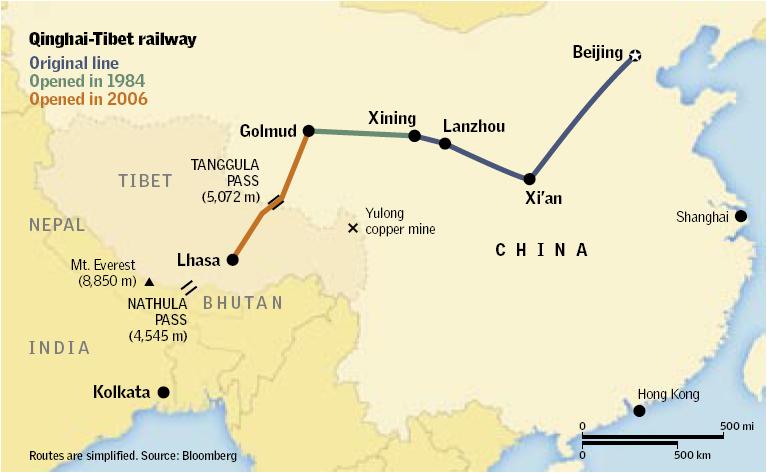
When former McKinsey & Co. consultant Ben Tsen boarded the first-ever train from Beijing to Tibet on July 1, the 48-hour journey in a sleeper berth cost him less than $100. His eventual outlay on Tibetan rail travel, he says, will be more like $100 million.
Even before China opened the world's highest railway line, over 5,072-meter-high (16,640-foot-tall) Tanggula Pass, investors such as Orange County, California-born Tsen, 33, were betting that they could profit from it.
In Tsen's case, that meant his company, Rail Partners, striking a deal with China's Ministry of Railways and Montreal- based rail-carmaker Bombardier Inc. to operate three private luxury tourist trains along the 4,064-kilometer (2,525-mile) route to the Tibetan capital of Lhasa.
Tibetan companies that manufacture everything from beer to copper to herbal altitude sickness potions have been eagerly awaiting completion of the rail line. Shares in listed companies that do business in Tibet have climbed as much as 300 percent in anticipation of new markets, cheaper freight rates and increased tourist numbers. An index of eight Tibetan companies listed on the Shanghai and Shenzhen stock exchanges rose 65 percent for the year ended on Aug. 29, according to data compiled by Bloomberg, compared with a 43 percent rise for the Shanghai Composite Index.
``Tibetan stocks have become theme stocks,'' says Chris Ruffle, 47, who helps manage $21.5 billion at Edinburgh-based Martin Currie Investment Management Ltd. ``They're going up even if they're 1,000 kilometers away from the railway.''
Beer at Top of World
Among the winners is Tibet Lhasa Brewery Co., which is 33 percent owned by Danish brewer Carlsberg A/S, and 50 percent owned by a local-listed company called Tibet Galaxy Science & Technology Development Co. Tibet Galaxy's stock increased 73 percent to 6.71 yuan in the year to Aug. 10, when shares were suspended from trading while the company undergoes restructuring as part of the Chinese government's efforts to sell off previously untradable state-owned shares. Lhasa Brewery's slogan is ``The Beer on the Top of the World.''
Chinese officials say that the opening of the railway will mean a rise in Tibet-bound tourists from 1.8 million in 2005 to 2.5 million this year. The line will also bring new streams of ethnic Chinese settlers that actor Richard Gere, chairman of the Washington-based International Campaign for Tibet, says will accelerate the destruction of Tibetan culture -- and make it easy to supply the Chinese military based there.
A Beijing-Lhasa rail link was first talked about by Sun Yat- sen, founder of modern China, after the fall of the Qing dynasty in 1911, according to Xinhua, the official news agency.
Deng Revives Idea
Mao Zedong revived the idea in the 1950s; those plans fell victim to the chaos of the Great Leap Forward and the Cultural Revolution. Deng Xiaoping revived the idea when he came to power in 1978, and the section from arid Qinghai province's capital, Xining, to Golmud, 2,800 meters above sea level, was finally opened in 1984.
It wasn't until 2000 that former President Jiang Zemin gave the order to proceed across the Tibetan border to Lhasa. More than 100,000 workers labored on the line. During the five- year construction period, 40 workers died, according to Zhu Zengsheng, deputy director of the Qinghai-Tibet railroad office, most in accidents on the road adjacent to the railway.
Some 550 kilometers of the track had to be laid over frozen tundra in temperatures that plunge to minus 35 degrees Celsius (minus 31 degrees Fahrenheit) in winter and then rise as high as 30-plus degrees in summer, causing the permafrost to turn to unstable mud that's impossible to build on.

Sinking into Permafrost
Railroad officials tried to solve the problem by constructing a 180-kilometer network of bridges and causeways over the most- troublesome patches of frozen earth. At some locations, they have piped super cold liquid nitrogen below the rail bed to keep the ground temperature constant.
Already, there's trouble. In some sections, the concrete in the rail bed has developed surface cracks, and foundations are sinking into the permafrost, according to Xinhua. On Aug. 9, Xinhua quoted Ministry of Railways Vice Minister Song Yongfu as saying the ministry would take measures to deal with such difficulties.
Some investors started counting their profits from the new train line early on. Fairfield, Connecticut-based General Electric Co. will gross about $150 million for 78 custom-built locomotives. Although China builds its own locomotives, it chose instead to use teams of three 3,800-horsepower GE engines for the haul up to Tibet.
For rail cars, it turned to an existing joint venture between Bombardier, the world's biggest rail-car manufacturer, Power Corp. of Canada and a Chinese partner. Their engineers created cars with an oxygen-enriched air supply to compensate for the 40 percent decrease in oxygen content at Tibet's highest altitudes.
Raging Thunderstorms
The cars come equipped with emergency breathing masks, windows that shield passengers from ultraviolet rays and lightning protection equipment. On the high plateau between Mount Everest and the Kun Lun and Tanggula mountains, thunderstorms rage an average of 82 days a year, according to Zhang Jiangwei, Beijing-based president and chief country representative of Bombardier China.
The rail cars are sealed to keep the elements out and the oxygen in. ``Our cars look classical, but not one screw remained classical when adapted to the Tibet operation,'' Zhang says. Bombardier and its two joint venture partners will bank $281 million in sales for 361 passenger cars.
A Hyatt in Lhasa
The flood of new tourists will be a boon to Tibet's hotel industry. The first big new hotel is likely to be a Hyatt, officials say. Beijing-based Citic Group, China's biggest in- vestment company, last year signed an agreement with the Lhasa city government to build a Park Hyatt, according to the China Tibet Information Center. The hotel will cost $25 million, the Tibet Government Commerce Bureau said in February.
Daniella Wu, a Hong Kong-based spokeswoman for Global Hyatt Inc., says she can't confirm Hyatt's involvement, since a management agreement hasn't been signed. ``Hyatt is always very interested in opportunities in Tibet,'' Wu says. ``It's one of the finest tourist attractions in the world, and the train is exciting news.''
The railway itself is an engineering marvel, says Lou Thompson, a Washington-based rail consultant who was the World Bank's chief railway adviser from 1986 to 2003. ``This is probably the largest and grandest piece of railway construction anywhere in the world in the last 20 years,'' he says. ``It's comparable to the Channel Tunnel link in Europe.''
Auld Lang Syne
Reporters were given rare permission to visit Tibet via the first scheduled train. Number T27 departed Beijing at 9:30 on a sultry summer's evening with strains of ``Auld Lang Syne'' playing on the station's public address system. The train sped at 140 kilometers per hour through the teeming cities and lush rice fields of China's heartland and then jolted to a halt a day and a half later at the western outpost of Golmud. There, three new GE locomotives were attached.
Then the real adventure began. As the sun rose over the Tanggula mountain range, which guards Tibet's northern frontier, the train snaked its way up toward the high plateau James Hilton fictionalized as Shangri-La in his novel ``Lost Horizon.''
At 3,500 meters, pens began to leak in reporters' pockets as the high altitude thinned the ink. At 4,500 meters, laptop computers began malfunctioning. So did human bodies. In hard seats and soft sleepers, passengers laid low by altitude sickness reached for the oxygen supply apparatus attached to every seat and pushed tubes up their nostrils. A doctor and nurse paced between compartments checking those who seemed most ill.
Shaggy Yaks
For passengers not afflicted, it was the view that was breathtaking. Glaciers reflected off arctic-blue lakes. Shaggy yaks grazed on green summer pastures. Herdsmen waved and antelope scattered as T27 approached, albeit at a reduced speed of 100 kph over the permafrost.
At one-kilometer intervals, security forces stood guard along the tracks. ``The People's Armed Police are determined to protect the railway and make the running safe and smooth,'' a banner at Nagqu station read.
From there, the train descended into the Lhasa River valley, still 3,600 meters above sea level. In Lhasa, passengers stepped out into a new railway station modeled on the Potala Palace, once the hilltop residence of the Dalai Lama, Tibetan Buddhism's spiritual leader that dominates the capital. All around were snowcapped peaks: to the South, the Himalayan chain arcing west toward Mount Everest; to the north, the Kun Lun and Tanggula ranges.
The Chinese national government spent $4.2 billion to extend the existing rail network 1,142 kilometers from Golmud to Lhasa, rail office director Zhu says.
$49 One Way
Even while the railway increases business opportunities in the region, the government-owned line will itself lose money, Thompson says. Passenger fares are as low as $49 one-way for a so- called hard-class seat -- a thinly padded chair with no amenities.
Freight capacity is 7.5 million tons a year and charges have been set at 1.5 cents a ton, according to railway officials. That's a little less than international standards, Thompson says, while costs will be high to maintain the road bed and bridges across some of the world's most hostile terrain.
Champa Phuntsok, chairman of the Beijing-appointed Tibetan regional government, says the new railway will speed up economic and social development for all Tibetans, who are among the poorest people in China. ``This is a magical road of heaven,'' Phuntsok told reporters.
Just 2.8 million Tibetans live in the Tibet autonomous region, which is the size of France, Germany and the U.K. combined. Gross domestic product per capita in Tibet has only just passed $1,000, according to Phuntsok, 59. That's 40 percent below the national average and one-seventh that of Shanghai.


Developing the West
The yak herdsmen and barley farmers of rural Tibet earn an average of just 71 cents a day. Tibetans have the lowest life expectancy in China: 67 years compared with a national average of 73.
The railway is one leg of a larger development plan for Tibet and other western provinces, says Jiang Yu, a spokesperson for the Ministry of Foreign Affairs. From 2001 to '05, China spent 5.77 trillion yuan ($724 billion) -- almost one-third of its annual GDP -- on roads, railways and gas, oil and hydroelectric projects in the West, according to the National Bureau of Statistics. That includes the $22 billion Three Gorges Dam in Hubei province, which can generate as much electricity as 10 nuclear reactors, according to the China Society for Hydropower Engineering.
Tibet and other mountainous regions, where great rivers such as the Yangtze and Mekong plunge through giant gorges, will be a future hub of hydropower. ``We are going to be transporting electricity from West to East,'' Phuntsok says. ``And companies from abroad are welcome to develop water resources in Tibet.''
Mine Shares Soar
Tibet is also a valuable repository of mineral wealth. Tibet Yulong Copper Industrial Corp., a private company 39 percent owned by Hong Kong-listed Zijin Mining Group Co., has begun preliminary construction on China's largest copper mine, near Jomda, 1,000 kilometers east of Lhasa, Zijin Chairman Chen Jinghe said at an August press conference.
The mine has 6.5 million metric tons of reserves. Phuntsok says Tibet has other copper deposits to exploit. ``We are going to gradually accelerate development of copper so as to benefit the people of Tibet,'' he says.
Shares in Zijin Mining, which also runs China's biggest gold mine, soared 287 percent to 3.76 Hong Kong dollars on Aug. 29 from 97 Hong Kong cents a year earlier. Sean Zheng, who helps manage $100 million at Beijing-based Dingtian Asset Management, says developing the remote mine won't be easy. ``In the short term, it's a challenge,'' Zheng says. ``But in the long term, it's good for the company and very good for China.''
`Wholesale Rape'
Activist Gere says the rail line and other development will benefit only Beijing. ``It's going to lead to a wholesale rape of Tibet's natural resources,'' Gere, 57, said in an interview. Gere, a practicing Buddhist, is a devotee of the Dalai Lama, who fled his homeland in 1959 after a failed uprising and now heads a Tibetan government in exile in India.
Over the centuries, Tibet was repeatedly overrun by Mongol and Manchu invaders, with sporadic periods of independence. After the fall of the Qing dynasty in 1911, it was an independent theocracy headed by successive Dalai Lamas.
Two years after Mao Zedong's communists seized power in 1949, People's Liberation Army troops conquered Tibet with little resistance. The Chinese takeover was a ``peaceful liberation,'' says Phuntsok, and saved Tibetans from feudal serfdom. In recent years, the Dalai Lama has dropped his demand for an independent Tibet, saying he would settle instead for ``genuine autonomy.''
`Too Many Chinese'
Gere laments that the railroad will bring more ethnic Chinese to Lhasa, where he says they already are a majority of the provincial capital's population of 500,000. Phuntsok responds that many of the Chinese in Lhasa are temporary residents doing business there and that 90 percent of the city's population is Tibetan.
The Dalai Lama's supporters say they welcome investment that gives opportunities to Tibetans. ``I have nothing against these companies making a profit, but I do have a problem with them making a profit when it brings about the destruction of the Tibetan people and their culture,'' Gere says of Bombardier and GE.
Spokesmen for the companies say they have no qualms about their involvement in the rail project. ``Railways bring benefits that result in improved living conditions,'' says Patrick Jarvis, a spokesman for GE. Bombardier China President Zhang says his company supplied only passenger cars and wasn't involved in the decision to build the railroad.
At Lhasa's 1,300-year-old Jokhang monastery, a 28-year-old monk has a dim view of the railway. ``I don't think it is a good thing,'' he says. ``It will bring too many Chinese here.''
Yak Herders' Bonanza
Laurence Brahm, a New York-born, Beijing-based lawyer and entrepreneur who this year opened House of Shambhala, a 10-room boutique hotel in Lhasa, says he's not deterred by tensions over Tibetan politics. ``I have a very strong feeling they are going to solve this issue by 2008, when Beijing hosts the Olympics,'' Brahm, 45, says. ``I would not put my time and money here if I wasn't optimistic.''
Nu Jo, 66, a grizzled yak herder on the windswept Tibetan plateau, says the railroad will be a bonanza. Last year was a record year for his family of nine, he says. First, there was the 2,000 yuan he earned from the meat, yogurt and cheese he obtained from his 70-strong herd of yaks. Then, with his rickety three- wheeled tractor, he made 9,000 yuan by hiring himself out to the ministry of railways to help build track across his grazing land.
Now, Nu Jo, who until this year had never seen a train, is betting 2006 will deliver him another financial bonus when he and his neighbors start using the new railway to ship their yak meat and yogurt to faraway markets.
Spurring Beer Consumption
In Lhasa, both local companies and multinationals are hoping to profit in Tibet and other western provinces. Carlsberg, for instance, owns stakes in breweries in Gansu, Ning-xia, Qinghai, Xinjiang and Yunnan, all of them among China's poorest provinces.
``Economic development is far behind east and south China, and beer consumption in Yunnan is one-quarter of the national average,'' says Jesper Madsen, 52, senior vice president in charge of Asia for Carlsberg. ``We see this as a growth region.''
In the past two years, Lhasa Brewery has spent 380 million yuan to triple the factory's capacity to 150,000 tons of beer a year. It expects the railway to reduce the company's freight costs by about two-thirds and enable it to export to the rest of China and abroad. ``With the coming of the railway, the company's cost base will collapse,'' says Ruffle, who says he sold a 4 percent stake in Tibet Galaxy earlier this year to take profit.
Clean, Clear Water
Wallace Yu's Tibetan investment is in Lhasa Beer's most important ingredient, the autonomous region's clear, clean water. Yu, a Canadian-Chinese investor, has spent $30 million so far to set up Tibet Glacier Mineral Water Co., located 4,330 meters up a mountainside, a three-hour drive north of Lhasa.
``It's the biggest investment I ever made,'' says Yu, 50, who is calling his water ``5100'' after the altitude of his source. ``And it wouldn't have been possible without the railway because this water is a premium product mostly for export.''
No industry will benefit more from the new railway than tourism. In 2004, 1.25 million visitors arrived in Tibet to explore the Potala Palace, the Jokhang monastery and the streets of the ancient Barkhor quarter. This year, the new train will bring in an additional 600,000 visitors, according to the China Tibet Tourism Bureau. By 2020, the bureau says, Tibet will host 10 million tourists a year, who will spend $2.3 billion, or 18 percent of the region's GDP.
New Silk Road
``My biggest headache used to be having enough money to restore the palace,'' says Qiangba Gesang, director of Potala, where tourists wander the labyrinthine rooms by the light of flickering butter lamps -- lanterns whose fuel is oil made from yak butter. ``Now that the government has given me enough money, my headache is to protect it from too many tourists.'' When Qiangba, 64, took the job in 1988, the palace received 90,000 visitors a year. Next year, he says, it will greet 600,000.
Now, Phuntsok has an even grander vision. He wants to make the rail line part of an international trade route to India, with which Tibet has a 1,000-kilometer border. The main motivation is to spur cross-border trade between two of the world's fastest- growing economies, since Lhasa is closer to Kolkata (formerly Calcutta) than it is to Beijing.
In July, China and India reopened the 4,545-meter-high Nathula Pass across the Himalayas, a trade route dating back to the Silk Road that had been closed since the two neighbors fought a border war in 1962. So far, 44 products are permitted to cross the border, including raw silk and yak's tails from Tibet and textiles, liquor, cigarettes and barley from India.
China has only agreed to extend the line to Xigaze, 250 kilometers southwest of Lhasa, well short of the Indian border, according to Yu Yungui, a Xigaze prefecture official quoted by Xinhua. Rail Partners' Tsen might have to wait a few years before he can steer his luxury trains from the serenity of Tibet to the hurly-burly of Kolkata.
By William Mellor
Bloomberg, 2006-08-29
When former McKinsey & Co. consultant Ben Tsen boarded the first-ever train from Beijing to Tibet on July 1, the 48-hour journey in a sleeper berth cost him less than $100. His eventual outlay on Tibetan rail travel, he says, will be more like $100 million.
Even before China opened the world's highest railway line, over 5,072-meter-high (16,640-foot-tall) Tanggula Pass, investors such as Orange County, California-born Tsen, 33, were betting that they could profit from it.
In Tsen's case, that meant his company, Rail Partners, striking a deal with China's Ministry of Railways and Montreal- based rail-carmaker Bombardier Inc. to operate three private luxury tourist trains along the 4,064-kilometer (2,525-mile) route to the Tibetan capital of Lhasa.
Tibetan companies that manufacture everything from beer to copper to herbal altitude sickness potions have been eagerly awaiting completion of the rail line. Shares in listed companies that do business in Tibet have climbed as much as 300 percent in anticipation of new markets, cheaper freight rates and increased tourist numbers. An index of eight Tibetan companies listed on the Shanghai and Shenzhen stock exchanges rose 65 percent for the year ended on Aug. 29, according to data compiled by Bloomberg, compared with a 43 percent rise for the Shanghai Composite Index.
``Tibetan stocks have become theme stocks,'' says Chris Ruffle, 47, who helps manage $21.5 billion at Edinburgh-based Martin Currie Investment Management Ltd. ``They're going up even if they're 1,000 kilometers away from the railway.''
Beer at Top of World
Among the winners is Tibet Lhasa Brewery Co., which is 33 percent owned by Danish brewer Carlsberg A/S, and 50 percent owned by a local-listed company called Tibet Galaxy Science & Technology Development Co. Tibet Galaxy's stock increased 73 percent to 6.71 yuan in the year to Aug. 10, when shares were suspended from trading while the company undergoes restructuring as part of the Chinese government's efforts to sell off previously untradable state-owned shares. Lhasa Brewery's slogan is ``The Beer on the Top of the World.''
Chinese officials say that the opening of the railway will mean a rise in Tibet-bound tourists from 1.8 million in 2005 to 2.5 million this year. The line will also bring new streams of ethnic Chinese settlers that actor Richard Gere, chairman of the Washington-based International Campaign for Tibet, says will accelerate the destruction of Tibetan culture -- and make it easy to supply the Chinese military based there.
A Beijing-Lhasa rail link was first talked about by Sun Yat- sen, founder of modern China, after the fall of the Qing dynasty in 1911, according to Xinhua, the official news agency.
Deng Revives Idea
Mao Zedong revived the idea in the 1950s; those plans fell victim to the chaos of the Great Leap Forward and the Cultural Revolution. Deng Xiaoping revived the idea when he came to power in 1978, and the section from arid Qinghai province's capital, Xining, to Golmud, 2,800 meters above sea level, was finally opened in 1984.
It wasn't until 2000 that former President Jiang Zemin gave the order to proceed across the Tibetan border to Lhasa. More than 100,000 workers labored on the line. During the five- year construction period, 40 workers died, according to Zhu Zengsheng, deputy director of the Qinghai-Tibet railroad office, most in accidents on the road adjacent to the railway.
Some 550 kilometers of the track had to be laid over frozen tundra in temperatures that plunge to minus 35 degrees Celsius (minus 31 degrees Fahrenheit) in winter and then rise as high as 30-plus degrees in summer, causing the permafrost to turn to unstable mud that's impossible to build on.

Sinking into Permafrost
Railroad officials tried to solve the problem by constructing a 180-kilometer network of bridges and causeways over the most- troublesome patches of frozen earth. At some locations, they have piped super cold liquid nitrogen below the rail bed to keep the ground temperature constant.
Already, there's trouble. In some sections, the concrete in the rail bed has developed surface cracks, and foundations are sinking into the permafrost, according to Xinhua. On Aug. 9, Xinhua quoted Ministry of Railways Vice Minister Song Yongfu as saying the ministry would take measures to deal with such difficulties.
Some investors started counting their profits from the new train line early on. Fairfield, Connecticut-based General Electric Co. will gross about $150 million for 78 custom-built locomotives. Although China builds its own locomotives, it chose instead to use teams of three 3,800-horsepower GE engines for the haul up to Tibet.
For rail cars, it turned to an existing joint venture between Bombardier, the world's biggest rail-car manufacturer, Power Corp. of Canada and a Chinese partner. Their engineers created cars with an oxygen-enriched air supply to compensate for the 40 percent decrease in oxygen content at Tibet's highest altitudes.
Raging Thunderstorms
The cars come equipped with emergency breathing masks, windows that shield passengers from ultraviolet rays and lightning protection equipment. On the high plateau between Mount Everest and the Kun Lun and Tanggula mountains, thunderstorms rage an average of 82 days a year, according to Zhang Jiangwei, Beijing-based president and chief country representative of Bombardier China.
The rail cars are sealed to keep the elements out and the oxygen in. ``Our cars look classical, but not one screw remained classical when adapted to the Tibet operation,'' Zhang says. Bombardier and its two joint venture partners will bank $281 million in sales for 361 passenger cars.
A Hyatt in Lhasa
The flood of new tourists will be a boon to Tibet's hotel industry. The first big new hotel is likely to be a Hyatt, officials say. Beijing-based Citic Group, China's biggest in- vestment company, last year signed an agreement with the Lhasa city government to build a Park Hyatt, according to the China Tibet Information Center. The hotel will cost $25 million, the Tibet Government Commerce Bureau said in February.
Daniella Wu, a Hong Kong-based spokeswoman for Global Hyatt Inc., says she can't confirm Hyatt's involvement, since a management agreement hasn't been signed. ``Hyatt is always very interested in opportunities in Tibet,'' Wu says. ``It's one of the finest tourist attractions in the world, and the train is exciting news.''
The railway itself is an engineering marvel, says Lou Thompson, a Washington-based rail consultant who was the World Bank's chief railway adviser from 1986 to 2003. ``This is probably the largest and grandest piece of railway construction anywhere in the world in the last 20 years,'' he says. ``It's comparable to the Channel Tunnel link in Europe.''
Auld Lang Syne
Reporters were given rare permission to visit Tibet via the first scheduled train. Number T27 departed Beijing at 9:30 on a sultry summer's evening with strains of ``Auld Lang Syne'' playing on the station's public address system. The train sped at 140 kilometers per hour through the teeming cities and lush rice fields of China's heartland and then jolted to a halt a day and a half later at the western outpost of Golmud. There, three new GE locomotives were attached.
Then the real adventure began. As the sun rose over the Tanggula mountain range, which guards Tibet's northern frontier, the train snaked its way up toward the high plateau James Hilton fictionalized as Shangri-La in his novel ``Lost Horizon.''
At 3,500 meters, pens began to leak in reporters' pockets as the high altitude thinned the ink. At 4,500 meters, laptop computers began malfunctioning. So did human bodies. In hard seats and soft sleepers, passengers laid low by altitude sickness reached for the oxygen supply apparatus attached to every seat and pushed tubes up their nostrils. A doctor and nurse paced between compartments checking those who seemed most ill.
Shaggy Yaks
For passengers not afflicted, it was the view that was breathtaking. Glaciers reflected off arctic-blue lakes. Shaggy yaks grazed on green summer pastures. Herdsmen waved and antelope scattered as T27 approached, albeit at a reduced speed of 100 kph over the permafrost.
At one-kilometer intervals, security forces stood guard along the tracks. ``The People's Armed Police are determined to protect the railway and make the running safe and smooth,'' a banner at Nagqu station read.
From there, the train descended into the Lhasa River valley, still 3,600 meters above sea level. In Lhasa, passengers stepped out into a new railway station modeled on the Potala Palace, once the hilltop residence of the Dalai Lama, Tibetan Buddhism's spiritual leader that dominates the capital. All around were snowcapped peaks: to the South, the Himalayan chain arcing west toward Mount Everest; to the north, the Kun Lun and Tanggula ranges.
The Chinese national government spent $4.2 billion to extend the existing rail network 1,142 kilometers from Golmud to Lhasa, rail office director Zhu says.
$49 One Way
Even while the railway increases business opportunities in the region, the government-owned line will itself lose money, Thompson says. Passenger fares are as low as $49 one-way for a so- called hard-class seat -- a thinly padded chair with no amenities.
Freight capacity is 7.5 million tons a year and charges have been set at 1.5 cents a ton, according to railway officials. That's a little less than international standards, Thompson says, while costs will be high to maintain the road bed and bridges across some of the world's most hostile terrain.
Champa Phuntsok, chairman of the Beijing-appointed Tibetan regional government, says the new railway will speed up economic and social development for all Tibetans, who are among the poorest people in China. ``This is a magical road of heaven,'' Phuntsok told reporters.
Just 2.8 million Tibetans live in the Tibet autonomous region, which is the size of France, Germany and the U.K. combined. Gross domestic product per capita in Tibet has only just passed $1,000, according to Phuntsok, 59. That's 40 percent below the national average and one-seventh that of Shanghai.
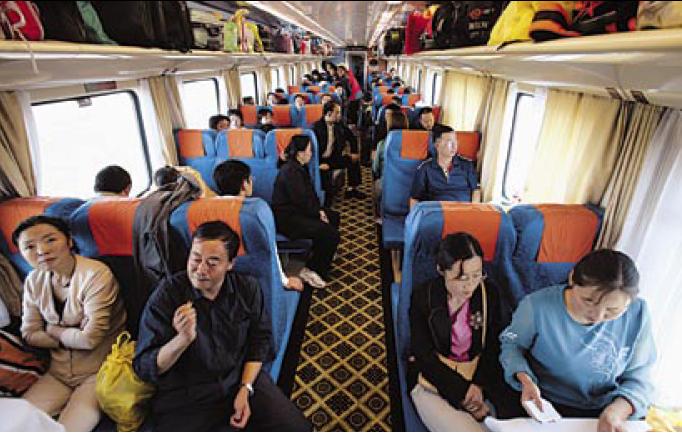
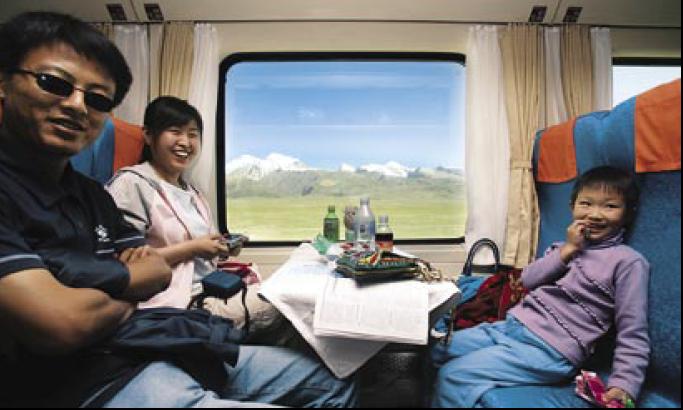
Developing the West
The yak herdsmen and barley farmers of rural Tibet earn an average of just 71 cents a day. Tibetans have the lowest life expectancy in China: 67 years compared with a national average of 73.
The railway is one leg of a larger development plan for Tibet and other western provinces, says Jiang Yu, a spokesperson for the Ministry of Foreign Affairs. From 2001 to '05, China spent 5.77 trillion yuan ($724 billion) -- almost one-third of its annual GDP -- on roads, railways and gas, oil and hydroelectric projects in the West, according to the National Bureau of Statistics. That includes the $22 billion Three Gorges Dam in Hubei province, which can generate as much electricity as 10 nuclear reactors, according to the China Society for Hydropower Engineering.
Tibet and other mountainous regions, where great rivers such as the Yangtze and Mekong plunge through giant gorges, will be a future hub of hydropower. ``We are going to be transporting electricity from West to East,'' Phuntsok says. ``And companies from abroad are welcome to develop water resources in Tibet.''
Mine Shares Soar
Tibet is also a valuable repository of mineral wealth. Tibet Yulong Copper Industrial Corp., a private company 39 percent owned by Hong Kong-listed Zijin Mining Group Co., has begun preliminary construction on China's largest copper mine, near Jomda, 1,000 kilometers east of Lhasa, Zijin Chairman Chen Jinghe said at an August press conference.
The mine has 6.5 million metric tons of reserves. Phuntsok says Tibet has other copper deposits to exploit. ``We are going to gradually accelerate development of copper so as to benefit the people of Tibet,'' he says.
Shares in Zijin Mining, which also runs China's biggest gold mine, soared 287 percent to 3.76 Hong Kong dollars on Aug. 29 from 97 Hong Kong cents a year earlier. Sean Zheng, who helps manage $100 million at Beijing-based Dingtian Asset Management, says developing the remote mine won't be easy. ``In the short term, it's a challenge,'' Zheng says. ``But in the long term, it's good for the company and very good for China.''
`Wholesale Rape'
Activist Gere says the rail line and other development will benefit only Beijing. ``It's going to lead to a wholesale rape of Tibet's natural resources,'' Gere, 57, said in an interview. Gere, a practicing Buddhist, is a devotee of the Dalai Lama, who fled his homeland in 1959 after a failed uprising and now heads a Tibetan government in exile in India.
Over the centuries, Tibet was repeatedly overrun by Mongol and Manchu invaders, with sporadic periods of independence. After the fall of the Qing dynasty in 1911, it was an independent theocracy headed by successive Dalai Lamas.
Two years after Mao Zedong's communists seized power in 1949, People's Liberation Army troops conquered Tibet with little resistance. The Chinese takeover was a ``peaceful liberation,'' says Phuntsok, and saved Tibetans from feudal serfdom. In recent years, the Dalai Lama has dropped his demand for an independent Tibet, saying he would settle instead for ``genuine autonomy.''
`Too Many Chinese'
Gere laments that the railroad will bring more ethnic Chinese to Lhasa, where he says they already are a majority of the provincial capital's population of 500,000. Phuntsok responds that many of the Chinese in Lhasa are temporary residents doing business there and that 90 percent of the city's population is Tibetan.
The Dalai Lama's supporters say they welcome investment that gives opportunities to Tibetans. ``I have nothing against these companies making a profit, but I do have a problem with them making a profit when it brings about the destruction of the Tibetan people and their culture,'' Gere says of Bombardier and GE.
Spokesmen for the companies say they have no qualms about their involvement in the rail project. ``Railways bring benefits that result in improved living conditions,'' says Patrick Jarvis, a spokesman for GE. Bombardier China President Zhang says his company supplied only passenger cars and wasn't involved in the decision to build the railroad.
At Lhasa's 1,300-year-old Jokhang monastery, a 28-year-old monk has a dim view of the railway. ``I don't think it is a good thing,'' he says. ``It will bring too many Chinese here.''
Yak Herders' Bonanza
Laurence Brahm, a New York-born, Beijing-based lawyer and entrepreneur who this year opened House of Shambhala, a 10-room boutique hotel in Lhasa, says he's not deterred by tensions over Tibetan politics. ``I have a very strong feeling they are going to solve this issue by 2008, when Beijing hosts the Olympics,'' Brahm, 45, says. ``I would not put my time and money here if I wasn't optimistic.''
Nu Jo, 66, a grizzled yak herder on the windswept Tibetan plateau, says the railroad will be a bonanza. Last year was a record year for his family of nine, he says. First, there was the 2,000 yuan he earned from the meat, yogurt and cheese he obtained from his 70-strong herd of yaks. Then, with his rickety three- wheeled tractor, he made 9,000 yuan by hiring himself out to the ministry of railways to help build track across his grazing land.
Now, Nu Jo, who until this year had never seen a train, is betting 2006 will deliver him another financial bonus when he and his neighbors start using the new railway to ship their yak meat and yogurt to faraway markets.
Spurring Beer Consumption
In Lhasa, both local companies and multinationals are hoping to profit in Tibet and other western provinces. Carlsberg, for instance, owns stakes in breweries in Gansu, Ning-xia, Qinghai, Xinjiang and Yunnan, all of them among China's poorest provinces.
``Economic development is far behind east and south China, and beer consumption in Yunnan is one-quarter of the national average,'' says Jesper Madsen, 52, senior vice president in charge of Asia for Carlsberg. ``We see this as a growth region.''
In the past two years, Lhasa Brewery has spent 380 million yuan to triple the factory's capacity to 150,000 tons of beer a year. It expects the railway to reduce the company's freight costs by about two-thirds and enable it to export to the rest of China and abroad. ``With the coming of the railway, the company's cost base will collapse,'' says Ruffle, who says he sold a 4 percent stake in Tibet Galaxy earlier this year to take profit.
Clean, Clear Water
Wallace Yu's Tibetan investment is in Lhasa Beer's most important ingredient, the autonomous region's clear, clean water. Yu, a Canadian-Chinese investor, has spent $30 million so far to set up Tibet Glacier Mineral Water Co., located 4,330 meters up a mountainside, a three-hour drive north of Lhasa.
``It's the biggest investment I ever made,'' says Yu, 50, who is calling his water ``5100'' after the altitude of his source. ``And it wouldn't have been possible without the railway because this water is a premium product mostly for export.''
No industry will benefit more from the new railway than tourism. In 2004, 1.25 million visitors arrived in Tibet to explore the Potala Palace, the Jokhang monastery and the streets of the ancient Barkhor quarter. This year, the new train will bring in an additional 600,000 visitors, according to the China Tibet Tourism Bureau. By 2020, the bureau says, Tibet will host 10 million tourists a year, who will spend $2.3 billion, or 18 percent of the region's GDP.
New Silk Road
``My biggest headache used to be having enough money to restore the palace,'' says Qiangba Gesang, director of Potala, where tourists wander the labyrinthine rooms by the light of flickering butter lamps -- lanterns whose fuel is oil made from yak butter. ``Now that the government has given me enough money, my headache is to protect it from too many tourists.'' When Qiangba, 64, took the job in 1988, the palace received 90,000 visitors a year. Next year, he says, it will greet 600,000.
Now, Phuntsok has an even grander vision. He wants to make the rail line part of an international trade route to India, with which Tibet has a 1,000-kilometer border. The main motivation is to spur cross-border trade between two of the world's fastest- growing economies, since Lhasa is closer to Kolkata (formerly Calcutta) than it is to Beijing.
In July, China and India reopened the 4,545-meter-high Nathula Pass across the Himalayas, a trade route dating back to the Silk Road that had been closed since the two neighbors fought a border war in 1962. So far, 44 products are permitted to cross the border, including raw silk and yak's tails from Tibet and textiles, liquor, cigarettes and barley from India.
China has only agreed to extend the line to Xigaze, 250 kilometers southwest of Lhasa, well short of the Indian border, according to Yu Yungui, a Xigaze prefecture official quoted by Xinhua. Rail Partners' Tsen might have to wait a few years before he can steer his luxury trains from the serenity of Tibet to the hurly-burly of Kolkata.
Subscribe to:
Posts (Atom)