
Saturday, August 26, 2006

Friday, August 25, 2006
Roundup of Economic & Business News (Aug 19 - Aug 25)
Commentaries & Editorials
Oil crisis and the 'Nepali Drama' (Aug 25, 06, Nepalnews.com)
Petroleum price hike fiasco (Aug 24, 06, eKantipur.com)
Debate on petroleum prices is missing (Aug 22, 06, eKantipur.com)
Aug 25
NEA hemorrhages Rs 1.75b as suppliers pocket Rs 1.4b (eKantipur.com)
Comprehensive economic partnership proposed (eKantipur.com)
Cabinet endorses Public Procurement Act (eKantipur.com)
Thailand luring more and more Nepalis (eKantipur.com)
Biz News Brief (eKantipur.com)
Government tables NRN bill before HoR (Nepalbiznews.com)
CEO’s forum set up for initiating policy dialogue (Nepalbiznews.com)
PAC, NRB governor discuss bad loans (Himalaya Times)
BRAND WATCH : LG launches Chocolate phone (Himalaya Times)
Biz News Brief (Himalaya Times)
Human development is more important than poverty reduction: Kahane (Nepalnews.com)
Development works hit after Maoists interfere (RSS)
'Govt to appeal to donors for assistance to farmers' (RSS)
Aug 24
Nepal proposes route for Sino-India trade (eKantipur.com)
Rs 200m relief package for farmers (eKantipur.com)
Govt fixes minimum wages (eKantipur.com)
12 parties sign accord to produce 45 MW electricity (Nepalbiznews.com)
Aug 23
Fuel supply yet to normalize (eKantipur.com)
Inmarsat satcom service launched (eKantipur.com)
Parliament passes budget (Nepalbiznews.com)
Food production to fall; Paddy waning across the nation (Nepalbiznews.com)
SWC approves an annual budget of about 68 m (Nepalbiznews.com)
Nepal-India talks to focus on trade balance (Nepalnews.com)
Asian countries may face shortage of water: Report (Nepalnews.com)
Aug 22
'Lack of suitable laws mar irrigation sector' (eKantipur.com)
Arrest warrants issued against NCSIDB officials (eKantipur.com)
Nepal-India trade meet begins (eKantipur.com)
‘No wage hike without subsidy’ (eKantipur.com)
Hydro Power Invest Mart kicks off (Nepalbiznews.com)
Aug 21
Petro dealers on nationwide strike (eKantipur.com)
Nepal-India trade talks from this week (eKantipur.com)
Exports from eastern region plummet (eKantipur.com)
RBB registers profit by 1.68 billion Biz News (Nepalbiznews.com)
Thoppal Khola Hydropower to produce electricity within 3 months (Nepalbiznews.com)
Indo Nepal inter governmental committee for trade promotion (Nepalbiznews.com)
'NOC is bankrupt' (Nepalnews.com)
Aug 20
Weak monsoon hits Terai paddy plantation (eKantipur.com)
Nepse sheds 3.79 points (eKantipur.com)
Govt withdraws fuel price hike (6:45 p.m.) (Nepalnews.com)
Aug 19
China bank to invest $1b in West Seti (eKantipur.com)
BANK DEFAULTERS: Govt to take strong action after deadline (eKantipur.com)
Petroleum price hike triggers nationwide protest (eKantipur.com)
Oil crisis and the 'Nepali Drama' (Aug 25, 06, Nepalnews.com)
Petroleum price hike fiasco (Aug 24, 06, eKantipur.com)
Debate on petroleum prices is missing (Aug 22, 06, eKantipur.com)
Aug 25
NEA hemorrhages Rs 1.75b as suppliers pocket Rs 1.4b (eKantipur.com)
Comprehensive economic partnership proposed (eKantipur.com)
Cabinet endorses Public Procurement Act (eKantipur.com)
Thailand luring more and more Nepalis (eKantipur.com)
Biz News Brief (eKantipur.com)
Government tables NRN bill before HoR (Nepalbiznews.com)
CEO’s forum set up for initiating policy dialogue (Nepalbiznews.com)
PAC, NRB governor discuss bad loans (Himalaya Times)
BRAND WATCH : LG launches Chocolate phone (Himalaya Times)
Biz News Brief (Himalaya Times)
Human development is more important than poverty reduction: Kahane (Nepalnews.com)
Development works hit after Maoists interfere (RSS)
'Govt to appeal to donors for assistance to farmers' (RSS)
Aug 24
Nepal proposes route for Sino-India trade (eKantipur.com)
Rs 200m relief package for farmers (eKantipur.com)
Govt fixes minimum wages (eKantipur.com)
12 parties sign accord to produce 45 MW electricity (Nepalbiznews.com)
Aug 23
Fuel supply yet to normalize (eKantipur.com)
Inmarsat satcom service launched (eKantipur.com)
Parliament passes budget (Nepalbiznews.com)
Food production to fall; Paddy waning across the nation (Nepalbiznews.com)
SWC approves an annual budget of about 68 m (Nepalbiznews.com)
Nepal-India talks to focus on trade balance (Nepalnews.com)
Asian countries may face shortage of water: Report (Nepalnews.com)
Aug 22
'Lack of suitable laws mar irrigation sector' (eKantipur.com)
Arrest warrants issued against NCSIDB officials (eKantipur.com)
Nepal-India trade meet begins (eKantipur.com)
‘No wage hike without subsidy’ (eKantipur.com)
Hydro Power Invest Mart kicks off (Nepalbiznews.com)
Aug 21
Petro dealers on nationwide strike (eKantipur.com)
Nepal-India trade talks from this week (eKantipur.com)
Exports from eastern region plummet (eKantipur.com)
RBB registers profit by 1.68 billion Biz News (Nepalbiznews.com)
Thoppal Khola Hydropower to produce electricity within 3 months (Nepalbiznews.com)
Indo Nepal inter governmental committee for trade promotion (Nepalbiznews.com)
'NOC is bankrupt' (Nepalnews.com)
Aug 20
Weak monsoon hits Terai paddy plantation (eKantipur.com)
Nepse sheds 3.79 points (eKantipur.com)
Govt withdraws fuel price hike (6:45 p.m.) (Nepalnews.com)
Aug 19
China bank to invest $1b in West Seti (eKantipur.com)
BANK DEFAULTERS: Govt to take strong action after deadline (eKantipur.com)
Petroleum price hike triggers nationwide protest (eKantipur.com)
Friday, August 18, 2006
Roundup of Economic & Business News (Aug 12 - Aug 18)
Commentaries - Editorials
Govt failure, private sector rescue (Aug 13, 06, Nepalbiznews.com.com)
Interview with Narendra Basnyat (Aug 13, 06, eKantipur.com)
Aug 18
Banks' outstanding dues around Rs 28 b : Finance Minister (Nepalbiznews.com)
Tourism industry needs to seize upcoming arrival season (Nepalbiznews.com)
Load-shedding to hit hard consumers; NEA in turmoil unveils the White Paper Biz News (Nepalbiznews.com)
NATO elects new executive committee (Nepalnews.com)
Aug 17
Load shedding from Sept 1 (eKantipur.com)
Height of injustice (eKantipur.com)
Bank shares at stock market overvalued: official (eKantipur.com)
Indian leader assures for railway extension (Nepalbiznews.com)
Transporters halt trade via Nepalgunj customs (Nepalbiznews.com)
Tea workers' agitation continues (Nepalbiznews.com)
South Korea exploits migrant workers: AI (Nepalnews.com)
NPC irrelevant, restructure it: Experts (Nepalnews.com)
Government endorses Biotechnology Policy-2063 (Nepalnews.com)
Aid to Nepal grows to Rs 93b (The Himalayan Time)
Biz Briefs (The Himalayan Time)
Aug 16
50 Nepalis stranded in Malaysia, demand action against manpower companies (eKantipur.com)
53 groups default Rs 25b with banks (eKantipur.com)
26,000 health workers to go on strike from Thursday (eKantipur.com)
NRB declares NCSIDB a 'troubled bank' (eKantipur.com)
Workers threaten to shut down Khimti Hydel Project (eKantipur.com)
NCSIDB declared troubled bank (Nepalbiznews.com)
More efforts essential to meet MDGs' target: Experts (Nepalbiznews.com)
NRB directed to disclose loan defaulters; 53 defaulters yet to pay Rs 15.2 billion (Nepalbiznews.com)
Aug 15
53 groups default Rs 25b with banks (eKantipur.com)
NRB declares NCSIDB a 'troubled bank' (eKantipur.com)
Petrol crisis persists in Valley (eKantipur.com)
Freelance agents swindle Rs 158m (eKantipur.com)
‘Govt serious in promoting tourism’ (eKantipur.com)
Tea workers' protest in full swing (eKantipur.com)
PM promises adequate fertilizer supply (eKantipur.com)
Biz News Summary (eKantipur.com)
53 groups default Rs 25b with banks (eKantipur.com)
NRB declares NCSIDB a 'troubled bank' (eKantipur.com)
Petrol crisis persists in Valley (eKantipur.com)
Freelance agents swindle Rs 158m (eKantipur.com)
‘Govt serious in promoting tourism’ (eKantipur.com)
Tea workers' protest in full swing (eKantipur.com)
PM promises adequate fertilizer supply (eKantipur.com)
Biz News Summary (eKantipur.com)
India to treble development assistance (Nepalbiznews.com)
Government indifferent to NOC losses (Nepalnews.com)
Aug 14
Petrol supply situation worsens (eKantipur.com)
Vehicle registration up by 37.6 pc (eKantipur.com)
Biz News Summary (eKantipur.com)
CNI to organise Hydropower Mart 2006 (Nepalbiznews.com)
Cabinet decides to put on NRN bill to HoR; no dual citizen now (Nepalbiznews.com)
Tea gardens in eastern Nepal on halt (Nepalbiznews.com)
Pilots express dissatisfaction over new regulatory for them (Nepalbiznews.com)
Turmoil over petroleum products persists in the capital (Nepalbiznews.com)
Modeling emerges as a new career option (Nepalbiznews.com)
Industrial sector performs poorly (The Himalayan Time)
KBL unveils new scheme (The Himalayan Time)
United World Trade Centre to open from September 22 (The Himalayan Time)
Gautam new GM at Sajha Prakashan (RSS)
MPs discuss health budget (RSS)
AIDS may cripple S Asia, warns WB (RSS)
Aug 13
Petro products supply normalized (eKantipur.com)
Biz News Summary (eKantipur.com)
Nissan's Tiida hits the road (eKantipur.com)
Investors’ confidence in stock market dips : Share transaction value in millions (The Himalayan Time)
NOM resumes its operation (The Himalayan Time)
Sujalgum comes to market (The Himalayan Time)
Aug 12
NOC denies short supply of fuel (eKantipur.com)
Gold price dips (eKantipur.com)
Rupee weakens against dollar (eKantipur.com)
Stock exchange gains 27.30 pts (eKantipur.com)
OC team returns, Nepal's request to be considered(Nepalnewsbiz.com)
High rise in inflation; remittance keeping economy alive: NRB (Nepalbiznews.com)
Govt failure, private sector rescue (Aug 13, 06, Nepalbiznews.com.com)
Interview with Narendra Basnyat (Aug 13, 06, eKantipur.com)
Aug 18
Banks' outstanding dues around Rs 28 b : Finance Minister (Nepalbiznews.com)
Tourism industry needs to seize upcoming arrival season (Nepalbiznews.com)
Load-shedding to hit hard consumers; NEA in turmoil unveils the White Paper Biz News (Nepalbiznews.com)
NATO elects new executive committee (Nepalnews.com)
Aug 17
Load shedding from Sept 1 (eKantipur.com)
Height of injustice (eKantipur.com)
Bank shares at stock market overvalued: official (eKantipur.com)
Indian leader assures for railway extension (Nepalbiznews.com)
Transporters halt trade via Nepalgunj customs (Nepalbiznews.com)
Tea workers' agitation continues (Nepalbiznews.com)
South Korea exploits migrant workers: AI (Nepalnews.com)
NPC irrelevant, restructure it: Experts (Nepalnews.com)
Government endorses Biotechnology Policy-2063 (Nepalnews.com)
Aid to Nepal grows to Rs 93b (The Himalayan Time)
Biz Briefs (The Himalayan Time)
Aug 16
50 Nepalis stranded in Malaysia, demand action against manpower companies (eKantipur.com)
53 groups default Rs 25b with banks (eKantipur.com)
26,000 health workers to go on strike from Thursday (eKantipur.com)
NRB declares NCSIDB a 'troubled bank' (eKantipur.com)
Workers threaten to shut down Khimti Hydel Project (eKantipur.com)
NCSIDB declared troubled bank (Nepalbiznews.com)
More efforts essential to meet MDGs' target: Experts (Nepalbiznews.com)
NRB directed to disclose loan defaulters; 53 defaulters yet to pay Rs 15.2 billion (Nepalbiznews.com)
Aug 15
53 groups default Rs 25b with banks (eKantipur.com)
NRB declares NCSIDB a 'troubled bank' (eKantipur.com)
Petrol crisis persists in Valley (eKantipur.com)
Freelance agents swindle Rs 158m (eKantipur.com)
‘Govt serious in promoting tourism’ (eKantipur.com)
Tea workers' protest in full swing (eKantipur.com)
PM promises adequate fertilizer supply (eKantipur.com)
Biz News Summary (eKantipur.com)
53 groups default Rs 25b with banks (eKantipur.com)
NRB declares NCSIDB a 'troubled bank' (eKantipur.com)
Petrol crisis persists in Valley (eKantipur.com)
Freelance agents swindle Rs 158m (eKantipur.com)
‘Govt serious in promoting tourism’ (eKantipur.com)
Tea workers' protest in full swing (eKantipur.com)
PM promises adequate fertilizer supply (eKantipur.com)
Biz News Summary (eKantipur.com)
India to treble development assistance (Nepalbiznews.com)
Government indifferent to NOC losses (Nepalnews.com)
Aug 14
Petrol supply situation worsens (eKantipur.com)
Vehicle registration up by 37.6 pc (eKantipur.com)
Biz News Summary (eKantipur.com)
CNI to organise Hydropower Mart 2006 (Nepalbiznews.com)
Cabinet decides to put on NRN bill to HoR; no dual citizen now (Nepalbiznews.com)
Tea gardens in eastern Nepal on halt (Nepalbiznews.com)
Pilots express dissatisfaction over new regulatory for them (Nepalbiznews.com)
Turmoil over petroleum products persists in the capital (Nepalbiznews.com)
Modeling emerges as a new career option (Nepalbiznews.com)
Industrial sector performs poorly (The Himalayan Time)
KBL unveils new scheme (The Himalayan Time)
United World Trade Centre to open from September 22 (The Himalayan Time)
Gautam new GM at Sajha Prakashan (RSS)
MPs discuss health budget (RSS)
AIDS may cripple S Asia, warns WB (RSS)
Aug 13
Petro products supply normalized (eKantipur.com)
Biz News Summary (eKantipur.com)
Nissan's Tiida hits the road (eKantipur.com)
Investors’ confidence in stock market dips : Share transaction value in millions (The Himalayan Time)
NOM resumes its operation (The Himalayan Time)
Sujalgum comes to market (The Himalayan Time)
Aug 12
NOC denies short supply of fuel (eKantipur.com)
Gold price dips (eKantipur.com)
Rupee weakens against dollar (eKantipur.com)
Stock exchange gains 27.30 pts (eKantipur.com)
OC team returns, Nepal's request to be considered(Nepalnewsbiz.com)
High rise in inflation; remittance keeping economy alive: NRB (Nepalbiznews.com)
Monday, August 14, 2006
Nepal - The Transit Economy
Keeping Track of News, Views and Research on Nepal Becoming the Transit Point Between India & China
News & Views
1) Nepal proposes route for Sino-India trade (Aug 24 2006, eKantipur.com)
2) Transit Economy (June 2006, Spotlight)
Papers presented at a national seminar on “Nepal as a Transit State: Emerging Possibilities”
1) Nepal at the First and Second Cross-roads: Opportunities for a Win/Win in the New Development Context - Dilli Prasad Bhattarai (pdf)
2) Transit Economy: An Opportunity to Revive Past Glory - Mr. Keshav Raj Jha (pdf)
3) Nepal as a Transit Point - Prakash A.Raj (pdf)
4) Nepal as a Transit State: Emerging Possibilities - Tara Dahal (pdf)
News & Views
1) Nepal proposes route for Sino-India trade (Aug 24 2006, eKantipur.com)
2) Transit Economy (June 2006, Spotlight)
Papers presented at a national seminar on “Nepal as a Transit State: Emerging Possibilities”
1) Nepal at the First and Second Cross-roads: Opportunities for a Win/Win in the New Development Context - Dilli Prasad Bhattarai (pdf)
2) Transit Economy: An Opportunity to Revive Past Glory - Mr. Keshav Raj Jha (pdf)
3) Nepal as a Transit Point - Prakash A.Raj (pdf)
4) Nepal as a Transit State: Emerging Possibilities - Tara Dahal (pdf)
Saturday, August 12, 2006
Nepal Rastra Bank - Current Macroeconomic Situation (Text)
Current Macroeconomic Situation
Based on The First Eleven Months' Data of 2005/06
Nepal Rastra Bank
Research Department
August 2006
www.nrb.org.np
Download Pdf
Monetary Developments
Growth of Monetary Aggregates
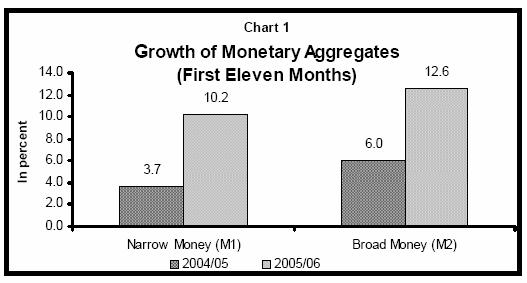
1. In the first eleven months of 2005/06, broad money (M2) registered a growth of 12.6 percent compared to a growth of 6.0 percent in the corresponding period of 2004/05. Of the components of M2, narrow money (M1) increased by 10.2 percent in the review period compared to a growth of 3.7 percent in the same period of 2004/05. Another component of M2, time deposits witnessed a growth of 13.8 percent in the review period while such time deposits had grown by just 7.2 percent in the same period of 2004/05. Despite the lower deposit interest rates, a higher inflow of remittances contributed to the upsurge in time deposits in the review period.
2. Despite low GDP growth rate, monetary aggregates exhibited the higher growth in the review period due mainly to substantial inflow of remittance, which increased the demand for domestic currency. Moreover, rising inflation also increased the demand for nominal money.
Source of Monetary Growth
3. Net foreign assets (NFA), a main source of monetary expansion, after adjusting foreign exchange valuation gain/loss, increased by Rs 21.9 billion (20.3 percent) in the review period compared to an increase of Rs 5.5 billion (5.1 percent) in 2004/05. NFA registered such a rise due to the increased inflow of remittances.
4. In the review period, M2 expanded by Rs. 37.9 billion, of which Rs. 21.9 billion (57.7 percent) was contributed by NFA and the remaining by net domestic assets (NDA). The NDA also registered a growth of 8.3 percent in the review period compared to a growth of 6.6 percent in the previous year.
5. Domestic credit, however, registered a slower growth of 9.8 percent in the review period compared to a growth of 10.0 percent in the previous year. A slowdown in the private sector credit lowered the growth of domestic credit in the review period.
6. Of the domestic credit aggregates, net claims on government increased by 2.6 percent in contrast to a decline of 4.2 percent in the preceding year. A higher level of government expenditure compared to revenue mobilization contributed to such a rise in net claims on government in the review period. Excluding the local authorities' deposit from the resource side, the net claims on government would increase further.
7. Claims on non-financial government enterprises declined by 10.6 percent in the review period due mainly to the loan repayment by Nepal Electricity Authority, Nepal Oil Corporation, Hetauda Textile Industries Ltd and National Trading Ltd to commercial banks.
8. Claims on private sector credit, which is a major chunk of domestic credit, registered a growth of 13.5 percent in the review period, which had increased by 13.8 percent in the preceding year. Lack of investment friendly environment and cautious steps taken by commercial banks in credit extension resulted in a lower credit off take in the review period.
Reserve Money
9. Reserve money (RM), a monetary base, increased by 11.5 percent in the review period due to the higher increase in NFA of monetary authority against a decline by 5.6 percent in 2004/05. As regards the components of RM, currency in circulation (CIC) and commercial banks deposits with NRB went up as a result of higher inflow of remittances.
Monetary Operations
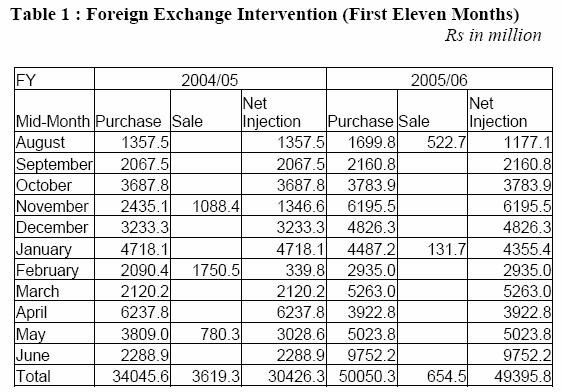
10. In the first eleven months of 2005/06, NRB intervened 56 times owing to heavy remittance inflows, through which NRB purchased US dollar equivalent to Rs 50.1 billion. In the review period, NRB sold two times US dollar equal to Rs 654.4 million. As a result, net liquidity of Rs. 49.4 billion was injected in the economy. This amount is quite higher than the amount injected in the previous year. A total of Rs 30.4 billion net liquidity was injected through the foreign exchange market in the same period in the preceding year. The higher inflow of workers' remittances in the review period required more interventions in the foreign exchange market.
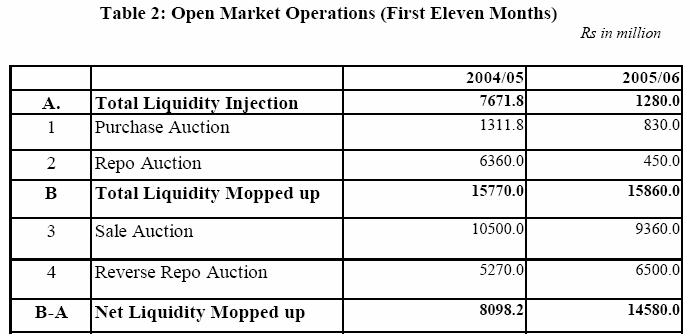
11. Since the money supply expanded more than the desirable level due to inflow of remittance, the liquidity was mopped up through the open market operations. Sale auctions mopped up Rs. 9.4 billion while reverse repo auctions mopped up Rs. 6.5 billion in the review period.
12. Moreover, fresh treasury bills amounting to Rs 8.1 billion were issued. This helped absorb excess liquidity of commercial banks. Further, a 10-year development bond worth Rs 750.0 million and citizen saving certificate worth Rs 250.0 million were also issued in the review period. As a result, short-term interest rates remained stable in the review period.
13. The use of standing liquidity facility (SLF) by commercial banks remained subdued in the review period. Deepened inter bank market and adequate liquidity 2004/05 2005/06 with the banks accounted for a lower level of SLF borrowing. In the review period, the use of such facility amounted to Rs 8.0 billion compared to Rs 45.8 billion in 2004/05 . The inter bank transactions, on the other hand, increased to Rs 162.9 billion in the review period from Rs 132.5 billion last year.
Short-term Interest Rates
14. The 91-day weighted average Treasury bill rate remained stabilized in the review period due mainly to appropriate liquidity management, notwithstanding the higher liquidity in the economy emanating from growing remittances. Such rate stood in a range of 2.2 to 3.6 percent in the review period.
Security Market Activities
Primary Issue of Securities
15. In the first eleven months of 2005/06, Nepal Security Board approved 26 financial institutions to issue their ordinary shares, right shares and debentures worth Rs 1.7 billion and Taragaon Regency Hotel to issue right share amounting to Rs. 446.5 million. Accordingly, 10 financial institutions have been given approval to issue right shares amounting to Rs. 647.0 million, 13 financial institutions for issuing ordinary share amounting to Rs. 354.4 million and three financial institutions to issue debentures amounting to Rs. 650.0 million.
16. Stock market activities expanded in terms of NEPSE index, market capitalization and turnover compared to the same period in the preceding year. However, on a month-on-month basis, NEPSE index and market capitalization decreased slightly compared to that of the previous month; while the share market turnover depicted a fair growth in comparison to that of the previous month.
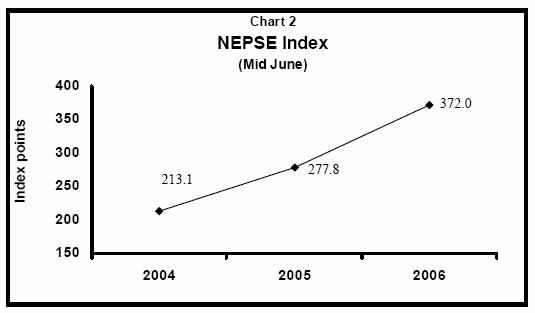
17. The year on year (y-o-y) NEPSE index increased substantially by 94.22 points (33.9 percent) to 372.01 points in mid-June 2006. An effective regulation and supervision of NRB helped increase transparency of financial reporting. Accordingly, these institutions have been adopting good corporate governance culture, which has left a positive impact on their financial health along with an increasing level of confidence of people towards these organizations. Hence, people's attraction towards the shares of such institutions has been increasing with an expectation of enhanced financial returns and capital appreciation of shares of these institutions, creating an upward thrust on the NEPSE index. Moreover, the lack of alternative investment opportunities, persistent increase in the inflow of workers' remittances and low level of real deposit rates have also created some upward pressure on the NEPSE index.
18. The number of listed companies in the Nepal Stock Exchange Limited increased by 7 to 131 in mid-June 2006. Of the 131 listed companies, 84 (64.1 percent) were financial institutions, 29 (22.1 percent) manufacturing and processing units, 4 (3.1 percent) hotels, 8 (6.1 percent) trading units and 6 (4.6 percent) others.
19. Market capitalization, on a y-o-y basis, increased by 57.8 percent to Rs. 93.8 billion in mid-June 2006. The market capitalization to GDP ratio increased by 5.6 percentage points to 16.1 percent in mid-June 2006. Of the total amount of market capitalization of the listed companies, financial institutions accounted for 82.9 percent, manufacturing and processing units 5.8 percent, hotel 2.5 percent, trading 0.8 percent and unclassified 8.0 percent.
20. Likewise, the total paid up value of listed shares on a y-o-y basis increased by 18.4 percent to Rs. 19.9 billion in mid-June 2006. Listing of some new companies in the NEPSE and the issuance of additional shares by the existing financial institutions contributed to the growth in the total paid up value of listed shares.
21. Together with growing tendency, the stock market witnessed an increase in liquidity of the shares listed in the stock exchange. Of the stock market liquidity indicators, the turnover to market capitalization ratio increased to 0.67 percent in mid-June 2006 from 0.48 percent a year ago. The high growth rate of turnover relative to market capitalization contributed to such an increase in the liquidity.
22. The Nepalese stock market continued to be highly concentrated and dominated by the stocks of commercial banks. For example, in mid-June 2006, of the total turnover of Rs. 618.3 million, the share of commercial banks alone stood at 67.6 percent followed by finance companies (5.4 percent), insurance companies (3.3 percent), and development banks (0.6 percent). In the comparable period of the preceding year, these entities occupied a share of 54.5 percent, 6.3 percent, 3.8 percent and 1.0 percent respectively. Clearly, the share of manufacturing and processing units, hotel and trading remained lower. However, the companies listed under others group experienced a substantial share of 22.1 percent of the total turnover in the review period. Share transaction in a considerable volume of Chilime Hydropower Company and NCM mutual fund contributed to the high percentage share in this group.
23. Volatility, as measured as a twelve-month rolling standard deviation of NEPSE index increased in the last twelve-months compared to that of corresponding period in the preceding year. For example, the twelve-month rolling standard deviation of NEPSE index stood at 31.9 in mid-June 2006 compared to 24.8 a year ago. This is an indication of increasing trading risk in the stock market.
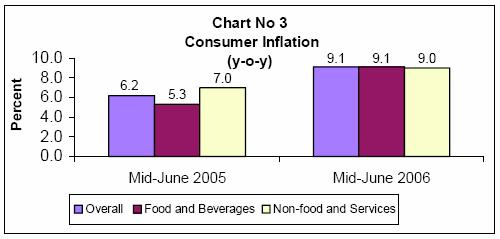
Consumer Inflation
24. The National Urban Consumer Price Index (1995/96=100), on y-o-y basis, increased by 9.1 percent as at mid-June 2006, compared to an increase of 6.2 percent during the same period of the preceding year. The higher growth in the price index is mainly attributable to the rise in the prices of petroleum products twice as well as the increase in the prices of transportation services in February 2006 together with the sharp rise in the prices of grains and cereal products, pulses, housing goods and services, transportation and communication, vegetables and fruits, meat, fish and eggs, education, reading materials and recreation and beverages. The average growth rate of the price index from mid-July 2005 to mid-June 2006 stood at 7.8 percent. Such growth rate was 4.2 percent in the same period of the previous year.
25. In the review period, on a y-o-y basis, the index of food and beverages group rose up by 9.1 percent compared to an increase of 5.3 percent during the same period of the preceding year. The rise in the prices of grains and cereal products, pulses, vegetables and fruits, meat, fish and eggs, restaurant meals, beverages as well as milk and milk products pushed up the index of this group. 26. The index of non-food and services group increased by 9.0 percent (y-o-y) compared to an increase of 7.0 percent during the same period of the preceding year. The higher rate of growth in the price index of this group is mainly attributed to the rise in the prices of petroleum products time and again as well as the increase in the prices of transportation services in February 2006 that exerted an upward pressure on the indices of housing goods and services as well as transport and communication. It was accompanied by the rise in the costs in education, reading and recreation, medical and personal care as well as the prices
of cloth, clothing and sewing services.
27. Region wise, the price indices of the Kathmandu Valley, Terai and Hills in the review period increased by 7.9 percent, 9.9 percent and 9.0 percent, respectively. During the corresponding period of the previous year, the indices of Kathmandu Valley, Terai and Hills had increased by 4.5 percent, 7.0 percent and 6.8 percent, respectively.
28. The y-o-y core inflation increased to 5.3 percent in mid-June 2006, compared to an increase of 3.8 percent during the same period of the preceding year.
Wholesale Price Index (WPI)
29. The National Wholesale Price Index (1999/00=100), on y-o-y basis as at mid-June 2006 stood at 138.2, registering a rise of 9.2 percent. Such index had increased by 8.9 percent during the corresponding period of the preceding year. The growth in the price index is mainly attributable to rise in the prices of foodgrains, pulses, fruits and vegetables, livestock production, transport vehicles and machinery goods as well as the sharp rise in the prices of petroleum products that gave an upward pressure in the index of petroleum products and coal. The indices of Agriculture, Domestic Manufactured and Imported Commodities increased by 10.9 percent, 2.7 percent and 10.7 percent, respectively, in the review period. The average National Wholesale Price Index from the mid-July 2005 to mid-June 2006 increased by 9.1 percent compared to a rise of 6.8 percent during the sameperiod of the previous year.
Salary and Wage Rate
30. The National Salary and Wage Rate Index (2004/05 = 100), on y-o-y basis, increased by 5.7 percent as at mid-July 2006. This increase is mainly attributable to the rise in the wage rate of labourers and the rise in the salary of the employees in the bank and financial institutions and public corporations. The indices of salary and wage rate increased by 0.4 percent and 7.7 percent respectively during the review period.
Fiscal Situation
Expenditure
31. Government spending saw an accelerated growth of 19.3 percent in the first eleven months of 2005/06, compared to a growth of 8.2 percent in the corresponding period of the preceding year.
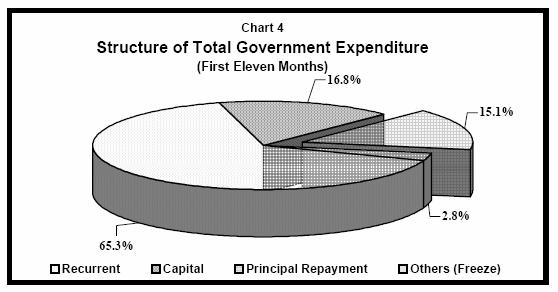
32. Of the total government expenditure, the share of recurrent expenditure, capital expenditure, principal repayments and freeze expenditure remained at 65.3 percent, 16.8 percent, 15.1 percent and 2.8 percent respectively in the review period. Such ratios were 70.4 percent, 14.5 percent, 13.1 percent and 2.0 percent respectively in the corresponding period of the previous year.
Resource Mobilization
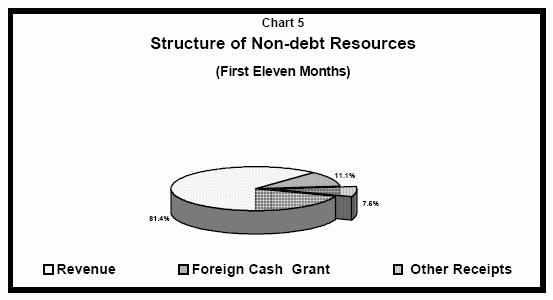
33. In the first eleven months of 2005/06, total non-debt resources of the government grew by 10.8 percent compared to a growth of 12.4 percent in the corresponding period of the previous year. Extremely low growth of revenue contributed to such a low growth of non-debt resources.
34. In the first eleven months of 2005/06, total government revenue mobilization increased by 0.5 percent compared to a higher increase of 13.3 percent in the corresponding period of the previous year. A decline in customs duties and some other non-tax revenues including dividends and principal repayments accounted for such a low growth of revenue mobilization.
35. In the first eleven months of 2005/06, foreign cash grants increased by a high rate of 65.7 percent compared to an increase of 7.5 percent in the preceding year.
Sources of Deficit Financing
36. Of the sources of deficit financing, government mobilized additional domestic borrowing of Rs 9.1 billion by issuing treasury bills worth Rs 8.1 billion and development bonds and citizen saving certificates amounting to Rs 1.0 billion in the first eleven months of 2005/06. Government had mobilized domestic borrowings amounting to Rs 6.9 billion in the corresponding period of the previous year. In the review period, government mobilized Rs 3.4 billion foreign cash loans compared to Rs 1.9 billion in the same period of the previous year.
Revenue Mobilization
37. In the first eleven months of 2005/06, of the total revenue mobilization, tax revenue increased by 7.2 percent where as non-tax revenue declined by 24.9 percent. In the corresponding period of the previous year, tax revenue had increased by 1.2 percent whereas non-tax revenue had declined by 5.3 percent. A remarkable increase in VAT revenue contributed to such an increase in tax revenue in the review period.
38. Of the total tax revenue, direct tax increased by 8.8 percent compared to an increase of 3.2 percent in the preceding year. An increase in income tax revenue accounted for such a rise in direct tax.. In the review period, indirect tax revenue rose by 6.8 percent compared to an increase of 0.6 percent in the preceding year. Of the indirect tax, revenue from all components of VAT recorded a higher growth. As a result, in the review period VAT collection increased by 17.5 percent compared to a rise of 1.4 percent in the preceding year. An increase in import by 17.6 percent in the review period is mainly responsible for the increase in VAT on import. In the review period, customs revenue declined due mainly to a decline in customs revenue on export and import as well as a decline in Indian excise refund.
Revenue Composition
39. Of the total government revenue mobilized in the first eleven months of 2005/06, the composition of tax and non-tax revenue constituted 84.5 percent and 15.5 percent respectively. Such a composition of tax and non-tax revenue had remained at 79.2 percent and 20.8 percent respectively in the previous year. Further the share of direct tax and indirect tax in total tax revenue was 23.2 percent and 76.8 percent respectively in the review period, compared to the composition of 22.9 percent and 77.1 percent in the same period last year. Of the total revenue mobilization, revenue from VAT constituted a major share of 32.9 percent followed by customs duty (22.6 percent) and income tax (12.8 percent). Such a composition was 28.1 percent, 23.5 percent and 12.0 percent respectively in the same period of the previous year.
Fiscal, Revenue and Primary Balance
40. The overall fiscal situation remained at a deficit of Rs 8.8 billion in the review period due to the high growth rate of government expenditure and very low growth rate of revenue mobilization. Fiscal balance, one of the main indicators of government budgetary operation remained at a deficit of 10.9 percent of the total government expenditure. Last year, such ratio of fiscal deficit had remained at only 4.1 percent of total government expenditure. Moreover, such ratio of fiscal deficit to total government expenditure excluding local authorities' deposits with banks remained at 15.6 percent. Similarly, revenue balance, another indicator of government budgetary operation remained at a deficit of 7.8 percent of the total government expenditure. In the corresponding period of the previous year, such ratio had remained at a surplus of 2.6 percent. Primary balance, the other indicator of the fiscal operation, remained at a deficit of 5.1 percent of the total government expenditures in the review period in contrast to a surplus of 2.9 percent last year. Furthermore, the primary deficit excluding local authorities' balance with banks remained at 9.9 percent of the total government expenditure.
External Sector
Foreign Trade
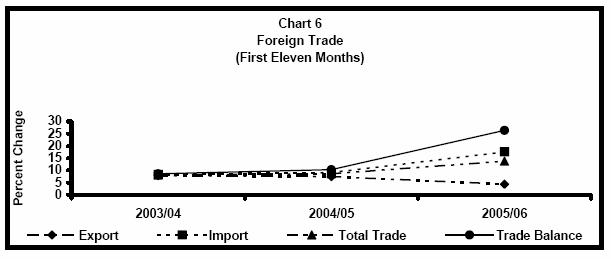
41. In the first eleven months of 2005/06, the foreign trade sector depicted a mixed performance. Exports grew by 4.4 percent compared to an increase of 7.5 percent in 2004/05. Of the total exports, export to India rose by 6.3 percent in 2005/06 in comparison to a growth of 25.2 percent in the same period of 2004/05. Additional customs tariff of 4 percent imposed by India on Nepalese exports to India since the end of February 2006 slowed the growth of Nepalese exports to India. Exports to other countries went up by 0.6 percent in the review period in contrast to a decline of 15.9 percent in the corresponding period of the revious year.
42. The items which saw a growth in the exports to India were polyster yarn, zinc sheet, readymade garments, wire and G.I. pipe. Likewise, the slight increase in the exports to other countries was due to the increase in the export of pashmina, pulses, tanned skin and woolen carpet.
43. Total imports expanded by 17.6 percent in 2005/06 in the first eleven months of 2005/06 as compared to an increase of 9.1 percent in the corresponding period of the previous year. While imports from India went up by 23.4 percent in the review period compared to a growth of 13.6 percent in the corresponding period of 2004/05, imports from other countries rose by 9.1 percent compared to a growth of just 3.3 percent a year earlier.
44. A rise in the import of petroleum products, rice, thread, chemical fertilizers and hot rolled sheet in coil, among others, from India and palm oil, crude palm oil, textile dyes, polythene granules and electrical goods, among others, from other countries led to the expansion in total imports in the first eleven months of 2005/06.
45. In the first eleven months of 2005/06, trade deficit surged by 26.4 percent as compared to an increase of 10.3 percent in the corresponding period of 2004/05.
Balance of Payments
46. Overall BOP registered a surplus of Rs. 21.9 billion in the first eleven months of 2005/06 compared to a surplus of Rs. 5.5 billion in the corresponding period of 2004/05.
47. Current account posted a surplus of Rs. 12.4 billion in the first eleven months of 2005/06 mainly owing to a significant rise in remittance inflows by 48.4 percent. In the corresponding period of the previous year, workers' remittances had risen by 10.1 percent.
48. On the capital account front, capital transfer rose to Rs. 2.9 billion from the level of Rs. 1.6 billion a year earlier. Under the financial account, the government received Rs. 4.6 billion as foreign loan and repaid Rs. 6.4 billion in amortization.
Foreign Exchange Reserves
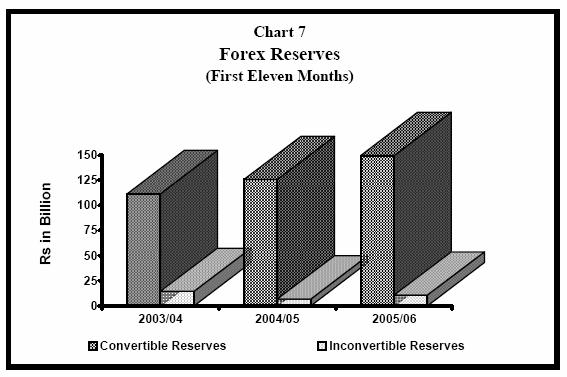
49. In comparison to mid-July 2005, gross foreign exchange reserves increased by 23.3 percent to Rs. 160.2 billion in mid-June 2006. Such reserves had risen by just 1.7 percent in the corresponding period of the preceding year. The share of convertible reserves in the total reserves declined slightly to 93.4 percent in mid-June 2006 from 95.0 percent in mid-June 2005, resulting in a corresponding increase in the share of the non-convertible reserves to 6.6 percent from 5.0 percent. The current level of reserves is adequate for financing merchandise imports of 11.2 months and merchandise and service imports of 9.4 months.
Price of Oil and Gold in the International Market and Exchange Rate Movement
50. The price of oil (Crude Oil Brent) in the international market increased by 23.5 percent to US$ 66.08 per barrel on June 15, 2006 from US$ 53.50 per barrel on June 15, 2005. Likewise, the price of gold rose by 32.8 percent to US$ 569.50 per ounce on June 15, 2006 from US$ 428.70 a year earlier.
51. In comparison to mid-July 2005, the Nepalese currency vis-à-vis the US dollar depreciated by 4.2 percent in mid-June 2006. It had appreciated by 5.4 percent in the corresponding period of the previous year. The exchange rate of one US dollar stood at Rs. 73.45 in mid-June 2006 compared to Rs. 70.35 in mid-June 2005.
Based on The First Eleven Months' Data of 2005/06
Nepal Rastra Bank
Research Department
August 2006
www.nrb.org.np
Download Pdf
Monetary Developments
Growth of Monetary Aggregates
1. In the first eleven months of 2005/06, broad money (M2) registered a growth of 12.6 percent compared to a growth of 6.0 percent in the corresponding period of 2004/05. Of the components of M2, narrow money (M1) increased by 10.2 percent in the review period compared to a growth of 3.7 percent in the same period of 2004/05. Another component of M2, time deposits witnessed a growth of 13.8 percent in the review period while such time deposits had grown by just 7.2 percent in the same period of 2004/05. Despite the lower deposit interest rates, a higher inflow of remittances contributed to the upsurge in time deposits in the review period.
2. Despite low GDP growth rate, monetary aggregates exhibited the higher growth in the review period due mainly to substantial inflow of remittance, which increased the demand for domestic currency. Moreover, rising inflation also increased the demand for nominal money.
Source of Monetary Growth
3. Net foreign assets (NFA), a main source of monetary expansion, after adjusting foreign exchange valuation gain/loss, increased by Rs 21.9 billion (20.3 percent) in the review period compared to an increase of Rs 5.5 billion (5.1 percent) in 2004/05. NFA registered such a rise due to the increased inflow of remittances.
4. In the review period, M2 expanded by Rs. 37.9 billion, of which Rs. 21.9 billion (57.7 percent) was contributed by NFA and the remaining by net domestic assets (NDA). The NDA also registered a growth of 8.3 percent in the review period compared to a growth of 6.6 percent in the previous year.
5. Domestic credit, however, registered a slower growth of 9.8 percent in the review period compared to a growth of 10.0 percent in the previous year. A slowdown in the private sector credit lowered the growth of domestic credit in the review period.
6. Of the domestic credit aggregates, net claims on government increased by 2.6 percent in contrast to a decline of 4.2 percent in the preceding year. A higher level of government expenditure compared to revenue mobilization contributed to such a rise in net claims on government in the review period. Excluding the local authorities' deposit from the resource side, the net claims on government would increase further.
7. Claims on non-financial government enterprises declined by 10.6 percent in the review period due mainly to the loan repayment by Nepal Electricity Authority, Nepal Oil Corporation, Hetauda Textile Industries Ltd and National Trading Ltd to commercial banks.
8. Claims on private sector credit, which is a major chunk of domestic credit, registered a growth of 13.5 percent in the review period, which had increased by 13.8 percent in the preceding year. Lack of investment friendly environment and cautious steps taken by commercial banks in credit extension resulted in a lower credit off take in the review period.
Reserve Money
9. Reserve money (RM), a monetary base, increased by 11.5 percent in the review period due to the higher increase in NFA of monetary authority against a decline by 5.6 percent in 2004/05. As regards the components of RM, currency in circulation (CIC) and commercial banks deposits with NRB went up as a result of higher inflow of remittances.
Monetary Operations
10. In the first eleven months of 2005/06, NRB intervened 56 times owing to heavy remittance inflows, through which NRB purchased US dollar equivalent to Rs 50.1 billion. In the review period, NRB sold two times US dollar equal to Rs 654.4 million. As a result, net liquidity of Rs. 49.4 billion was injected in the economy. This amount is quite higher than the amount injected in the previous year. A total of Rs 30.4 billion net liquidity was injected through the foreign exchange market in the same period in the preceding year. The higher inflow of workers' remittances in the review period required more interventions in the foreign exchange market.
11. Since the money supply expanded more than the desirable level due to inflow of remittance, the liquidity was mopped up through the open market operations. Sale auctions mopped up Rs. 9.4 billion while reverse repo auctions mopped up Rs. 6.5 billion in the review period.
12. Moreover, fresh treasury bills amounting to Rs 8.1 billion were issued. This helped absorb excess liquidity of commercial banks. Further, a 10-year development bond worth Rs 750.0 million and citizen saving certificate worth Rs 250.0 million were also issued in the review period. As a result, short-term interest rates remained stable in the review period.
13. The use of standing liquidity facility (SLF) by commercial banks remained subdued in the review period. Deepened inter bank market and adequate liquidity 2004/05 2005/06 with the banks accounted for a lower level of SLF borrowing. In the review period, the use of such facility amounted to Rs 8.0 billion compared to Rs 45.8 billion in 2004/05 . The inter bank transactions, on the other hand, increased to Rs 162.9 billion in the review period from Rs 132.5 billion last year.
Short-term Interest Rates
14. The 91-day weighted average Treasury bill rate remained stabilized in the review period due mainly to appropriate liquidity management, notwithstanding the higher liquidity in the economy emanating from growing remittances. Such rate stood in a range of 2.2 to 3.6 percent in the review period.
Security Market Activities
Primary Issue of Securities
15. In the first eleven months of 2005/06, Nepal Security Board approved 26 financial institutions to issue their ordinary shares, right shares and debentures worth Rs 1.7 billion and Taragaon Regency Hotel to issue right share amounting to Rs. 446.5 million. Accordingly, 10 financial institutions have been given approval to issue right shares amounting to Rs. 647.0 million, 13 financial institutions for issuing ordinary share amounting to Rs. 354.4 million and three financial institutions to issue debentures amounting to Rs. 650.0 million.
16. Stock market activities expanded in terms of NEPSE index, market capitalization and turnover compared to the same period in the preceding year. However, on a month-on-month basis, NEPSE index and market capitalization decreased slightly compared to that of the previous month; while the share market turnover depicted a fair growth in comparison to that of the previous month.
17. The year on year (y-o-y) NEPSE index increased substantially by 94.22 points (33.9 percent) to 372.01 points in mid-June 2006. An effective regulation and supervision of NRB helped increase transparency of financial reporting. Accordingly, these institutions have been adopting good corporate governance culture, which has left a positive impact on their financial health along with an increasing level of confidence of people towards these organizations. Hence, people's attraction towards the shares of such institutions has been increasing with an expectation of enhanced financial returns and capital appreciation of shares of these institutions, creating an upward thrust on the NEPSE index. Moreover, the lack of alternative investment opportunities, persistent increase in the inflow of workers' remittances and low level of real deposit rates have also created some upward pressure on the NEPSE index.
18. The number of listed companies in the Nepal Stock Exchange Limited increased by 7 to 131 in mid-June 2006. Of the 131 listed companies, 84 (64.1 percent) were financial institutions, 29 (22.1 percent) manufacturing and processing units, 4 (3.1 percent) hotels, 8 (6.1 percent) trading units and 6 (4.6 percent) others.
19. Market capitalization, on a y-o-y basis, increased by 57.8 percent to Rs. 93.8 billion in mid-June 2006. The market capitalization to GDP ratio increased by 5.6 percentage points to 16.1 percent in mid-June 2006. Of the total amount of market capitalization of the listed companies, financial institutions accounted for 82.9 percent, manufacturing and processing units 5.8 percent, hotel 2.5 percent, trading 0.8 percent and unclassified 8.0 percent.
20. Likewise, the total paid up value of listed shares on a y-o-y basis increased by 18.4 percent to Rs. 19.9 billion in mid-June 2006. Listing of some new companies in the NEPSE and the issuance of additional shares by the existing financial institutions contributed to the growth in the total paid up value of listed shares.
21. Together with growing tendency, the stock market witnessed an increase in liquidity of the shares listed in the stock exchange. Of the stock market liquidity indicators, the turnover to market capitalization ratio increased to 0.67 percent in mid-June 2006 from 0.48 percent a year ago. The high growth rate of turnover relative to market capitalization contributed to such an increase in the liquidity.
22. The Nepalese stock market continued to be highly concentrated and dominated by the stocks of commercial banks. For example, in mid-June 2006, of the total turnover of Rs. 618.3 million, the share of commercial banks alone stood at 67.6 percent followed by finance companies (5.4 percent), insurance companies (3.3 percent), and development banks (0.6 percent). In the comparable period of the preceding year, these entities occupied a share of 54.5 percent, 6.3 percent, 3.8 percent and 1.0 percent respectively. Clearly, the share of manufacturing and processing units, hotel and trading remained lower. However, the companies listed under others group experienced a substantial share of 22.1 percent of the total turnover in the review period. Share transaction in a considerable volume of Chilime Hydropower Company and NCM mutual fund contributed to the high percentage share in this group.
23. Volatility, as measured as a twelve-month rolling standard deviation of NEPSE index increased in the last twelve-months compared to that of corresponding period in the preceding year. For example, the twelve-month rolling standard deviation of NEPSE index stood at 31.9 in mid-June 2006 compared to 24.8 a year ago. This is an indication of increasing trading risk in the stock market.
Consumer Inflation
24. The National Urban Consumer Price Index (1995/96=100), on y-o-y basis, increased by 9.1 percent as at mid-June 2006, compared to an increase of 6.2 percent during the same period of the preceding year. The higher growth in the price index is mainly attributable to the rise in the prices of petroleum products twice as well as the increase in the prices of transportation services in February 2006 together with the sharp rise in the prices of grains and cereal products, pulses, housing goods and services, transportation and communication, vegetables and fruits, meat, fish and eggs, education, reading materials and recreation and beverages. The average growth rate of the price index from mid-July 2005 to mid-June 2006 stood at 7.8 percent. Such growth rate was 4.2 percent in the same period of the previous year.
25. In the review period, on a y-o-y basis, the index of food and beverages group rose up by 9.1 percent compared to an increase of 5.3 percent during the same period of the preceding year. The rise in the prices of grains and cereal products, pulses, vegetables and fruits, meat, fish and eggs, restaurant meals, beverages as well as milk and milk products pushed up the index of this group. 26. The index of non-food and services group increased by 9.0 percent (y-o-y) compared to an increase of 7.0 percent during the same period of the preceding year. The higher rate of growth in the price index of this group is mainly attributed to the rise in the prices of petroleum products time and again as well as the increase in the prices of transportation services in February 2006 that exerted an upward pressure on the indices of housing goods and services as well as transport and communication. It was accompanied by the rise in the costs in education, reading and recreation, medical and personal care as well as the prices
of cloth, clothing and sewing services.
27. Region wise, the price indices of the Kathmandu Valley, Terai and Hills in the review period increased by 7.9 percent, 9.9 percent and 9.0 percent, respectively. During the corresponding period of the previous year, the indices of Kathmandu Valley, Terai and Hills had increased by 4.5 percent, 7.0 percent and 6.8 percent, respectively.
28. The y-o-y core inflation increased to 5.3 percent in mid-June 2006, compared to an increase of 3.8 percent during the same period of the preceding year.
Wholesale Price Index (WPI)
29. The National Wholesale Price Index (1999/00=100), on y-o-y basis as at mid-June 2006 stood at 138.2, registering a rise of 9.2 percent. Such index had increased by 8.9 percent during the corresponding period of the preceding year. The growth in the price index is mainly attributable to rise in the prices of foodgrains, pulses, fruits and vegetables, livestock production, transport vehicles and machinery goods as well as the sharp rise in the prices of petroleum products that gave an upward pressure in the index of petroleum products and coal. The indices of Agriculture, Domestic Manufactured and Imported Commodities increased by 10.9 percent, 2.7 percent and 10.7 percent, respectively, in the review period. The average National Wholesale Price Index from the mid-July 2005 to mid-June 2006 increased by 9.1 percent compared to a rise of 6.8 percent during the sameperiod of the previous year.
Salary and Wage Rate
30. The National Salary and Wage Rate Index (2004/05 = 100), on y-o-y basis, increased by 5.7 percent as at mid-July 2006. This increase is mainly attributable to the rise in the wage rate of labourers and the rise in the salary of the employees in the bank and financial institutions and public corporations. The indices of salary and wage rate increased by 0.4 percent and 7.7 percent respectively during the review period.
Fiscal Situation
Expenditure
31. Government spending saw an accelerated growth of 19.3 percent in the first eleven months of 2005/06, compared to a growth of 8.2 percent in the corresponding period of the preceding year.
32. Of the total government expenditure, the share of recurrent expenditure, capital expenditure, principal repayments and freeze expenditure remained at 65.3 percent, 16.8 percent, 15.1 percent and 2.8 percent respectively in the review period. Such ratios were 70.4 percent, 14.5 percent, 13.1 percent and 2.0 percent respectively in the corresponding period of the previous year.
Resource Mobilization
33. In the first eleven months of 2005/06, total non-debt resources of the government grew by 10.8 percent compared to a growth of 12.4 percent in the corresponding period of the previous year. Extremely low growth of revenue contributed to such a low growth of non-debt resources.
34. In the first eleven months of 2005/06, total government revenue mobilization increased by 0.5 percent compared to a higher increase of 13.3 percent in the corresponding period of the previous year. A decline in customs duties and some other non-tax revenues including dividends and principal repayments accounted for such a low growth of revenue mobilization.
35. In the first eleven months of 2005/06, foreign cash grants increased by a high rate of 65.7 percent compared to an increase of 7.5 percent in the preceding year.
Sources of Deficit Financing
36. Of the sources of deficit financing, government mobilized additional domestic borrowing of Rs 9.1 billion by issuing treasury bills worth Rs 8.1 billion and development bonds and citizen saving certificates amounting to Rs 1.0 billion in the first eleven months of 2005/06. Government had mobilized domestic borrowings amounting to Rs 6.9 billion in the corresponding period of the previous year. In the review period, government mobilized Rs 3.4 billion foreign cash loans compared to Rs 1.9 billion in the same period of the previous year.
Revenue Mobilization
37. In the first eleven months of 2005/06, of the total revenue mobilization, tax revenue increased by 7.2 percent where as non-tax revenue declined by 24.9 percent. In the corresponding period of the previous year, tax revenue had increased by 1.2 percent whereas non-tax revenue had declined by 5.3 percent. A remarkable increase in VAT revenue contributed to such an increase in tax revenue in the review period.
38. Of the total tax revenue, direct tax increased by 8.8 percent compared to an increase of 3.2 percent in the preceding year. An increase in income tax revenue accounted for such a rise in direct tax.. In the review period, indirect tax revenue rose by 6.8 percent compared to an increase of 0.6 percent in the preceding year. Of the indirect tax, revenue from all components of VAT recorded a higher growth. As a result, in the review period VAT collection increased by 17.5 percent compared to a rise of 1.4 percent in the preceding year. An increase in import by 17.6 percent in the review period is mainly responsible for the increase in VAT on import. In the review period, customs revenue declined due mainly to a decline in customs revenue on export and import as well as a decline in Indian excise refund.
Revenue Composition
39. Of the total government revenue mobilized in the first eleven months of 2005/06, the composition of tax and non-tax revenue constituted 84.5 percent and 15.5 percent respectively. Such a composition of tax and non-tax revenue had remained at 79.2 percent and 20.8 percent respectively in the previous year. Further the share of direct tax and indirect tax in total tax revenue was 23.2 percent and 76.8 percent respectively in the review period, compared to the composition of 22.9 percent and 77.1 percent in the same period last year. Of the total revenue mobilization, revenue from VAT constituted a major share of 32.9 percent followed by customs duty (22.6 percent) and income tax (12.8 percent). Such a composition was 28.1 percent, 23.5 percent and 12.0 percent respectively in the same period of the previous year.
Fiscal, Revenue and Primary Balance
40. The overall fiscal situation remained at a deficit of Rs 8.8 billion in the review period due to the high growth rate of government expenditure and very low growth rate of revenue mobilization. Fiscal balance, one of the main indicators of government budgetary operation remained at a deficit of 10.9 percent of the total government expenditure. Last year, such ratio of fiscal deficit had remained at only 4.1 percent of total government expenditure. Moreover, such ratio of fiscal deficit to total government expenditure excluding local authorities' deposits with banks remained at 15.6 percent. Similarly, revenue balance, another indicator of government budgetary operation remained at a deficit of 7.8 percent of the total government expenditure. In the corresponding period of the previous year, such ratio had remained at a surplus of 2.6 percent. Primary balance, the other indicator of the fiscal operation, remained at a deficit of 5.1 percent of the total government expenditures in the review period in contrast to a surplus of 2.9 percent last year. Furthermore, the primary deficit excluding local authorities' balance with banks remained at 9.9 percent of the total government expenditure.
External Sector
Foreign Trade
41. In the first eleven months of 2005/06, the foreign trade sector depicted a mixed performance. Exports grew by 4.4 percent compared to an increase of 7.5 percent in 2004/05. Of the total exports, export to India rose by 6.3 percent in 2005/06 in comparison to a growth of 25.2 percent in the same period of 2004/05. Additional customs tariff of 4 percent imposed by India on Nepalese exports to India since the end of February 2006 slowed the growth of Nepalese exports to India. Exports to other countries went up by 0.6 percent in the review period in contrast to a decline of 15.9 percent in the corresponding period of the revious year.
42. The items which saw a growth in the exports to India were polyster yarn, zinc sheet, readymade garments, wire and G.I. pipe. Likewise, the slight increase in the exports to other countries was due to the increase in the export of pashmina, pulses, tanned skin and woolen carpet.
43. Total imports expanded by 17.6 percent in 2005/06 in the first eleven months of 2005/06 as compared to an increase of 9.1 percent in the corresponding period of the previous year. While imports from India went up by 23.4 percent in the review period compared to a growth of 13.6 percent in the corresponding period of 2004/05, imports from other countries rose by 9.1 percent compared to a growth of just 3.3 percent a year earlier.
44. A rise in the import of petroleum products, rice, thread, chemical fertilizers and hot rolled sheet in coil, among others, from India and palm oil, crude palm oil, textile dyes, polythene granules and electrical goods, among others, from other countries led to the expansion in total imports in the first eleven months of 2005/06.
45. In the first eleven months of 2005/06, trade deficit surged by 26.4 percent as compared to an increase of 10.3 percent in the corresponding period of 2004/05.
Balance of Payments
46. Overall BOP registered a surplus of Rs. 21.9 billion in the first eleven months of 2005/06 compared to a surplus of Rs. 5.5 billion in the corresponding period of 2004/05.
47. Current account posted a surplus of Rs. 12.4 billion in the first eleven months of 2005/06 mainly owing to a significant rise in remittance inflows by 48.4 percent. In the corresponding period of the previous year, workers' remittances had risen by 10.1 percent.
48. On the capital account front, capital transfer rose to Rs. 2.9 billion from the level of Rs. 1.6 billion a year earlier. Under the financial account, the government received Rs. 4.6 billion as foreign loan and repaid Rs. 6.4 billion in amortization.
Foreign Exchange Reserves
49. In comparison to mid-July 2005, gross foreign exchange reserves increased by 23.3 percent to Rs. 160.2 billion in mid-June 2006. Such reserves had risen by just 1.7 percent in the corresponding period of the preceding year. The share of convertible reserves in the total reserves declined slightly to 93.4 percent in mid-June 2006 from 95.0 percent in mid-June 2005, resulting in a corresponding increase in the share of the non-convertible reserves to 6.6 percent from 5.0 percent. The current level of reserves is adequate for financing merchandise imports of 11.2 months and merchandise and service imports of 9.4 months.
Price of Oil and Gold in the International Market and Exchange Rate Movement
50. The price of oil (Crude Oil Brent) in the international market increased by 23.5 percent to US$ 66.08 per barrel on June 15, 2006 from US$ 53.50 per barrel on June 15, 2005. Likewise, the price of gold rose by 32.8 percent to US$ 569.50 per ounce on June 15, 2006 from US$ 428.70 a year earlier.
51. In comparison to mid-July 2005, the Nepalese currency vis-à-vis the US dollar depreciated by 4.2 percent in mid-June 2006. It had appreciated by 5.4 percent in the corresponding period of the previous year. The exchange rate of one US dollar stood at Rs. 73.45 in mid-June 2006 compared to Rs. 70.35 in mid-June 2005.
Wednesday, August 09, 2006
Roundup of Economic & Business News (Aug 5 - Aug 11)
Commentaries - Editorials
Culture of corruption (Aug 8, 06, eKantipur.com)
Tourism for Economic Development: By Rabi Jung Pandey (Aug 9, 06 Nepalbiznews.com)
Services under SAFTA: How to make it work for South Asia? (Aug 6, 06, Nepalnews.com)
Tourism For Economic Development (Aug 7, 06, RSS)
Economic Diplomacy What Nepal Can Do? (Aug 10, 06, RSS)
South Asia Prospects For Development Exist (Aug 10, 06, RSS)
Aug 11
Remittances keep economy going (eKantipur.com)
NRB postpones decision on NCSIDB (eKantipur.com)
ADB pledges $55.2m grant for rural roads (eKantipur.com)
China railways to sprawl across Himalayas (eKantipur.com)
ADB extends 55 million dollars grant for feeder roads (Nepalbiznews.com)
Abundant royal property across the nation (Nepalbiznews.com)
India to release direct budgetary support soon (Nepalbiznews.com)
Aug 10
NRB to declare NCSIDB a ‘troubled bank’ (eKantipur.com)
Nepal asked to produce list of items for duty waiver (eKantipur.com)
NT to install GSM 1800 system (eKantipur.com)
India to release Rs 1.6b in grants (eKantipur.com)
Businessmen and educationist doubt over Maoists’ policy (Nepalbiznews.com)
Nepal to lead in BIMSTEC for poverty alleviation initiative (Nepalbiznews.com)
NT to launch CDMA cell phone (Nepalbiznews.com)
BIMSTEC meet fails to announce date for implementing free trade pact; Nepal to lead BIMSTEC to poverty alleviation (Nepalbiznews.com)
Aug 9
NT to launch CDMA mobile phone service (eKantipur.com)
Snag hits industrial electrification project (eKantipur.com)
Nepal to lead BIMSTEC in poverty alleviation (eKantipur.com)
Democracy brings life to Thamel (eKantipur.com)
MPs propose change in competition bill (Nepalbiznews.com)
Interview in Shyam Saran on SAFTA (Nepalbiznews.com)
Ministerial Conference of BIMSTEC kicks off (Nepalbiznews.com)
Parties decide to close down limestone excavation (Nepalbiznews.com)
Brand watch : Santoor Soap launched (The Himalayan Time)
Aug 8
MPs propose change in competition bill (eKantipur.com)
More Nepali patients may visit Bumrungrad (eKantipur.com)
Royalists top list of defaulters (eKantipur.com)
BIMSTEC expected to endorse FTA (eKantipur.com)
News Brief (eKantipur.com)
Nepal should focus on leisure tourism first: Ruben Toral (Nepalbiznews.com)
NEPSE to bring strategy to revitalise market (The Himalayan Time)
UNDP begins work on Human Development Report (RSS)
Aug 7
‘Construct trans-Himalayan railway’ (eKantipur.com)
BIMSTEC to hold ministerial meet (eKantipur.com)
Change in political superstructure essential to foster economy: Dr Bhattarai (Nepalbiznews.com)
NRB amends monetary policy (Nepalbiznews.com)
Turbulent NEPSE sheds 30.90 points (eKantipur.com)
Sustainability of domestic airlines: A big question (eKantipur.com)
Aug 6
Workers of tea gardens into strike (Nepalbiznews.com)
DoSCI still undecided over business incubation programme (Nepalbiznews.com)
Export of readymade garments to US declines by 17 percent (Nepalbiznews.com)
Economy has become like a chariot with broken wheel: Dhakal (Nepalbiznews.com)
Handicrafts Goods: Souvenirs From Nepal (RSS)
Aug 5
Turbulent NEPSE sheds 30.90 points (eKantipur.com)
Sustainability of domestic airlines: A big question (eKantipur.com)
Gold up by Rs 185 per 10 grams (eKantipur.com)
Nepali tea producers to go organic (Nepalbiznews.com)
40th general assembly of FNCCI from Sunday (Nepalbiznews.com)
Culture of corruption (Aug 8, 06, eKantipur.com)
Tourism for Economic Development: By Rabi Jung Pandey (Aug 9, 06 Nepalbiznews.com)
Services under SAFTA: How to make it work for South Asia? (Aug 6, 06, Nepalnews.com)
Tourism For Economic Development (Aug 7, 06, RSS)
Economic Diplomacy What Nepal Can Do? (Aug 10, 06, RSS)
South Asia Prospects For Development Exist (Aug 10, 06, RSS)
Aug 11
Remittances keep economy going (eKantipur.com)
NRB postpones decision on NCSIDB (eKantipur.com)
ADB pledges $55.2m grant for rural roads (eKantipur.com)
China railways to sprawl across Himalayas (eKantipur.com)
ADB extends 55 million dollars grant for feeder roads (Nepalbiznews.com)
Abundant royal property across the nation (Nepalbiznews.com)
India to release direct budgetary support soon (Nepalbiznews.com)
Aug 10
NRB to declare NCSIDB a ‘troubled bank’ (eKantipur.com)
Nepal asked to produce list of items for duty waiver (eKantipur.com)
NT to install GSM 1800 system (eKantipur.com)
India to release Rs 1.6b in grants (eKantipur.com)
Businessmen and educationist doubt over Maoists’ policy (Nepalbiznews.com)
Nepal to lead in BIMSTEC for poverty alleviation initiative (Nepalbiznews.com)
NT to launch CDMA cell phone (Nepalbiznews.com)
BIMSTEC meet fails to announce date for implementing free trade pact; Nepal to lead BIMSTEC to poverty alleviation (Nepalbiznews.com)
Aug 9
NT to launch CDMA mobile phone service (eKantipur.com)
Snag hits industrial electrification project (eKantipur.com)
Nepal to lead BIMSTEC in poverty alleviation (eKantipur.com)
Democracy brings life to Thamel (eKantipur.com)
MPs propose change in competition bill (Nepalbiznews.com)
Interview in Shyam Saran on SAFTA (Nepalbiznews.com)
Ministerial Conference of BIMSTEC kicks off (Nepalbiznews.com)
Parties decide to close down limestone excavation (Nepalbiznews.com)
Brand watch : Santoor Soap launched (The Himalayan Time)
Aug 8
MPs propose change in competition bill (eKantipur.com)
More Nepali patients may visit Bumrungrad (eKantipur.com)
Royalists top list of defaulters (eKantipur.com)
BIMSTEC expected to endorse FTA (eKantipur.com)
News Brief (eKantipur.com)
Nepal should focus on leisure tourism first: Ruben Toral (Nepalbiznews.com)
NEPSE to bring strategy to revitalise market (The Himalayan Time)
UNDP begins work on Human Development Report (RSS)
Aug 7
‘Construct trans-Himalayan railway’ (eKantipur.com)
BIMSTEC to hold ministerial meet (eKantipur.com)
Change in political superstructure essential to foster economy: Dr Bhattarai (Nepalbiznews.com)
NRB amends monetary policy (Nepalbiznews.com)
Turbulent NEPSE sheds 30.90 points (eKantipur.com)
Sustainability of domestic airlines: A big question (eKantipur.com)
Aug 6
Workers of tea gardens into strike (Nepalbiznews.com)
DoSCI still undecided over business incubation programme (Nepalbiznews.com)
Export of readymade garments to US declines by 17 percent (Nepalbiznews.com)
Economy has become like a chariot with broken wheel: Dhakal (Nepalbiznews.com)
Handicrafts Goods: Souvenirs From Nepal (RSS)
Aug 5
Turbulent NEPSE sheds 30.90 points (eKantipur.com)
Sustainability of domestic airlines: A big question (eKantipur.com)
Gold up by Rs 185 per 10 grams (eKantipur.com)
Nepali tea producers to go organic (Nepalbiznews.com)
40th general assembly of FNCCI from Sunday (Nepalbiznews.com)
Friday, August 04, 2006
Roundup of Economic & Business News (Aug 3 - Aug 4)
Govt to relax grip on foreign employment
eKantipur.com, Aug 4
The labor ministry has agreed to scrap a provision restricting manpower agencies from exporting workers without obtaining final approval of the government. more…
Bumrungrad’s office in Nepal
eKantipur.com, Aug 4
Bumrungrad International, Thailand's premier medical center, has opened its referral center in Nepal for patients seeking overseas medical care there. more…
Code of Conduct for orthodox tea industry
eKantipur.com, Aug 4
Tea Development Alliance is going to implement a code of conduct (CoC) in the orthodox tea industry in order to enhance competitiveness of Nepali tea in the international market. more…
The country’s future is dark
Commentary
Kunda Dixit
Nepalnews.com, Aug 4
It is simple demand and supply: Nepal’s electricity demand is increasing at 60 MW a year and no new major hydropower unit is coming onstream in the foreseeable future to cover the shortfall. more…
Made in Nepal: an ambitious campaign
Feature Article
Nepalbiznews.com, Aug 4
Breaking down the conservative perception over the Nepal made product as least qualitative, youth entrepreneurs have initiated a campaign to give recognition to the national products and to inspire Nepali consumers to buy the products made in Nepal. more…
Minister discloses King's land property
Nepalbiznews.com, Aug 4
The government of Nepal on Friday has informed that the King and the Royal family have 34,000 ropanies of land around the country. more…
Tourist arrival up by 7 percent
Nepalbiznews.com, Aug 4
Tourist arrival to Nepal in July grew by 7.2 this year compared to the same month of last year as the nation is heading towards permanent peace through dialogue, according to the Ministry of Culture, Tourism and Civil Aviation (MoCTCA). more…
Bankers vary the cause of stock market crisis
Nepalbiznews.com, Aug 4
Opposing the idea that the “monetary policy was the major cause of decline in share transaction” that caused loss of about Rs. 11 billion to the stock market during last 10 days, the bankers claimed that the “rumors” didn’t represent the reality. more…
Nepal not to enter highly indebted poor category
Nepalbiznews.com, Aug 4
Finance minister Dr Ram Saran Mahat has reaffirmed his commitment that he would not rush to enter into Highly Indebted Poor Countries (HIPC) Initiative and Multilateral Debt Relief Initiative (MDRI) as Nepal can better its economy by stimulating reform activities. more…
Nepal’s trade deficit with India to cross Rs 50b
The Himalayan Times, Aug 4
The deficit in Nepal-India trade will cross Rs 50 billion during this fiscal year due to a decrease in exports to India, custom charge imposed by India and also because India has started exporting goods that were being imported from third countries earlier. more…
Self-policing planned to ensure tea quality
The Himalayan Times, Aug 4
Nepali tea industry has formulated a Code of Conduct (CoC) in a bid to advance its market segment of orthodox tea and counter the bad publicity over the inferior quality of its tea in the global market. more…
Non-tariff barriers hurt Nepal-India trade
The Himalayan Times, Aug 4
Senior government officials and private sector people today pointed out to the non-tariff barriers prevalent in trade between Nepal and India in recent years. more…
Union cash card launched
The Himalayan Times, Aug 4
Union Money Transfer Company Ltd (UMTCL) has formally launched its remittance product ‘Union Cash Card’ yesterday, states a press statement issued here today. more…
Damming Asia's watershed: China's hydropower plans in Tibet
Interfax, Aug 4
The Tibetan belief that all bodies of water are sacred and inviolable is unlikely to hinder China's power developers in their quest for new sources of electricity. more…
NEPSE loses Rs. 11bl. in 9 days
Nepalbiznews.com, Aug 3
The stock market lost Rs. 11 billion during last nine days after a heavy decline in the NEPSE index as the investors declined to invest reasoning that the new provision on capital structure of the commercial banks made by monitory policy reduced their chance of getting more dividends. more…
'Monetary Policy not behind turmoil'
eKantipur.com, Aug 3
At a time when fingers are being pointed towards Nepal Rastra Bank's new Monetary Policy for the current turmoil in the share market, a top NRB official has said that there is no reason in the allegation. more…
Maoists close Himalayan Snax
eKantipur.com, Aug 3
BANEPA, Aug 3 - Maoist activists forcibly closed Himalayan Snax and Noodles Thursday. They forced employees to move out of the factory premise and smashed glasses of the windows. more…
Ministry holds review meet on dev projects
RSS, Aug 3
The third quarterly and annual review of the development projects and programmes implemented in Fiscal Year 2005/2006 under the Ministry of Industry, Commerce and Supplies and the meeting of the Ministry level Problems Resolution Committee was held under the chairmanship of Minister for Industry, Commerce and Supplies Hridayesh Tripathi today. more…
eKantipur.com, Aug 4
The labor ministry has agreed to scrap a provision restricting manpower agencies from exporting workers without obtaining final approval of the government. more…
Bumrungrad’s office in Nepal
eKantipur.com, Aug 4
Bumrungrad International, Thailand's premier medical center, has opened its referral center in Nepal for patients seeking overseas medical care there. more…
Code of Conduct for orthodox tea industry
eKantipur.com, Aug 4
Tea Development Alliance is going to implement a code of conduct (CoC) in the orthodox tea industry in order to enhance competitiveness of Nepali tea in the international market. more…
The country’s future is dark
Commentary
Kunda Dixit
Nepalnews.com, Aug 4
It is simple demand and supply: Nepal’s electricity demand is increasing at 60 MW a year and no new major hydropower unit is coming onstream in the foreseeable future to cover the shortfall. more…
Made in Nepal: an ambitious campaign
Feature Article
Nepalbiznews.com, Aug 4
Breaking down the conservative perception over the Nepal made product as least qualitative, youth entrepreneurs have initiated a campaign to give recognition to the national products and to inspire Nepali consumers to buy the products made in Nepal. more…
Minister discloses King's land property
Nepalbiznews.com, Aug 4
The government of Nepal on Friday has informed that the King and the Royal family have 34,000 ropanies of land around the country. more…
Tourist arrival up by 7 percent
Nepalbiznews.com, Aug 4
Tourist arrival to Nepal in July grew by 7.2 this year compared to the same month of last year as the nation is heading towards permanent peace through dialogue, according to the Ministry of Culture, Tourism and Civil Aviation (MoCTCA). more…
Bankers vary the cause of stock market crisis
Nepalbiznews.com, Aug 4
Opposing the idea that the “monetary policy was the major cause of decline in share transaction” that caused loss of about Rs. 11 billion to the stock market during last 10 days, the bankers claimed that the “rumors” didn’t represent the reality. more…
Nepal not to enter highly indebted poor category
Nepalbiznews.com, Aug 4
Finance minister Dr Ram Saran Mahat has reaffirmed his commitment that he would not rush to enter into Highly Indebted Poor Countries (HIPC) Initiative and Multilateral Debt Relief Initiative (MDRI) as Nepal can better its economy by stimulating reform activities. more…
Nepal’s trade deficit with India to cross Rs 50b
The Himalayan Times, Aug 4
The deficit in Nepal-India trade will cross Rs 50 billion during this fiscal year due to a decrease in exports to India, custom charge imposed by India and also because India has started exporting goods that were being imported from third countries earlier. more…
Self-policing planned to ensure tea quality
The Himalayan Times, Aug 4
Nepali tea industry has formulated a Code of Conduct (CoC) in a bid to advance its market segment of orthodox tea and counter the bad publicity over the inferior quality of its tea in the global market. more…
Non-tariff barriers hurt Nepal-India trade
The Himalayan Times, Aug 4
Senior government officials and private sector people today pointed out to the non-tariff barriers prevalent in trade between Nepal and India in recent years. more…
Union cash card launched
The Himalayan Times, Aug 4
Union Money Transfer Company Ltd (UMTCL) has formally launched its remittance product ‘Union Cash Card’ yesterday, states a press statement issued here today. more…
Damming Asia's watershed: China's hydropower plans in Tibet
Interfax, Aug 4
The Tibetan belief that all bodies of water are sacred and inviolable is unlikely to hinder China's power developers in their quest for new sources of electricity. more…
NEPSE loses Rs. 11bl. in 9 days
Nepalbiznews.com, Aug 3
The stock market lost Rs. 11 billion during last nine days after a heavy decline in the NEPSE index as the investors declined to invest reasoning that the new provision on capital structure of the commercial banks made by monitory policy reduced their chance of getting more dividends. more…
'Monetary Policy not behind turmoil'
eKantipur.com, Aug 3
At a time when fingers are being pointed towards Nepal Rastra Bank's new Monetary Policy for the current turmoil in the share market, a top NRB official has said that there is no reason in the allegation. more…
Maoists close Himalayan Snax
eKantipur.com, Aug 3
BANEPA, Aug 3 - Maoist activists forcibly closed Himalayan Snax and Noodles Thursday. They forced employees to move out of the factory premise and smashed glasses of the windows. more…
Ministry holds review meet on dev projects
RSS, Aug 3
The third quarterly and annual review of the development projects and programmes implemented in Fiscal Year 2005/2006 under the Ministry of Industry, Commerce and Supplies and the meeting of the Ministry level Problems Resolution Committee was held under the chairmanship of Minister for Industry, Commerce and Supplies Hridayesh Tripathi today. more…
Thursday, August 03, 2006
Learning from the World - Mr Ayisi Makatiani & AMSCO
From online to helpline
Aug 3rd 2006
From The Economist print edition
Ayisi Makatiani is on a mission to promote development in Africa, one small business at a time
TEN years ago, Ayisi Makatiani would have burst out laughing if someone had suggested that he would end up working with the World Bank and the United Nations. An engineering graduate of the Massachusetts Institute of Technology, he was busy building his own business, Africa Online, which eventually became the largest pan-African internet service provider. But today Mr Makatiani uses his acumen to try to help the continent's other entrepreneurs. Since 2004, he has been at the helm of the African Management Services Company (AMSCO), based in Johannesburg. It is the brainchild of the International Finance Corporation (IFC)—the World Bank's private-sector arm—the UN Development Programme, and the African Development Bank. Its mission is to help small African firms become competitive.
It was a surprising move for an established entrepreneur. “My friends thought I was mad,” he chuckles. Ironically, his joining AMSCO was the result of a failure. For two years, he had tried to raise 300m rand ($44m) to launch Gallium, a private-equity fund for Africa. After leaving Africa Online, he wanted to use his experience to help companies in the region. But he got only half the money he wanted, and decided to drop the idea. While looking for investors, however, he had approached the IFC. They thought he was just the man to run AMSCO, and Mr Makatiani felt it was a chance to do what he had hoped to do with Gallium.
The Kenyan-born entrepreneur certainly understands the problems faced by African companies. While studying in America in the mid-1990s, he started Africa Online with two Kenyan friends. It began as a service distributing news from Africa by e-mail. “We hooked up two computers, one in Boston, the other in Kenya,” Mr Makatiani recalls. When they realised that there was demand for the service, they went on to create a web-based offering, and then rode the internet wave that was starting to sweep across the world. Africa Online was bought by Prodigy, an American technology firm. It began to provide internet access, as well as content, and expanded into other African countries, where it was often the first to offer such a service.
Setting up the company in Kenya gave Mr Makatiani a first-hand taste of some of the difficulties of doing business in Africa. Shortly after the office opened in Nairobi, powerful rivals leaned on the national telephone operator to switch off Africa Online's phone lines, paralysing the company. Mr Makatiani was determined to stay clean, though, and stuck to a simple strategy: “if you don't pay bribes, people don't ask for them.” Appointing a well-connected board of directors helped to shield Africa Online from further troubles. A management buy-out in 1998 and the acquisition by African Lakes, an investment company, two years later led to differences over strategy, and Mr Makatiani departed.
At AMSCO, he took over a troubled ship. Created in 1989, the company was making big losses and had lost its way. “It was trying to be everything to everybody,” Mr Makatiani recalls. He cut costs, sharpened the organisation's focus and got AMSCO back into the black. It could then concentrate on promoting economic growth by giving advice to other businesses.
The local private sector is increasingly seen as having an important role to play in Africa's development. Almost half of the region's economy is informal, and there are very few small and medium-sized enterprises (SMEs) to bridge the enormous gap between informal traders and large companies. Although aid agencies have long been involved in helping businesses, fresh initiatives are now proliferating. The Investment Climate Facility, set up to improve commercial conditions in Africa, was launched in June; last year, big firms with an interest in the region started Business Action for Africa, to look at how companies can help development; and the New Partnership for Africa's Development (Nepad) also has a business initiative.
Hands-on help
AMSCO's aim is to help small firms to become competitive at home and abroad by offering management help and on-the-job training. “Harvard takes young smart people and turns them into global leaders,” explains Mr Makatiani. “We want to take SMEs and make them successful.” He believes that for many African companies, the problem is often not money or ideas, but management. AMSCO selects struggling firms that have strong potential, where experienced managers can make a big difference. It is a non-profit organisation, but its services are not free. A foundation helps clients that cannot afford its services.
AMSCO typically hires one or two specialist managers to work at the client company, usually for three years. Around 225 managers from all over the world—including Africa—are now working with 120 clients in 21 African countries. It is not easy work. The first manager placed at the Hotel Nord Sud in Mali gave up after a few months, discouraged by the task at hand—but the second turned it around. At the end of the process, the client's own management is expected to be able to fend for itself.
Global Forest Products, a South African wood company, was losing money when it approached AMSCO. Outside specialists then introduced modern wood-processing techniques, helped develop new products, improved productivity and trained their successors. Today, the company is profitable. Patricia Mothibi, Global Forest's corporate development manager, says AMSCO's specialists have transformed the company's culture. “Long after they're gone, their skills stay,” she says. At Omnium Mali, a firm that makes environmentally friendly batteries outside Bamako, the technical manager sent by AMSCO increased production by 45% and reduced the reject rate from 5% to less than 1% in a few months, by training workers and improving procedures. A small dose of management, in short, can make a difference—not just to individual firms, but more broadly. As Mr Makatiani puts it: “By making profitable companies, you develop countries.”
Aug 3rd 2006
From The Economist print edition
Ayisi Makatiani is on a mission to promote development in Africa, one small business at a time
TEN years ago, Ayisi Makatiani would have burst out laughing if someone had suggested that he would end up working with the World Bank and the United Nations. An engineering graduate of the Massachusetts Institute of Technology, he was busy building his own business, Africa Online, which eventually became the largest pan-African internet service provider. But today Mr Makatiani uses his acumen to try to help the continent's other entrepreneurs. Since 2004, he has been at the helm of the African Management Services Company (AMSCO), based in Johannesburg. It is the brainchild of the International Finance Corporation (IFC)—the World Bank's private-sector arm—the UN Development Programme, and the African Development Bank. Its mission is to help small African firms become competitive.
It was a surprising move for an established entrepreneur. “My friends thought I was mad,” he chuckles. Ironically, his joining AMSCO was the result of a failure. For two years, he had tried to raise 300m rand ($44m) to launch Gallium, a private-equity fund for Africa. After leaving Africa Online, he wanted to use his experience to help companies in the region. But he got only half the money he wanted, and decided to drop the idea. While looking for investors, however, he had approached the IFC. They thought he was just the man to run AMSCO, and Mr Makatiani felt it was a chance to do what he had hoped to do with Gallium.
The Kenyan-born entrepreneur certainly understands the problems faced by African companies. While studying in America in the mid-1990s, he started Africa Online with two Kenyan friends. It began as a service distributing news from Africa by e-mail. “We hooked up two computers, one in Boston, the other in Kenya,” Mr Makatiani recalls. When they realised that there was demand for the service, they went on to create a web-based offering, and then rode the internet wave that was starting to sweep across the world. Africa Online was bought by Prodigy, an American technology firm. It began to provide internet access, as well as content, and expanded into other African countries, where it was often the first to offer such a service.
Setting up the company in Kenya gave Mr Makatiani a first-hand taste of some of the difficulties of doing business in Africa. Shortly after the office opened in Nairobi, powerful rivals leaned on the national telephone operator to switch off Africa Online's phone lines, paralysing the company. Mr Makatiani was determined to stay clean, though, and stuck to a simple strategy: “if you don't pay bribes, people don't ask for them.” Appointing a well-connected board of directors helped to shield Africa Online from further troubles. A management buy-out in 1998 and the acquisition by African Lakes, an investment company, two years later led to differences over strategy, and Mr Makatiani departed.
At AMSCO, he took over a troubled ship. Created in 1989, the company was making big losses and had lost its way. “It was trying to be everything to everybody,” Mr Makatiani recalls. He cut costs, sharpened the organisation's focus and got AMSCO back into the black. It could then concentrate on promoting economic growth by giving advice to other businesses.
The local private sector is increasingly seen as having an important role to play in Africa's development. Almost half of the region's economy is informal, and there are very few small and medium-sized enterprises (SMEs) to bridge the enormous gap between informal traders and large companies. Although aid agencies have long been involved in helping businesses, fresh initiatives are now proliferating. The Investment Climate Facility, set up to improve commercial conditions in Africa, was launched in June; last year, big firms with an interest in the region started Business Action for Africa, to look at how companies can help development; and the New Partnership for Africa's Development (Nepad) also has a business initiative.
Hands-on help
AMSCO's aim is to help small firms to become competitive at home and abroad by offering management help and on-the-job training. “Harvard takes young smart people and turns them into global leaders,” explains Mr Makatiani. “We want to take SMEs and make them successful.” He believes that for many African companies, the problem is often not money or ideas, but management. AMSCO selects struggling firms that have strong potential, where experienced managers can make a big difference. It is a non-profit organisation, but its services are not free. A foundation helps clients that cannot afford its services.
AMSCO typically hires one or two specialist managers to work at the client company, usually for three years. Around 225 managers from all over the world—including Africa—are now working with 120 clients in 21 African countries. It is not easy work. The first manager placed at the Hotel Nord Sud in Mali gave up after a few months, discouraged by the task at hand—but the second turned it around. At the end of the process, the client's own management is expected to be able to fend for itself.
Global Forest Products, a South African wood company, was losing money when it approached AMSCO. Outside specialists then introduced modern wood-processing techniques, helped develop new products, improved productivity and trained their successors. Today, the company is profitable. Patricia Mothibi, Global Forest's corporate development manager, says AMSCO's specialists have transformed the company's culture. “Long after they're gone, their skills stay,” she says. At Omnium Mali, a firm that makes environmentally friendly batteries outside Bamako, the technical manager sent by AMSCO increased production by 45% and reduced the reject rate from 5% to less than 1% in a few months, by training workers and improving procedures. A small dose of management, in short, can make a difference—not just to individual firms, but more broadly. As Mr Makatiani puts it: “By making profitable companies, you develop countries.”
Wednesday, August 02, 2006
Roundup of Economic & Business News (Aug 1 - Aug 2)
Stock market loses Rs 3b in a day
eKantipur.com, Aug 2
KATHMANDU, Aug 2 - Alarmed by another heavy single-day fall that wiped out Rs 3 billion from the share market on Tuesday, Nepal Stock Exchange (NEPSE) has decided to suspend matching transaction from Wednesday, in order to cool down the heated market by barring brokers from conducting both buying and selling activities. more…
SAARC defers free trade dispute
BBC, Aug 2
South Asian foreign ministers have agreed to defer a dispute between India and Pakistan over the implementation of a regional free trade agreement. more…
"Enforce provision of capital adequacy": Dr. Pant
Nepalbiznews.com, Aug 2
Institute for Development Studies (IfDS) has requested Nepal Rastra Bank (NRB) to immediately enforce the previously announced provision regarding to the adequacy of capital. more…
FNCCI begins Environ and energy promotion service Biz News
Nepalbiznews.com, Aug 2
Federation of Nepalese Chambers of Commerce and Industries (FNCCI), the apex body of the industries and commerce across the nation, has launched "Industrial Environment and Energy Promotion Program (IEEP)" with the view to make Nepalese industries nationally and internationally competitive. more…
Reversing 'Lahure' legacy in 'New Nepal'?
Comentary
Surendra Phyyal
eKantipur.com, Aug 1
On my recent flight back to New Delhi, two gentlemen were seated next to me. Returning to my assignment base in the next door neighborhood, I was privileged. Not Mohamed Khan and Ramesh Chaudhary, both of Morang district (I still remember their name because I helped them fill out their disembarkation cards) were bound for Kuala Lumpur, Malaysia. more…
Stock market loses Rs 3b in a day
eKantipur.com, Aug 1
Alarmed by another heavy single-day fall that wiped out Rs 3 billion from the share market on Tuesday, Nepal Stock Exchange (NEPSE) has decided to suspend matching transaction from Wednesday, in order to cool down the heated market by barring brokers from conducting both buying and selling activities. more…
Economy Survey: Foggy figures erode credibility
eKantipur.com, Aug 1
The recently unveiled Economy Survey for the last fiscal year 2005/06 presented misleading and contradictory figures of some major sectors, raising serious questions over its credibility. more…
Weak treasury recipe for risks
The Himalayan Times, Aug 1
Experts from banking and financial sector today said that sound treasury management (TM) is required to control risks in the banking system, including the functions of banking, money-market, capital market transactions, project financing, borrowing, investment and hedging instruments. more…
India accuses Pakistan of jeopardising SAFTA
India Monitor, August 1
India on Monday accused Pakistan of jeopardising the South Asian Free Trade Agreement (SAFTA) after Islamabad failed to implement key tariff reductions for New Delhi, a senior Indian official said. more…
eKantipur.com, Aug 2
KATHMANDU, Aug 2 - Alarmed by another heavy single-day fall that wiped out Rs 3 billion from the share market on Tuesday, Nepal Stock Exchange (NEPSE) has decided to suspend matching transaction from Wednesday, in order to cool down the heated market by barring brokers from conducting both buying and selling activities. more…
SAARC defers free trade dispute
BBC, Aug 2
South Asian foreign ministers have agreed to defer a dispute between India and Pakistan over the implementation of a regional free trade agreement. more…
"Enforce provision of capital adequacy": Dr. Pant
Nepalbiznews.com, Aug 2
Institute for Development Studies (IfDS) has requested Nepal Rastra Bank (NRB) to immediately enforce the previously announced provision regarding to the adequacy of capital. more…
FNCCI begins Environ and energy promotion service Biz News
Nepalbiznews.com, Aug 2
Federation of Nepalese Chambers of Commerce and Industries (FNCCI), the apex body of the industries and commerce across the nation, has launched "Industrial Environment and Energy Promotion Program (IEEP)" with the view to make Nepalese industries nationally and internationally competitive. more…
Reversing 'Lahure' legacy in 'New Nepal'?
Comentary
Surendra Phyyal
eKantipur.com, Aug 1
On my recent flight back to New Delhi, two gentlemen were seated next to me. Returning to my assignment base in the next door neighborhood, I was privileged. Not Mohamed Khan and Ramesh Chaudhary, both of Morang district (I still remember their name because I helped them fill out their disembarkation cards) were bound for Kuala Lumpur, Malaysia. more…
Stock market loses Rs 3b in a day
eKantipur.com, Aug 1
Alarmed by another heavy single-day fall that wiped out Rs 3 billion from the share market on Tuesday, Nepal Stock Exchange (NEPSE) has decided to suspend matching transaction from Wednesday, in order to cool down the heated market by barring brokers from conducting both buying and selling activities. more…
Economy Survey: Foggy figures erode credibility
eKantipur.com, Aug 1
The recently unveiled Economy Survey for the last fiscal year 2005/06 presented misleading and contradictory figures of some major sectors, raising serious questions over its credibility. more…
Weak treasury recipe for risks
The Himalayan Times, Aug 1
Experts from banking and financial sector today said that sound treasury management (TM) is required to control risks in the banking system, including the functions of banking, money-market, capital market transactions, project financing, borrowing, investment and hedging instruments. more…
India accuses Pakistan of jeopardising SAFTA
India Monitor, August 1
India on Monday accused Pakistan of jeopardising the South Asian Free Trade Agreement (SAFTA) after Islamabad failed to implement key tariff reductions for New Delhi, a senior Indian official said. more…
Tuesday, August 01, 2006
Monthly Commentary (August 2006)
This is the first installment of the economic and biz summary. More later.
Subscribe to:
Posts (Atom)